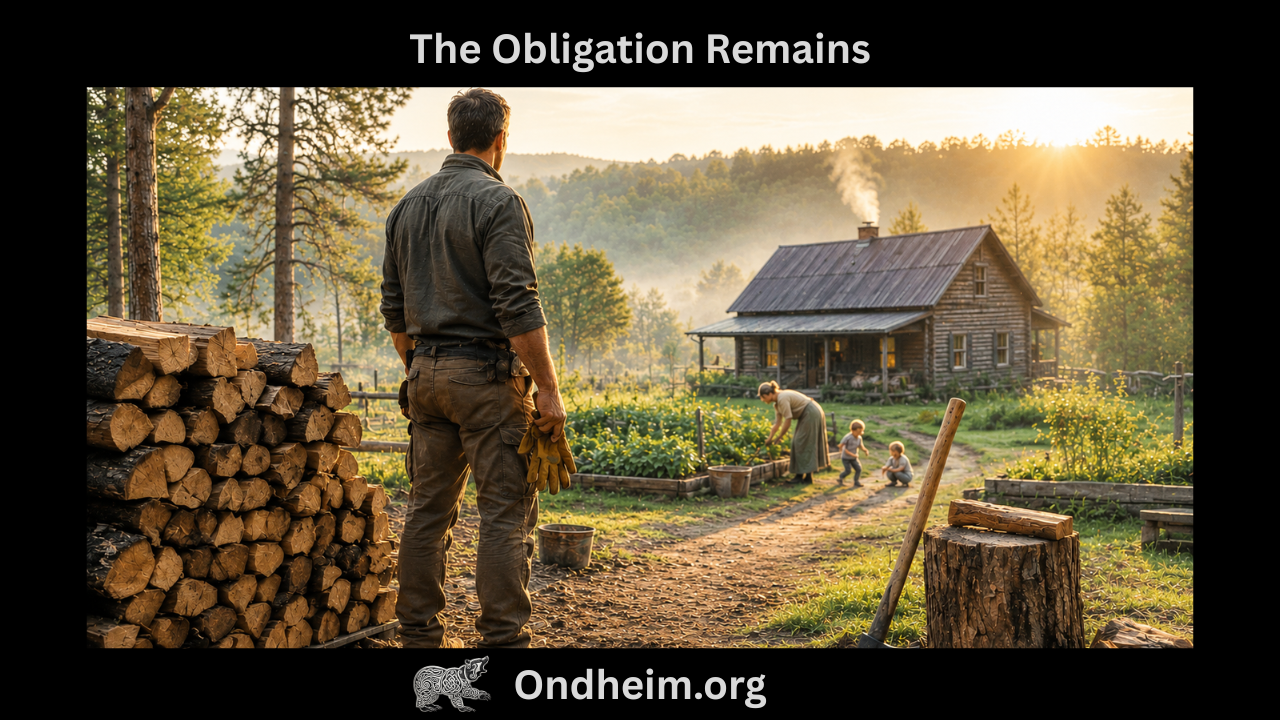
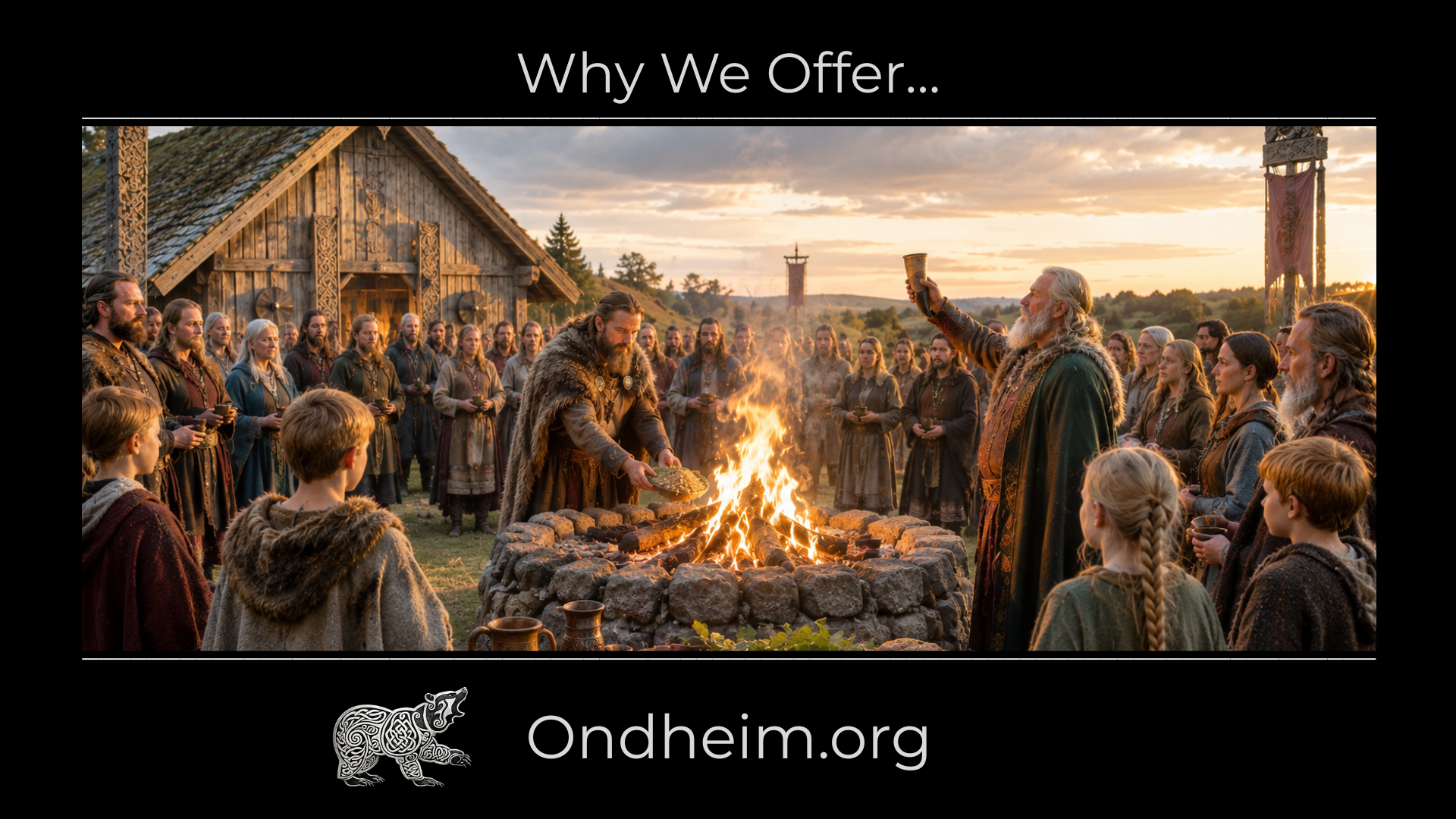
The Obligation Remains

There comes a moment in most lives when the question stops being whether something is fair and becomes what must be done next.

It is rarely a moment we would choose for ourselves.

Sometimes it arrives with the death of someone we love. Sometimes it comes through illness, betrayal, financial hardship, or the collapse of plans we spent years building. However it arrives, most people eventually encounter a season where life refuses to proceed according to their expectations.

In those moments, fairness feels like an important question.  Sometimes it may even be the right question, Yet I have noticed that life rarely waits for us to answer it. The bills continue to arrive. The roof continues to leak. Children still need guidance. Communities still require effort. Responsibilities remain stubbornly present whether we feel ready for them or not.

I learned this lesson in a particularly painful way after the death of my father. Like many people facing that kind of loss, I did not handle it perfectly. I spent some time sitting with my grief and, if I am being honest, spent more time than I should have hiding from it in a whiskey bottle. At the time, it felt justified. Grief is real. Loss is real. The pain of losing someone who helped shape your life is not something that can simply be dismissed with a slogan about perseverance.

Yet eventually I looked around and realized something uncomfortable. I was not the only person hurting.  My wife was grieving too. My sons were grieving too. The world had not stopped simply because I wished it would. The responsibilities that existed before my father’s death still existed afterward. The people who depended on me still depended on me.  More than that, I OWED them the strength and guidance they needed. That realization did not erase the grief, nor did it make the loss easier.  It simply forced me to confront a truth that I had spent years seeing reflected in the old stories.

The obligation remained.

As I have gotten older, I have found myself returning to the Hávamál for many of the same reasons I return to old friends. Not because it always tells me what I want to hear, but because it has a way of reminding me of things I already know and occasionally forget. One of the things that has always fascinated me is how practical the advice is. The speaker seems entirely unconcerned with whether life is fair. Instead, he assumes life will be messy. People will drink too much. They will speak unwisely. They will trust the wrong person. They will find themselves in situations they would rather avoid. The advice is never built around the assumption that life will cooperate. It is built around the assumption that it will not.  At first glance these appear to be separate pieces of advice, yet they are connected by a common thread. A person’s responsibilities do not disappear simply because they are angry, distracted, celebrating, grieving, or otherwise occupied. The obligation to conduct oneself wisely persists regardless of circumstance. The situation changes. The obligation remains.

Perhaps that is one of the reasons the old stories continue to endure. They are not stories about perfect people living ideal lives. More often they are stories about imperfect people confronted by circumstances they did not choose.  When I think about Egil’s Saga, I do not see a man whose life unfolded according to plan. I see a man repeatedly forced to respond to loss, political realities, and circumstances beyond his control. Modern readers often remember the poetry, the temper, and the larger-than-life personality. Yet beneath all of those things is a man continually deciding what to do next after life has handed him something he did not ask for. The saga is not particularly interested in whether those hardships are fair. It is interested in how he responds to them.  The same pattern appears in Njál’s Saga, though in a different form. Few of the characters are dealing with problems entirely of their own making. Feuds emerge from older feuds. Obligations arise from previous obligations. Consequences ripple outward through families and communities long after the original events have passed. Again and again, people find themselves carrying burdens they would likely have preferred to avoid. Yet the story rarely pauses to ask whether those burdens are fair. The attention remains fixed on what responsibility remains and what consequences must still be faced.  Perhaps that is why these stories continue to resonate despite the centuries that separate us from them. Most of us will never stand before a king, settle a blood feud, or compose a poem to ransom our lives. Yet the problems that confront us are not as different as they first appear. We still inherit burdens we did not choose. We still find ourselves dealing with the consequences of decisions made by others. We still lose people we love, watch plans unravel, and discover that life has little interest in consulting us before changing direction. The details may differ from those found in the old stories, but the underlying question remains remarkably familiar. Once the shock has passed, once the grief has settled enough for us to think clearly again, what must be done next? What responsibilities remain waiting for us when we return to the work of living?

I suspect this is one of the reasons our ancestors told stories rather than merely compiling lists of virtues. Most people can agree with a virtue in the abstract. Wisdom, courage, perseverance, responsibility, and honor sound admirable when discussed around a table or written on a page. The challenge comes when those virtues collide with reality. Stories allow us to witness that collision. They show us what happens when grief, hardship, temptation, fear, and uncertainty test a person’s character. In those moments, values cease to be ideas and become choices.  Perhaps that is the difference between understanding something and truly internalizing it.  A person can comprehend a lesson after hearing it once. They can repeat it, explain it, and even agree with it. Yet some truths only become part of us after life has demanded a price for them. The old stories endure because they remind us that wisdom is not measured by what we can recite. It is measured by what remains when circumstances become difficult.

Life is not fair, It never has been. Fairness alone has never built a home, raised a child, honored an oath, preserved a community, or carried a family through hardship. Those things are built by people who continue carrying their responsibilities even when circumstances become difficult.

Grief may remain.

Pain may remain.

Loss may remain.

And yet, despite all of them..

The Obligation Remains.

William Lord

Ondheim Theodish Fellowship

Frith defines the boundary, oaths bind the word, kin carry obligation, and the hall holds witness and memory. The shape of obligation gives these structure, and through symbel they are spoken into wyrd and given force.

For additional primary sources and public-domain texts related to kinship, obligation, feud, and Germanic social structure, see our Links page.

SPÆCRAFT: Ráð, Perception, and the Discipline of Seeing Clearly

Modern people often approach practices of perception through one of two extremes. Some dismiss them entirely as fantasy or superstition. Others approach them primarily as vehicles for personal spiritual expression where emotion, symbolism, and subjective interpretation gradually become more important than clarity itself.

The surviving sources point toward something very different.

When speaking about spæcraft, it is important to begin where the sources actually allow us to stand and no further. The surviving material provides fragments, patterns, glimpses, and preserved structures. It does not provide a perfectly complete system waiting to be reconstructed in exact historical detail. What it does provide is enough to understand the shape, discipline, and purpose of the work.

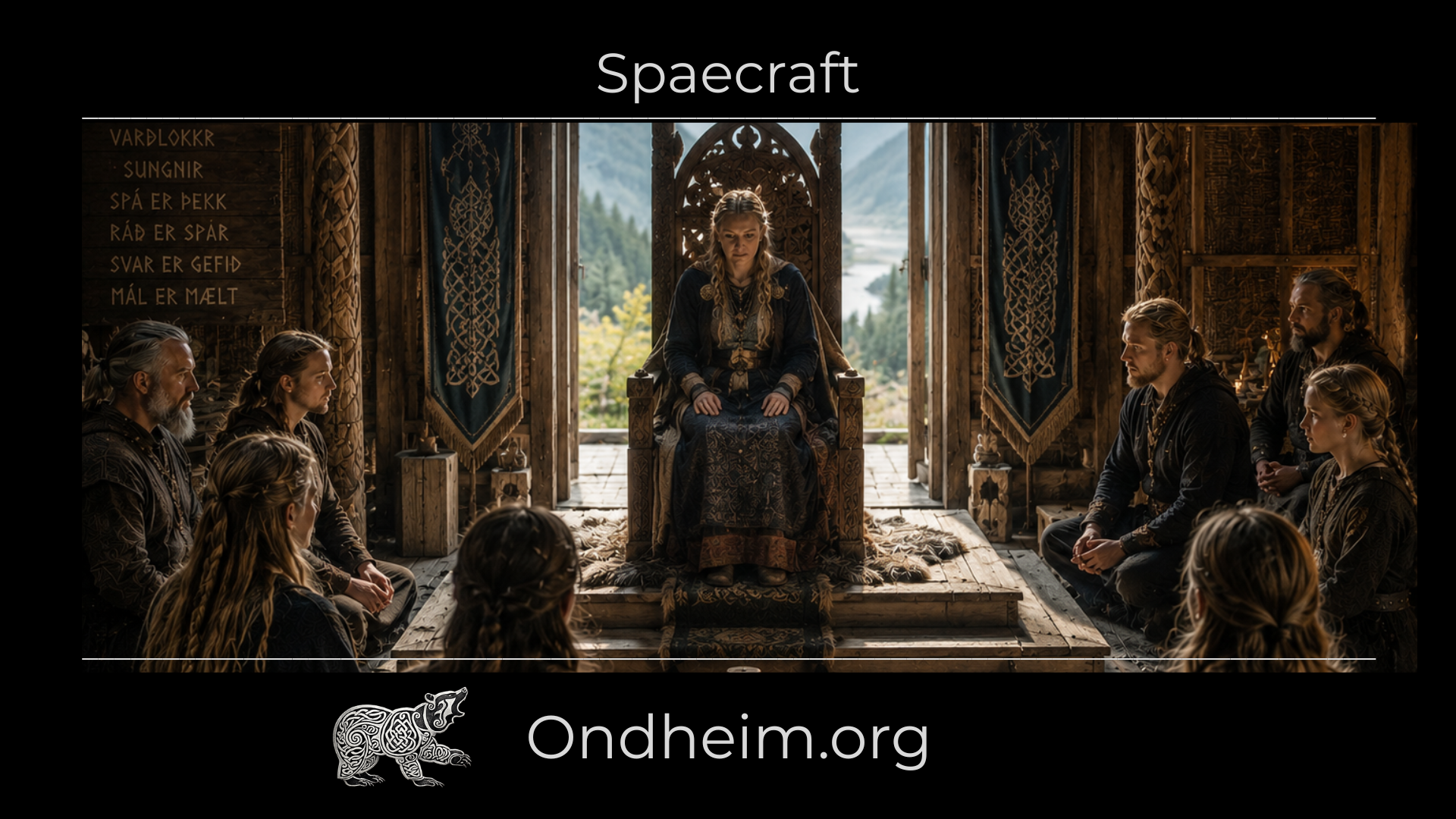
The clearest surviving account appears within Eiríks saga rauða in the description of Þorbjörg lítilvölva.

What stands out immediately in that account is not theatrical mysticism or emotional spectacle, but structure.

A place is prepared beforehand. A seat is established intentionally. The gathered folk assemble deliberately. Varðlokkur are sung before the work begins. Only afterward does the speaking itself occur.

Even the questioning remains restrained and practical. Questions are asked. Counsel is given. The work exists to provide guidance useful to the folk gathered there.

That detail matters enormously.

The purpose of the rite was not performance, self-elevation, or symbolic display. The surviving material instead presents perception as something tied directly to usefulness, guidance, judgment, and consequence.

This same attitude appears repeatedly throughout the surviving lore.

In Hávamál, Óðinn does not gain wisdom casually or effortlessly. He suffers, sacrifices, searches, and endures in pursuit of understanding. Yet the same text repeatedly warns against the illusion of wisdom and the danger of believing oneself insightful merely because one desires hidden understanding.

“The unwise man thinks he knows all…”

That warning matters because perception becomes unreliable the moment desire overtakes clarity. Ego distorts judgment. Fear distorts judgment. The longing to possess hidden knowledge can become stronger than the willingness to observe honestly.

This is one reason restraint matters so deeply within spæcraft.

The work is not improved through dramatic language, emotional intensity, theatrical mystery, or increasingly elaborate symbolic interpretation. In many cases, those things can actively obscure clarity rather than strengthen it.

If perception cannot survive direct examination and clear language, then it should be approached cautiously rather than accepted automatically as truth.

Elsewhere in the Eddic material, wisdom repeatedly proves itself through testing rather than declaration alone. In Vafþrúðnismál, knowledge is challenged openly. In Völuspá, even the gods deliberate together before acting. The sources consistently present wisdom not as private self-certainty, but as something measured through consequence, discernment, and outcome.

Perception exists to guide action rather than replace judgment entirely.

That principle stands near the center of how Ondheim approaches spæcraft.

Spæcraft is not pursued merely for fascination, entertainment, prediction, or personal identity. It is the disciplined act of seeking ráð: right counsel concerning what stands, what moves, what approaches, and what should be done in response.

If what is gained cannot contribute toward wiser action, clearer judgment, or stronger decision-making, then its value becomes questionable.

This is also why structure matters so heavily within the rite itself.

In the surviving accounts, spæcraft does not emerge from chaos, improvisation, or unrestricted openness. The space is prepared beforehand. Boundaries are established before perception is sought. Order exists before inquiry begins.

Without structure, perception easily drifts toward projection and confusion. Without boundaries, uncertainty multiplies rapidly. And without discipline, the work gradually begins centering itself around the individual personality of the speaker rather than the actual task requiring discernment.

For this reason, Ondheim places spæcraft within established ritual structure:
warding,
framing,
varðlokkur,
spæcraft,
invocation,
and exchange.

The space is held deliberately before the work begins.

The role of varðlokkur is especially important within this process. Modern people often interpret ritual songs primarily through emotional performance or mystical atmosphere. Yet the surviving account suggests something far more restrained and purposeful.

The songs do not simply invite anything whatsoever into the space indiscriminately.

They draw near what is rightful and appropriate to the work itself.

That distinction matters enormously because openness without discernment eventually ceases to be hospitality and becomes vulnerability instead.

The same restraint applies to the role of the speaker during spæcraft.

The individual performing the work does not become unquestionable authority elevated above the folk. They perform a function within an ordered communal structure.

Their responsibility is straightforward:
to perceive as clearly as possible,
and to speak as plainly and honestly as possible.

If clarity is absent, restraint becomes preferable to invention.

This is not weakness.

It is discipline.

And discipline is precisely what prevents perception from collapsing gradually into projection, ego, fantasy, or self-created mythology detached from consequence.

For this reason, speech within spæcraft should remain direct and usable rather than needlessly obscure. The purpose is not endless symbolic interpretation detached from action. The purpose is counsel capable of informing real decisions.

“This stands.”
“This should be done.”
“This should be avoided.”

Counsel proves its worth only afterward through lived consequence.

If the guidance repeatedly leads toward clearer judgment, wiser action, stronger decision-making, and healthier outcomes, then it gradually demonstrates usefulness. If it repeatedly fails beneath the weight of reality, then it should be reconsidered honestly rather than protected through ego or blind attachment.

This is not blind belief.

It is accountability.

The older worldview consistently understood that wisdom detached from consequence eventually drifts into performance. Knowledge incapable of surviving contact with reality gradually becomes vanity.

Spæcraft must remain tethered to action.

This is one reason Ondheim does not claim certainty where the sources themselves remain incomplete or fragmentary. We are not reconstructing a perfectly preserved lost system because the surviving material simply does not allow that honestly.

What we are building instead is a disciplined method consistent with the worldview reflected in the surviving sources:
restrained,
structured,
accountable,
and grounded in usefulness.

The purpose is not to elevate the individual.

The purpose is to strengthen awareness, sharpen judgment, support discernment, and better serve the needs of the folk.

In the end, spæcraft is not about seeing more than others.

It is about seeing clearly enough to act rightly.

And what is spoken during the work must ultimately prove itself afterward through consequence, judgment, and lived reality.

That is the measure.

— William Lord
Ondheim Theodish Fellowship
Ondheim.org

Frith defines the boundary, oaths bind the word, kin carry obligation, and the hall holds witness and memory. The shape of obligation gives these structure, and through symbel they are spoken into wyrd and given force.

For additional primary sources and public-domain texts related to kinship, obligation, feud, and Germanic social structure, see our Links page.

Building Worth: From Consumption to Stewardship

Modern culture has it backwards. It measures importance by volume — who’s loudest, who’s most visible, who got the most attention this week. Recognition first, substance if there’s time.

The old way ran the order in reverse. Achievement first. Recognition followed — if it followed at all — through witnessed conduct over time.

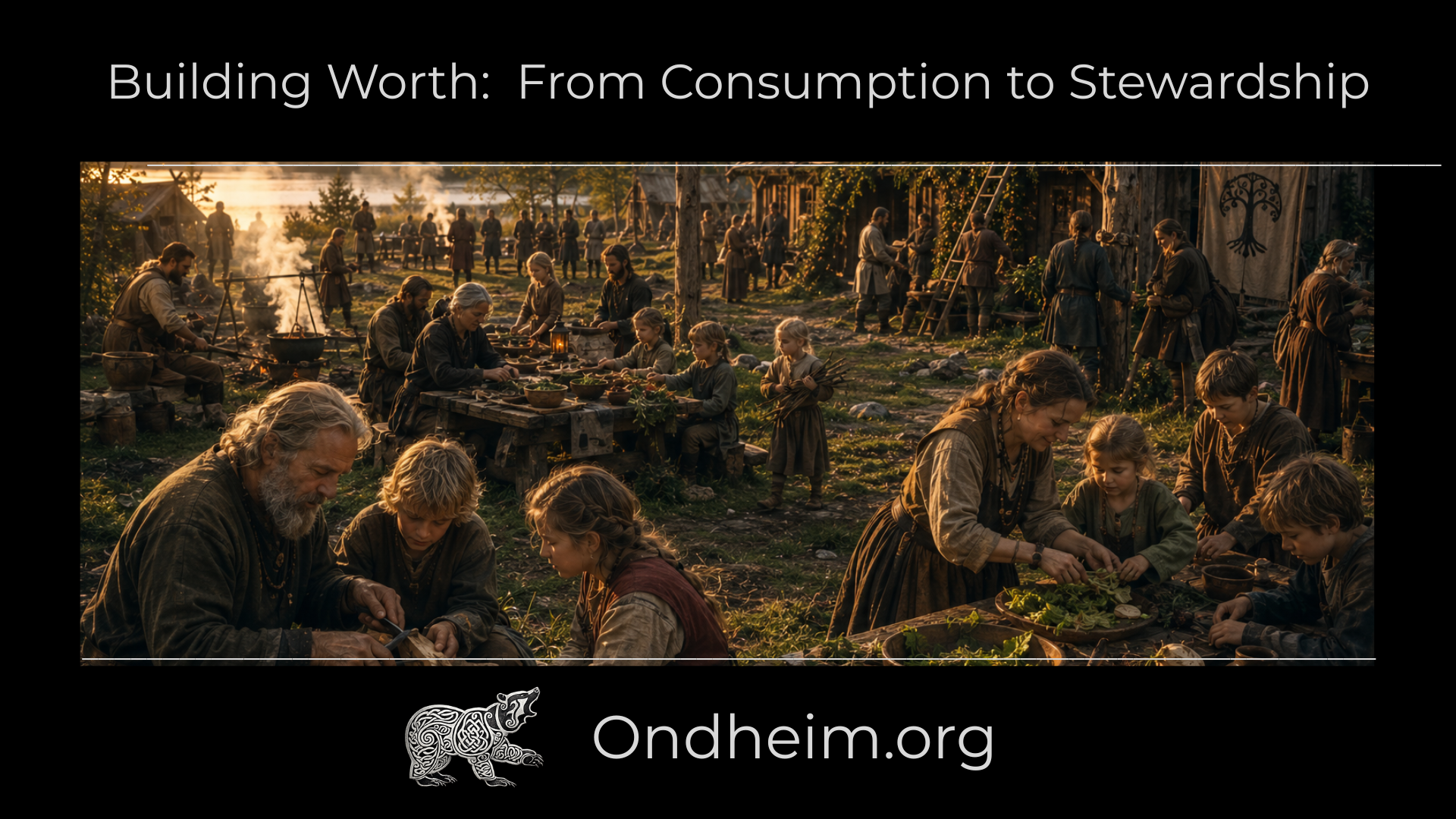
Worth wasn’t claimed loudly. It was built slowly, the way you build anything that has to hold weight: stone by stone, act by act, across years.

There’s a distinction worth making here, because reputation and worth aren’t the same thing, though they’re related. Reputation is what others remember about your conduct. Worth is deeper — it’s the capacity underneath: the ability to act consistently, carry obligation, endure hardship, and contribute something real to the folk. Reputation is how you’re perceived. Worth is what you’ve become through sustained effort.

The Hávamál understands formation, not instant transformation. Wisdom isn’t inherited and it isn’t downloaded — it’s cultivated through restraint, judgment, experience, and discipline.

“Cattle die, and kinsmen die, and so one dies one’s self; one thing I know that never dies, the fame of a dead man’s deeds.” (Hávamál 78)

What survives you isn’t your self-image. It’s the deeds, remembered by people who watched.

The sagas bear this out across centuries. Njáll (Njáls saga) isn’t remembered for physical prowess — he’s remembered for wisdom, restraint, counsel, judgment. His worth shows in how he thinks and advises, not in how loudly he announces himself. Egill’s (Egils saga) reputation wasn’t built in a single dramatic moment either. It came from decades of demonstrated skill, courage, intelligence, and force of personality — sustained, under pressure, over a lifetime.

That’s the pattern. Worth accumulates through pattern, not isolated event.

A man might fight bravely once. The question is whether he can be trusted repeatedly. He might speak wisely in a moment — can he counsel consistently across years? He might fulfill one oath — can he carry obligation through hardship, loss, and temptation? Worth is the answer to those questions, given in the form of a lived life.

This is why the old way put such weight on endurance. A single brave act gets attention. Worth requires sustained reliability — showing up the same way, holding the line, doing the work when nobody’s watching and when everybody is.

And work itself was part of the formation. Labor wasn’t just economic necessity; it shaped the man. Through work you learned discipline. Through repeated effort, skill. Through sustained contribution, others learned what they could expect from you. A farmer who tended his land faithfully for decades demonstrated reliability. A craftsman who produced consistently demonstrated mastery. A leader who judged fairly across many disputes demonstrated wisdom. Worth emerged through contribution, not declaration.

Boasting is where this gets teeth. In the old way, a boast wasn’t harmless self-promotion — it was a public claim that invited future testing. You put your worth before the judgment of others and accepted the consequences if reality didn’t match. That’s why worth couldn’t be manufactured with words. It had to be proven in deed, because the folk were going to check.

Leadership worked the same way. Authority wasn’t just inherited or seized — it had to be sustained through demonstrated capacity. A chieftain who judged poorly lost influence. A leader who failed to protect his people lost loyalty. A counselor whose advice kept failing lost trust. Worth was the foundation under authority. Without it, position went hollow.

So: build quietly. Act consistently. Fulfill obligation. Endure hardship without complaint. Contribute without demanding recognition. That’s not modesty as performance — it’s the actual mechanics of how worth gets made.

Worth cannot be claimed. It can only be built. And what gets built through sustained effort outlasts every loud proclamation.

Stone by stone. That’s the whole method.

William J. McNamara Jr.

Blót: The Act of Exchange

Blót: The Act of Exchange

Modern people tend to approach ritual through feeling. Did it move me? Did it feel meaningful? Was the experience powerful?

The old way didn’t measure it that way.

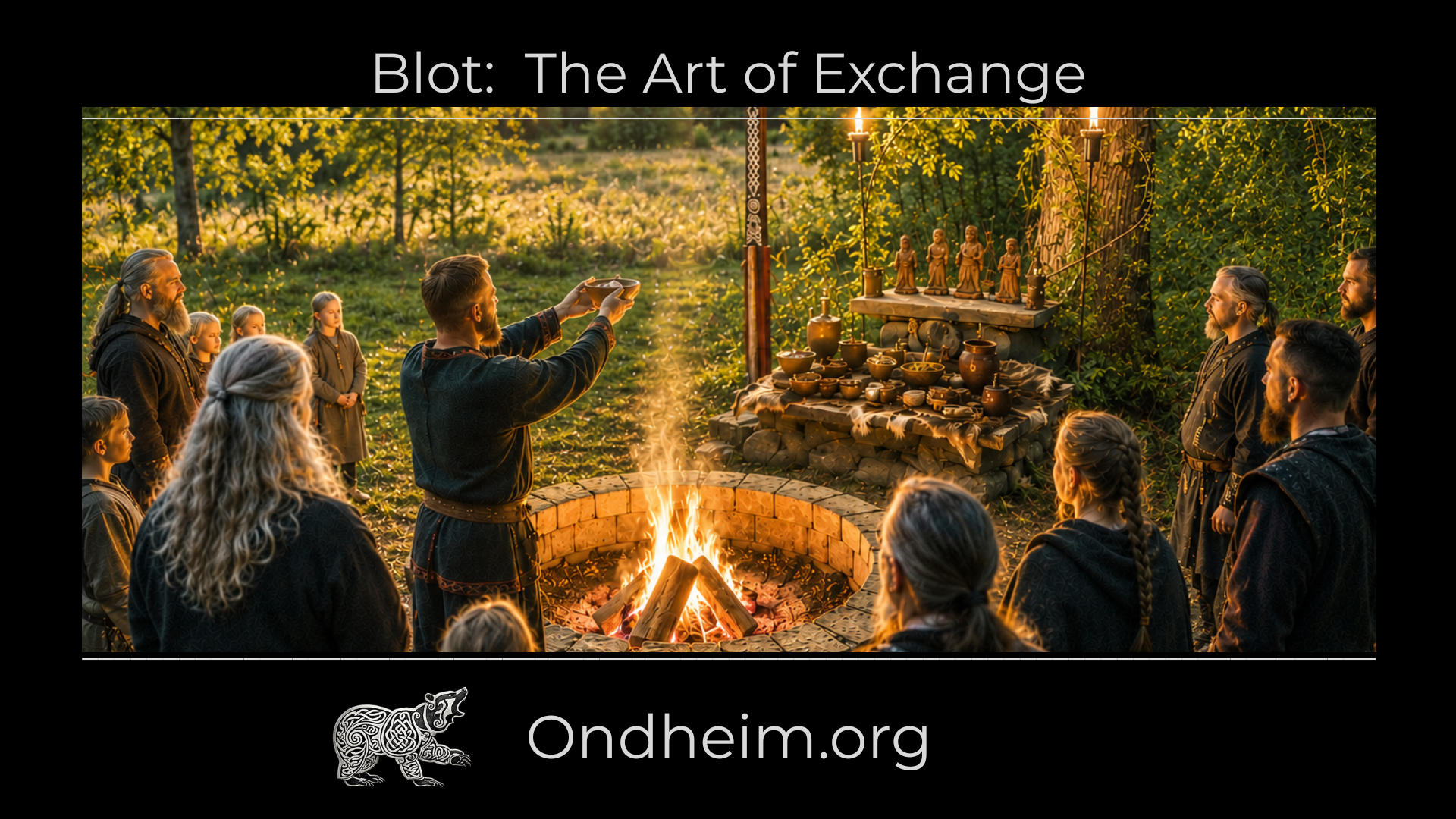
Blót wasn’t primarily about feeling. It was about exchange.

At the center stands a plain principle: relationship with the holy powers was maintained through reciprocal giving. Humans gave. The gods gave in return. Through repeated exchange, the relationship deepened and the obligation was honored. Feeling might follow. It was never the measure.

The Hávamál states the logic directly.

“Friends shall gladden each other with arms and garments, as each for himself can see; gift-givers’ friendships are longest found, if fair their fates may be.” (Hávamál 41)

“To his friend a man a friend shall prove, and gifts with gifts requite; but men shall mocking with mockery answer, and fraud with falsehood meet.” (Hávamál 42)

That wasn’t just social advice. It was a cosmological principle — governing humans with humans, humans with gods, the living with the dead.

Blót was where the folk enacted it together, formally, on purpose.

The sources don’t hand us a complete manual — none survives. But the pattern is consistent across what we have: offerings made to gods, ancestors, or land spirits; given freely and intentionally; and through the giving, relationship affirmed and strengthened.

(Hákonar saga góða, in Heimskringla) describes sacrificial feasts where offerings were made and the gathered folk shared in communal consumption. That detail matters. Blót wasn’t a private mystical experience. It was a communal act — the folk bound together through shared giving, shared feast, shared participation. The giving worked on multiple levels at once: it honored the holy powers, it tightened the bonds among the folk, and it affirmed each giver’s place inside the ordered relationships of the tribe.

This is why the old way never drew a hard line between the sacred and the social. The same principles ran through both — reciprocity, obligation, loyalty, gratitude. A gift between friends created obligation and deepened friendship; an offering to the gods created relationship and deepened connection. Same logic, because the worldview was coherent.

The offerings themselves varied. Animals at the great blóts. Food and drink at smaller observances. Objects of value, given deliberately. What mattered wasn’t the price tag — it was the intention and the act. To give was to acknowledge dependence, express gratitude, and affirm relationship. It was to recognize that the folk didn’t exist on their own, but inside a web of relationships running out to gods, ancestors, and land.

That’s also why correct performance mattered so much. Not because the gods were petty about details — because the act of giving demanded sincerity, intention, and care. A careless offering revealed a careless attitude toward the relationship. A generous one, given with full intention, affirmed the seriousness of the bond.

The principle didn’t stop at the ritual fence. Hospitality to guests, generosity to kin, faithfulness in obligation — all the same logic. Relationships are maintained through giving, everywhere, not just at the altar.

The old phrase for it is do ut des — I give that you might give. The reality was deeper than transaction. Humans offered worship, sacrifice, remembrance. The gods offered protection, prosperity, wisdom, favor. Neither side gave unconditionally without expectation, because the relationship was reciprocal the way reality itself was reciprocal.

Even prayer worked this way. You didn’t just show up asking for favors. You gave first — or gave alongside the asking — because relationship requires contribution from both sides.

So the corrective for modern practice is blunt: the question isn’t “what did I feel?” It’s “what did I give, and was it given well?” Through disciplined, intentional, generous giving, relationship with the holy powers is maintained. Through neglect, it weakens. That’s the whole of it.

The way we do it in my tribe, the Ondheim Theodish Fellowship, is to keep that exchange at the center — not the feeling, not the spectacle, but the giving and the return.

To blót is to give. To give is to affirm relationship. And through relationship rightly maintained, the folk endure.

William J. McNamara Jr.

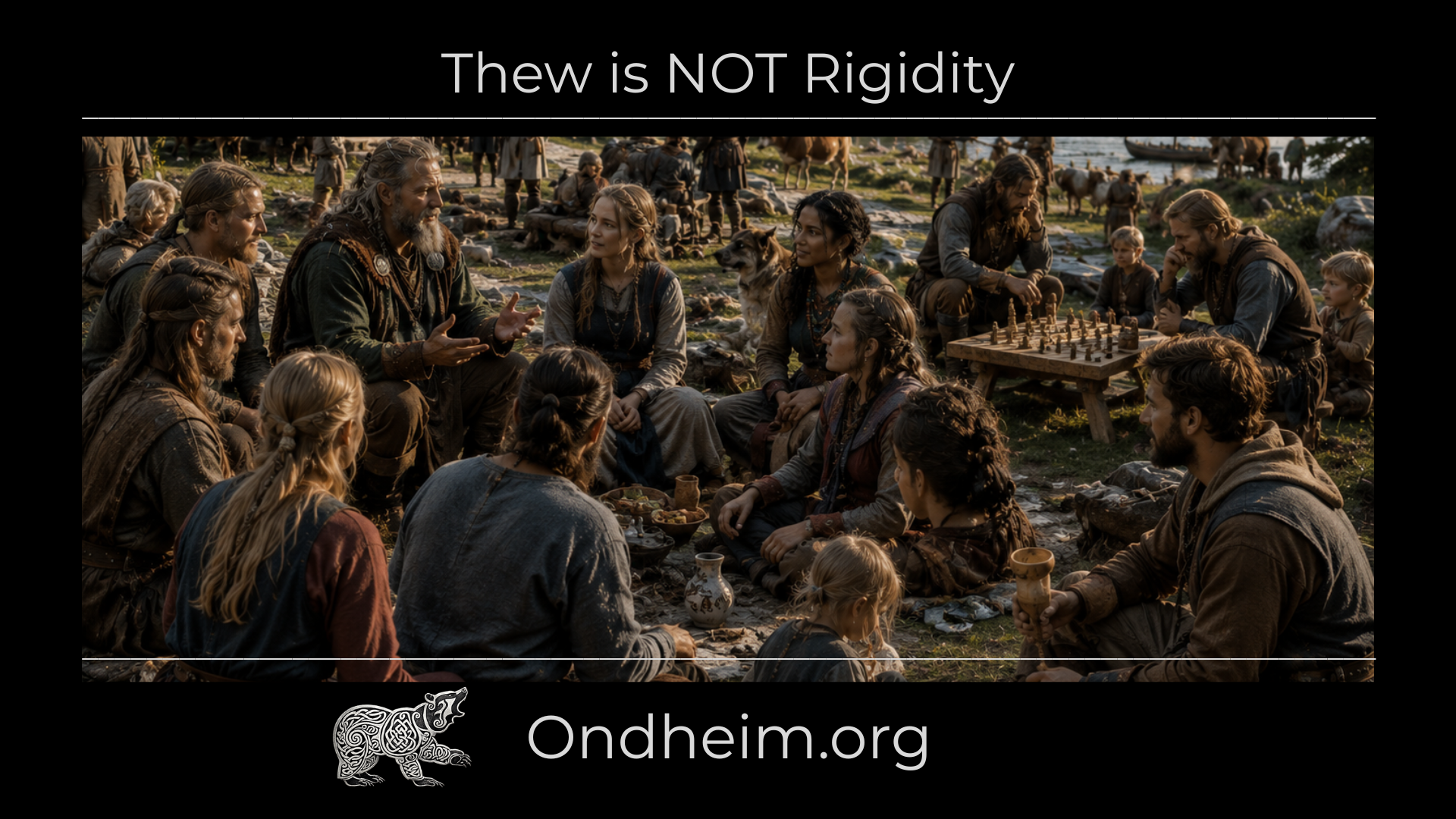
Thew is NOT Rigidity

One of the most common misunderstandings about thews is that they demand rigidity — the same move, every time, no thinking, regardless of what's actually happening.

That's not thew. That's machinery.

The old world didn't prize rule-followers. It prized wise men. There's a difference, and the lore never lets you forget it.

Take Óðinn. He is the opposite of rigid. He wanders. He questions. He gives up an eye for a drink from Mimir's well and hangs nine nights on the tree for the runes — suffering, sacrifice, endurance, all to earn understanding through experience instead of reciting formulas. That's not rigidity. That's disciplined adaptation: the goal held firm, the path walked with eyes open.

The sagas show the same thing in human leaders. Njáll of Njáls saga isn't wise because he applies one rule to every situation. He's wise because he reads each situation for what it is and counsels accordingly — and his counsel changes, because reality changes. The thew gives him the structure. His judgment does the work inside it.

That's the relationship: thew provides the structure, judgment operates within it. Rigidity replaces judgment with repetition.

The Hávamál's whole opening stretch is built on this contrast — the wise man against the fool — and the difference between them is never obedience. It's judgment. Knowing when to speak and when to stay quiet. Knowing the difference between a friend and a flatterer. The fool isn't condemned for breaking rules. He's condemned for having no sense.

Consider hospitality. The Hávamál opens with it — (Hávamál 3): "Fire he needs who with frozen knees / Has come from the cold without; / Food and clothes must the farer have, / The man from the mountains come." The framework is clear: receive the traveler with honor.

But the same poem spends the stanzas that follow telling you to watch that traveler — to weigh him, to be slow with trust, to know the difference between a guest and a threat. The thew says: honor the guest. Wisdom says: figure out who you're dealing with first. That's not contradiction. That's principle and judgment working the way they're supposed to.

Here's where people get confused. Rigidity treats rules as mechanical — same response no matter the context — and mistakes consistency of action for consistency of principle. Discipline treats principles as living — the purpose held steady while the application adapts to what's real.

Take oaths. The thew is firm: oaths are upheld. But wisdom has to answer the real questions. What actually counts as an oath, versus words spoken loosely? How do you weigh it when two obligations pull against each other? What happens when the world changes so completely that the original understanding doesn't fit anymore?

A rigid man treats every uttered word as equally binding and calls it honor. A disciplined man understands that the purpose of oath-keeping is trust — reliability between people — and applies his judgment to serve that purpose. The principle doesn't move. The application does.

The tribe itself works this way. Thews aren't frozen. They develop through the lived experience of the folk, and when new circumstances come, the folk work out together how the old principles apply. That's not abandoning thew. That's thew doing what living law is supposed to do.

What it takes is honesty about two things: what the principle actually is, and what the circumstances actually are. Then deliberation — brought to the folk, not decided alone — about what stays essential and what can change shape.

The thew of mutual defense is a good example. The principle: the folk stand together. In an earlier age that meant shields, literally — standing in the line when raiders came. In our world it might mean legal help, money when someone's drowning, or standing up socially when one of yours is getting crushed. The shape changed completely. The principle didn't move an inch.

That's not relativism. It's not lowering the standard. It's living law engaging with a living world.

So: know the principle beneath the practice — why the thew exists, not just what it says. Use your judgment inside the framework instead of switching your brain off. Keep what's essential and let the form adapt. Bring the hard questions to the folk instead of freelancing. Hold the line against both extremes — mechanical repetition on one side, "anything goes" on the other. And watch the results: do your adaptations strengthen the order, or weaken it? The consequences will tell you.

Thews aren't chains. They're the structure the tribe lives and grows inside. A living structure gets maintained — and where adaptation serves the purpose, it gets adapted. The alternative is a rule so rigid it snaps the first time reality pushes back.

That is the thew. That is the test.

William J. McNamara Jr.

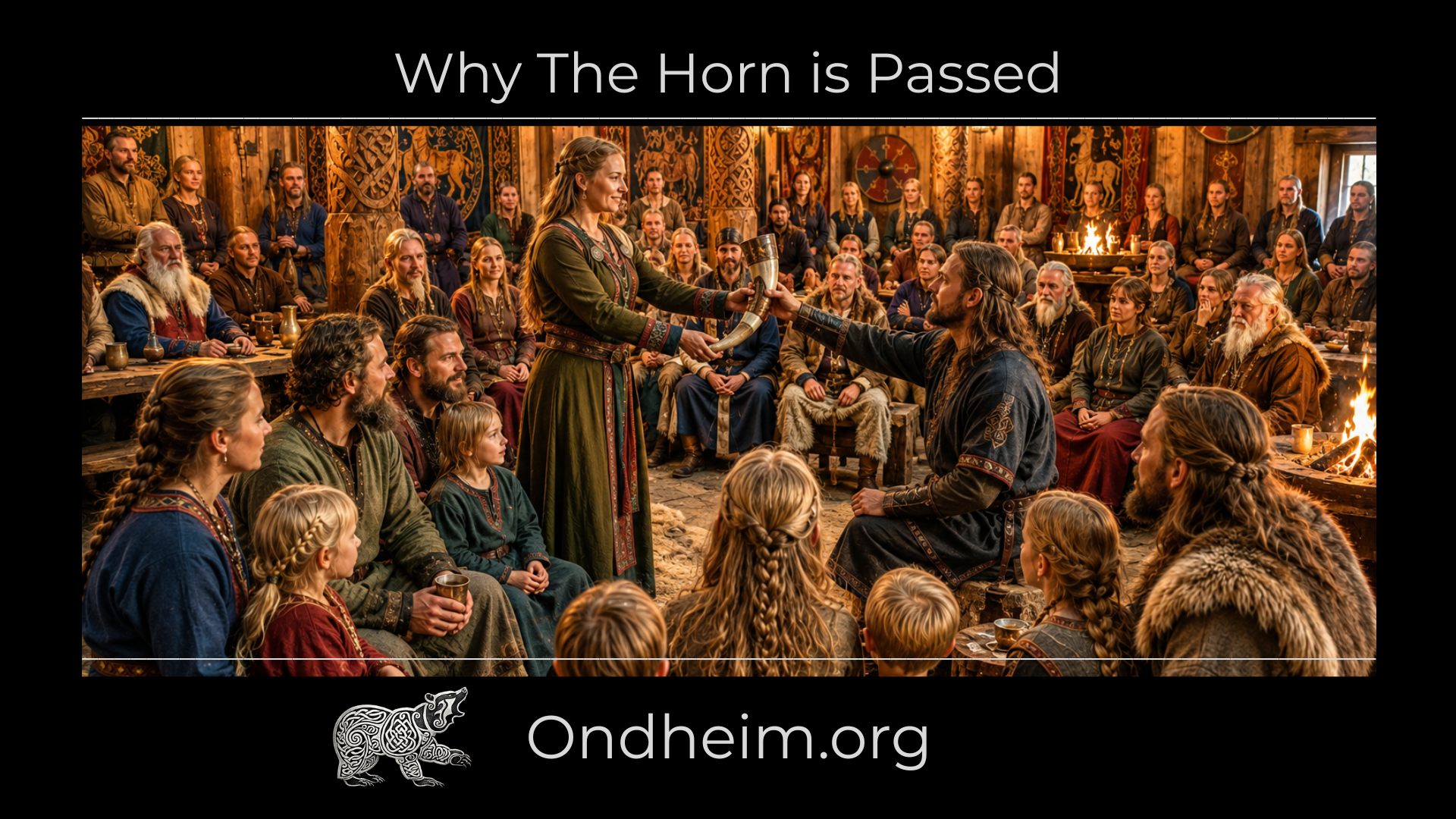
Why the Horn Is Passed

People drink now to relax. To celebrate. To escape. Ritual drinking at modern gatherings is social lubrication — a way to loosen up.

The passing of the horn was nothing like that.

The horn moving hand to hand around the circle wasn’t about drinking. It was a structured ritual act — and through it, speech was witnessed, memory was affirmed, frith was maintained, and the folk held its continuity across time.

The sources show this plainly. In Beowulf, Wealhtheow the queen bears the cup through the hall in sequence, serving each warrior in turn. That’s not casual hospitality. It’s a formal act, and the order matters: to be served first is honor, to be served in turn is inclusion. The passing of the cup maps the social order where everyone can see it.

The sagas show the same pattern. Drinking is almost never just drinking — it accompanies oaths, boasts, toasts, formal declarations. The drink and the speech belong together.

And the Hávamál warns about what happens when the discipline fails (Hávamál 12):

Less good there lies | than most believe

In ale for mortal men;

For the more he drinks | the less does man

Of his mind the mastery hold.

The issue was never the horn. It was what the horn revealed when a man lost control of himself.

When the horn came to you, you drank and you spoke, and the folk listened. That simple structure did several things at once. It created order — each person spoke in turn, nobody drowned out, nobody overlooked. It created witness — what you said was heard by everyone present and couldn’t be denied later. It created accountability — words spoken before the folk carried consequence. It affirmed inclusion — every man who held the horn was confirmed as part of the folk. And it enacted continuity — the horn moving hand to hand, the unbroken chain made visible.

The horn was never just a vessel. It was an instrument of order.

The critical element was witness. Toasts to gods, to ancestors, to the folk. Boasts declared. Oaths sworn. Memory affirmed. All of it spoken while holding the horn, heard by all present. A boast made over the horn created public expectation. An oath sworn over the horn created binding obligation. A toast to the dead affirmed, before witnesses, that the chain remained unbroken.

That’s why the discipline of the horn ran so deep. To speak while holding it was to place your words before the judgment of the community.

The passing of the horn also held frith — the right order of the gathered folk, the condition of things working inside the boundary. Within the hallowed round, ordinary conflicts were set aside. Not resolved — set aside, in honor of the gathered folk and the holy powers. Each person received the horn in turn. Each was honored. No one excluded. The unbroken circle of passing hands showed the unbroken bonds of the folk.

To disrupt the passing — to refuse the horn, to speak out of turn, to break the order — was to break frith itself.

And the continuity was physical. The horn passing from elder to younger, hand to hand, enacted the transmission itself — tradition, obligation, identity, moving across time in a single gesture. Every man who held it stood in a chain reaching back to ancestors and forward to descendants. That’s why the toasts to the dead sat at the center of it. By drinking to those who came before, the living affirmed the chain was unbroken. The dead remembered. Their examples enduring. The folk continuing.

So what does it take to hold the horn rightly? Receive it with honor — it’s the folk affirming you belong. Speak with intention, because words over the horn carry weight. Listen with attention — every man’s speech deserves witness, including yours. Pass it with care, handing the chain to the next man unbroken. Hold frith inside the round — set the conflicts down while the horn moves. And remember what was spoken. You are the witness for others as they are for you.

The passing of the horn was never about drinking. It was how the folk maintained themselves — speech witnessed, accountability created, frith held, continuity enacted, hand to hand to hand.

The horn passes. The folk endure.

William J. McNamara Jr.

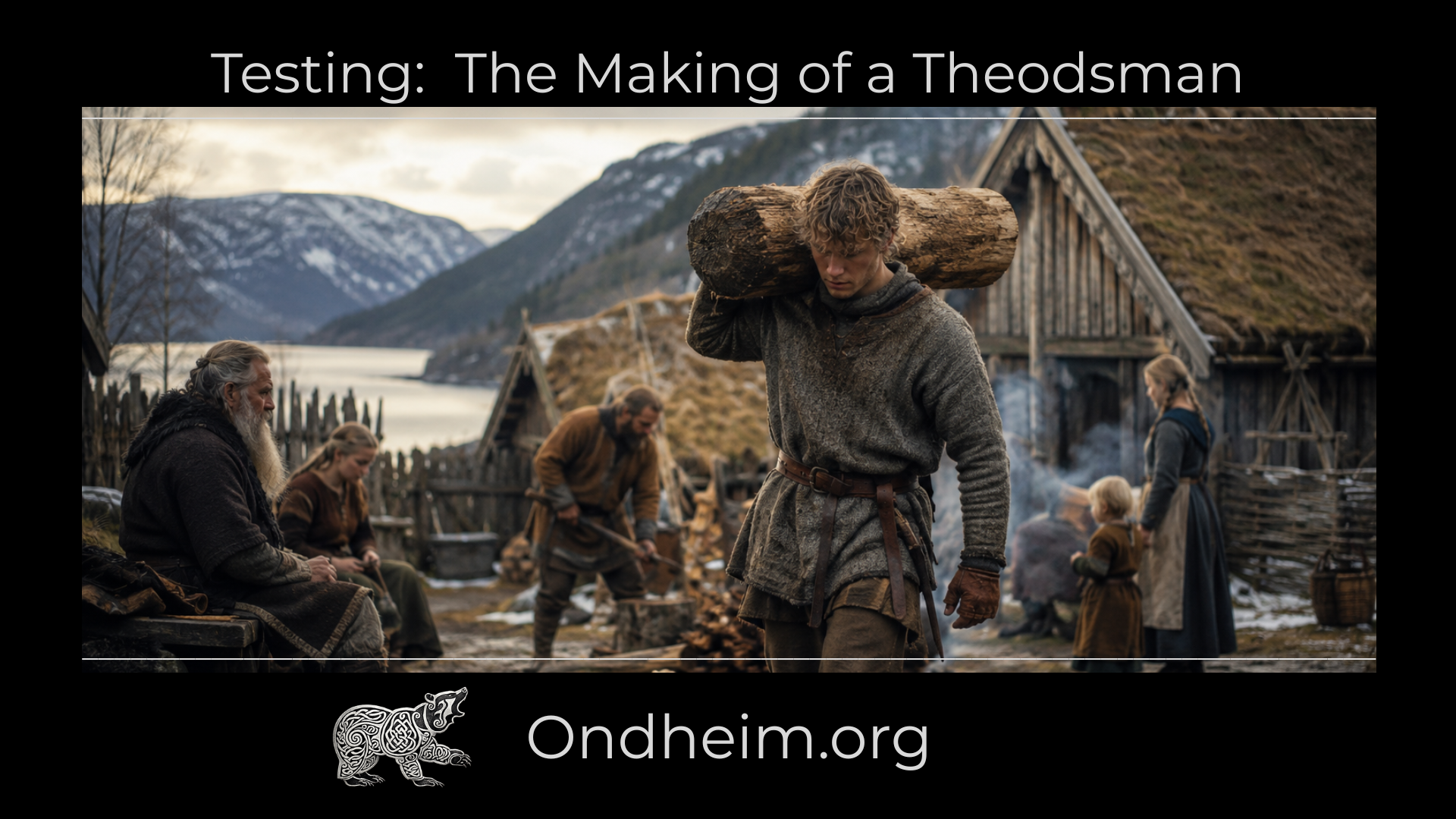
Testing: The making of a Theodsman


A man is not truly known by what he claims about himself.
Words may begin a path, but they do not complete it. Intentions may sound noble when spoken aloud, yet intention alone carries little weight until it survives hardship, obligation, consequence, and time. Within the older Heathen worldview, worth was never assumed merely because it was declared. It had to become visible through action repeatedly witnessed by the folk around a person.
This is why testing mattered.
Not as cruelty or humiliation, but as the process through which character became known both to the individual and to the community itself.
The surviving Norse sources repeatedly point toward proof through conduct rather than self-description. In Hávamál, the reader is warned that appearances alone are unreliable measures of character.
Anyone may speak well while life remains comfortable. The deeper question is what remains standing once hardship, disappointment, pressure, sacrifice, or responsibility arrive. Only then does character become fully visible.
Modern people often misunderstand testing because they associate it with hostility, exclusion, or personal attack. Within the older worldview, however, testing served a practical social purpose.
Testing exists because trust requires proof.
A tribe, family, or lasting community cannot safely place responsibility into the hands of individuals whose conduct has never been observed under strain. Reliability cannot simply be assumed, and character cannot be measured solely through self-description.
Some tests emerge naturally through hardship, exhaustion, sacrifice, disappointment, conflict, or failure. Others come deliberately through responsibility, expectation, service, and obligation placed upon an individual by the folk around them.
The sagas preserve this understanding repeatedly. In Grettis saga, Grettir proves both his strengths and his flaws through continual hardship, outlawry, isolation, violence, and adversity. He is not revealed fully through what he says about himself, but through how he acts while burdened by consequence and difficulty.
Within the Heathen worldview, worth cannot exist purely as inward self-perception. It must eventually become visible through lived conduct.
This is one reason many traditional societies placed such emphasis upon ordeal, labor, apprenticeship, discipline, fosterage, and earned standing. Young people in Norse and Germanic societies were often shaped gradually through service, fosterage, household responsibility, apprenticeship, and observed conduct long before full trust or authority was granted to them.
The older heroic literature reflects this repeatedly. In the Volsunga Saga, Sigurd does not become renowned merely because of noble lineage or potential. His worth becomes visible through ordeal, courage, sacrifice, and deed.
Within Theodish tradition, testing does not exist merely as random hardship or personal challenge. It exists within structure.
A tribe maintains roles, expectations, obligations, and graduated responsibility. Movement within that structure is not meant to occur casually because responsibility affects more than the individual alone. It affects frith, trust, stability, and the well-being of the folk itself.
The folk observes whether a person acts consistently, whether obligations are fulfilled, whether steadiness remains under strain, and whether conduct aligns with the values they claim to uphold.
Testing and oaths are closely connected because every oath eventually creates a moment of proof.
A fulfilled oath strengthens trust because it demonstrates reliability under consequence. A broken oath damages more than personal pride alone. It weakens confidence, frith, and trust not only in the individual, but in the stability of relationship itself.
Within Theodish tradition, one of the clearest examples of testing through time appears within the Hold Oath.
A Hold Oath is not casual membership or symbolic affiliation. It is a deliberate act of mutual obligation binding living people together through shared trust, responsibility, frith, and enduring commitment.
Within Theodish understanding, Hold Oaths developed in part as a modern attempt to recreate some of the stabilizing functions once naturally provided by ancestral social structure.
Leadership, within this understanding, is not superiority. Lordship is service.
To stand as Lord within the folk is not to elevate oneself above others, but to accept greater burden on behalf of them. The higher the responsibility, the greater the obligation carried toward those bound within the structure of the oath.
Testing shapes reputation gradually. Each hardship carried, each obligation fulfilled, each failure endured, and each responsibility upheld contributes to what others eventually come to know about a person’s character.
Frith depends upon this process. Trust cannot survive where reliability remains unknown. A stable community cannot exist if responsibility is handed freely to those who have never demonstrated the ability to carry it well.
Modern culture often encourages comfort, self-definition, and avoidance of hardship whenever possible. The older traditions viewed this very differently.
A person who avoids responsibility, burden, hardship, and evaluation may preserve comfort temporarily, but also avoids the conditions through which worth becomes visible.
The old traditions understood that no person is made through claim alone. They are made through what they repeatedly prove across time, hardship, obligation, and consequence.
Words may begin the path. But deed confirms the man.
— William Lord
Ondheim Theodish Fellowship
Ondheim.org

Frith defines the boundary, oaths bind the word, kin carry obligation, and the hall holds witness and memory. The shape of obligation gives these structure, and through symbel they are spoken into wyrd and given force.

For additional primary sources and public-domain texts related to kinship, obligation, feud, and Germanic social structure, see our Links page.

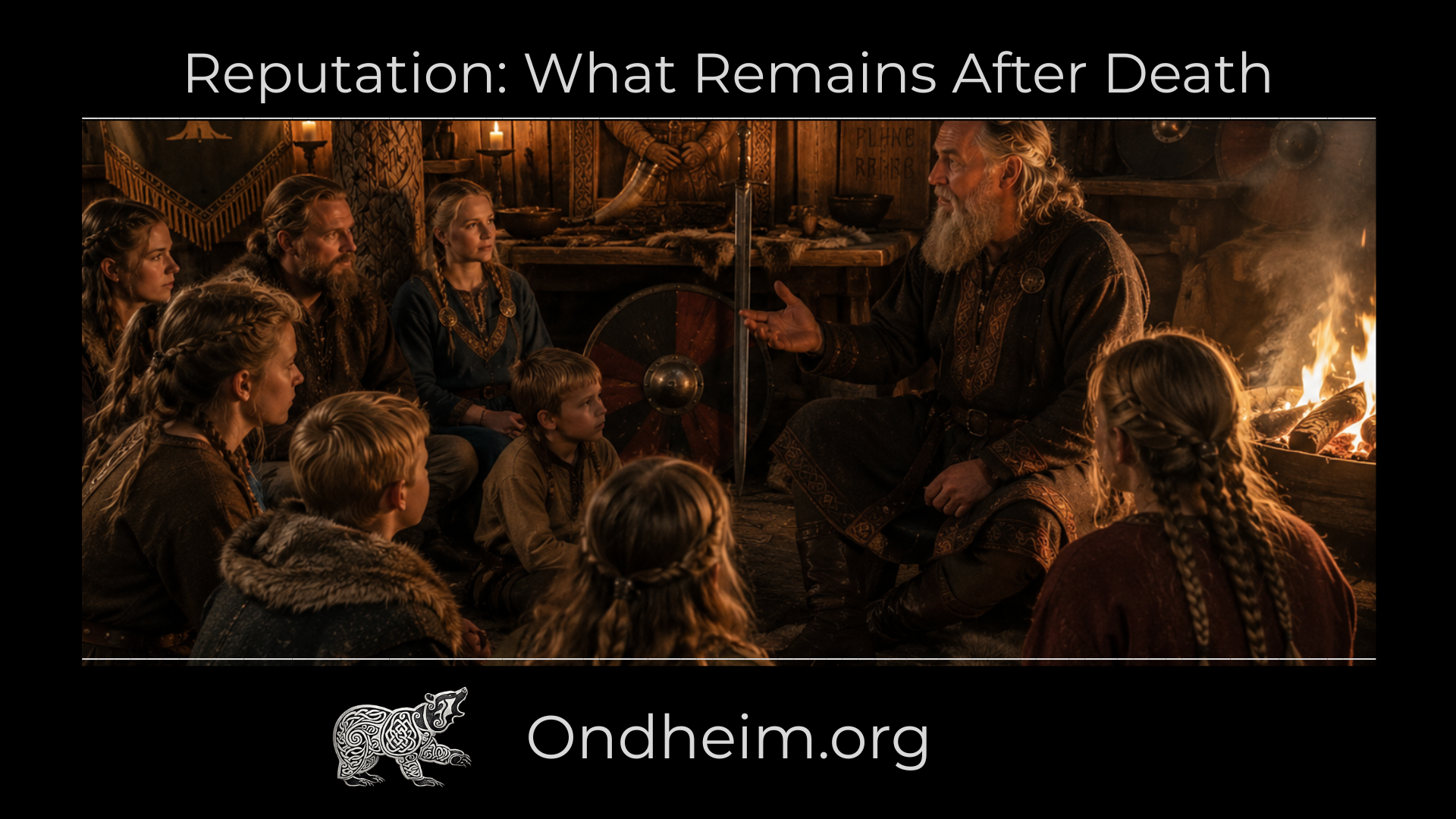
Reputation:  What Remains After Death

Every man dies.

This much was obvious within the older world. Strength fades. Wealth changes hands. The body weakens and eventually returns to the earth. Even great households and powerful leaders eventually pass from the living world into memory. Yet the surviving Norse and Germanic material repeatedly returns to a deeper question: what remains afterward?

Within the older Heathen worldview, death was never understood as the final measure of a life. What endured was not comfort, self-image, status, or personal intention alone, but the memory of conduct carried forward by the living. A person continued through reputation, descendants, story, obligation, and the continuing consequences left behind through deed.

This is one reason the surviving lore places such emphasis upon reputation.

Not as vanity or shallow public praise, but as the accumulated memory of how a person repeatedly conducted themselves among the folk across time.

In Hávamál, the reader is reminded that all material things eventually perish:

“Cattle die, and kinsmen die,
And so one dies one’s self;
But I know one thing that never dies:
The fame of a dead man’s deeds.”

The point is direct and practical. Wealth fades. The body fails. Even family lines shift across generations. Yet the memory of conduct can continue influencing the living long after death itself. The old traditions therefore treated reputation not as superficial image management, but as part of the enduring social memory of the community.

This reflects an important difference between the older worldview and many modern assumptions about identity. Modern people often define themselves inwardly through emotion, self-perception, personal authenticity, or intention. The older traditions were far more concerned with what a person consistently proved through visible conduct over time.

A man became known through how he carried obligation, whether he upheld his word, how he behaved under hardship, how he treated his own, and whether his conduct strengthened or weakened the people around him.

In this way, reputation represented accumulated witnessed behavior rather than self-definition.

The saga literature preserves this understanding repeatedly. In Njáls saga, even Njáll’s lack of a beard becomes a recurring point of insult aimed not merely at him personally, but at the standing and perceived strength of his household itself. The attacks carry social implications capable of provoking feud, dishonor, and violence because reputation affected not only the individual, but also the standing of the family line and the trust surrounding it within the wider community.

Likewise, in Egil’s Saga, Egil Skallagrímsson remains remembered centuries later not because he lived quietly or comfortably, but because his poetry, loyalties, violence, feuds, intellect, and force of character left enduring weight attached to his name. His reputation survived him because his conduct continued being remembered and spoken about long after the life of the body ended.

The sagas repeatedly preserve this understanding: what a person does among the folk continues echoing after death through memory, descendants, story, obligation, and the continuing consequences of action.

Within the older worldview, reputation and worth were deeply connected, though they were not identical. Worth was earned inwardly through discipline, sacrifice, reliability, courage, restraint, and right conduct. Reputation was how those qualities gradually became visible among the folk through repeated interaction across time.

A person might speak proudly about themselves. They might proclaim honor loudly before others. Yet reputation was never fully self-assigned. It formed gradually through the judgment of those who repeatedly witnessed a person’s conduct under real conditions across years of communal life.

This is one reason reputation could not be manufactured instantly.

A boast might attract attention briefly, but lasting reputation developed slowly through fulfilled obligation, steadiness under pressure, visible reliability, and the repeated carrying of responsibility over time.

The older traditions consistently suggest that isolated moments rarely defined a person completely. What mattered more was the enduring pattern created through repeated conduct. The person who carried burden steadily, honored obligation when it became difficult, and remained dependable through hardship gradually developed a reputation others learned to trust. Likewise, the person who spoke greatly but repeatedly failed in action eventually revealed the true weight of their character.

Within the older worldview, words alone possessed little lasting value without deed supporting them.

This is one reason oaths carried such gravity within Norse and broader Germanic societies. An oath was not casual emotional speech. It was a binding word placed publicly into the future, allowing others to measure the worth of the speaker afterward through whether the promise was ultimately fulfilled.

Reputation forms where word and action repeatedly meet.

A fulfilled oath strengthened trust because it demonstrated reliability under consequence. A broken oath damaged more than personal pride alone. It weakened confidence, frith, and trust not only in the individual, but in the stability of relationship itself.

The old traditions understood that people eventually forget many promises spoken casually in passing. What they remember is whether a person carried what they bound themselves to once hardship arrived.

This is why careless speech was viewed as dangerous. A person who swore endlessly without the discipline or strength to fulfill those words slowly weakened the worth attached to their own name.

Reputation therefore affected far more than the individual alone.

Within tribe, family, and community, frith depends heavily upon trust. Trust depends upon reliability. Reliability repeatedly demonstrated across time gradually becomes reputation. In this way, reputation formed part of the social structure helping communities maintain stability and continuity across generations.

Those whose reputation proved strong were trusted with responsibility, leadership, counsel, and obligation because their conduct repeatedly demonstrated steadiness and dependability. Those whose reputation became uncertain weakened trust around themselves and gradually eroded confidence within the community.

The older traditions therefore treated reputation not as vanity, but as part of the framework allowing lasting social order to endure.

A reliable person strengthens the folk around them because others learn that their word, conduct, and obligation can be trusted. An unreliable person creates uncertainty because no one fully knows whether responsibility placed upon them will ultimately hold.

Within the Heathen worldview, reputation also continues beyond death itself. The dead remain present through memory, inherited influence, story, descendants, and the continuing life of the folk. A person’s reputation shapes how their name is spoken afterward, how descendants remember them, whether their memory becomes a source of honor or warning, and what influence continues after the body itself has returned to the earth.

This understanding rests near the heart of ancestor veneration within many Heathen traditions. The honored dead are remembered not merely because they once existed, but because their conduct, sacrifice, wisdom, failures, and responsibilities continue shaping the living long afterward.

A family strengthened by the memory of its forebears carries more than genetics alone. It carries example, expectation, warning, inherited reputation, and accumulated memory.

The old traditions also understood that reputation without substance rarely endures for long. False reputation may rise quickly through appearance, manipulation, boast, or temporary recognition. Yet hardship eventually exposes what lacks real foundation beneath it. Time reveals character gradually because pressure forces conduct into the open where others can finally judge its substance clearly.

Only sustained action gives lasting strength to a name.

Every man dies.

What remains afterward is the measure of the life lived among others and the memory carried forward by the folk who continue speaking that name after death.

Within the older worldview, this is why reputation mattered so deeply. Not because people feared being forgotten alone, but because worth continued influencing the living through memory, descendant lines, deed, obligation, and the enduring continuity of the folk itself.

— William Lord
Ondheim Theodish Fellowship
Ondheim.org

Frith defines the boundary, oaths bind the word, kin carry obligation, and the hall holds witness and memory. The shape of obligation gives these structure, and through symbel they are spoken into wyrd and given force.

For additional primary sources and public-domain texts related to kinship, obligation, feud, and Germanic social structure, see our Links page.

Why We Offer

Modern religion runs on belief and feeling. People chase emotional resonance, personal experience, subjective meaning.

The old way ran on something more concrete: offering.

To offer was to give. To give was to affirm relationship. And through repeated giving — generation after generation — the bonds between humans and gods, between the living and the dead, were maintained and deepened.

The sources are full of it. Hákonar saga góða describes the sacrificial feasts: animals offered, and then the folk sharing the feast together. The offering wasn’t thrown away. It was given to the gods and shared communally — binding the folk to the powers and to each other in the same act.

And the logic underneath is stated directly in the Hávamál (Hávamál 41):

Friends shall gladden each other | with arms and garments,

As each for himself can see;

Gift-givers’ friendships | are longest found,

If fair their fates may be.

The friendships that last are the ones where giving goes both ways. That governed men among men — and it governed men and the holy powers too.

Because offering rests on reciprocity, and reciprocity isn’t bargaining. It’s deeper than that. It’s the understanding that a relationship only exists where both sides contribute.

A friendship where one man always gives and the other only takes doesn’t survive. A marriage where one carries everything and the other carries nothing breaks. The holy powers are no different: the relationship is maintained through ongoing exchange, or it isn’t maintained at all.

Humans give to the gods. The gods give protection, prosperity, wisdom, favor. Neither side gives unconditionally and neither side receives without owing. That’s not crude. That’s honest.

Offering is also gratitude — but gratitude made concrete. You can feel thankful in private and it costs you nothing. To offer is to take that thankfulness and put weight behind it: to surrender something you value, on purpose, to someone greater.

That’s why the offering had to be genuine. A worthless gift tossed off carelessly said exactly what the giver thought of the relationship. A valuable gift, given with full intention, said the bond mattered. The quality of the offering showed the quality of the relationship. There’s no faking that.

The old way of naming what this maintained is right relationship. The cosmos is ordered, everything has its place, and right relationship means honoring that order in how you act. Offering did that four ways at once: it acknowledged the gods’ power and place — they’re greater, and the folk said so openly. It admitted dependence honestly — the folk need the gods’ favor, and pretending otherwise would be a lie. It paid what was owed — what’s been received calls for giving in return. And it kept the continuity — repeated offering across time, the unbroken relationship.

Neglect the offering and you neglect the relationship. Neglected relationships weaken. There’s no version of this where they don’t.

And it was never just individual. When the folk gathered for blót and offered together, they affirmed two bonds at once — with the gods, and with each other. Shared giving made shared bonds. The man who offered alongside the folk showed he belonged. The man who refused set himself apart. Participation was membership, made visible.

What was offered varied — animals at the great blóts, food and drink at smaller observances, valued objects at shrines and holy places. The forms change. The requirements don’t. An offering has to be given freely — not extracted, not compelled. Given with intention — knowing to whom it’s made and why. Given genuinely — something of real value, not a token tossed to check a box. And given regularly — because a relationship isn’t maintained by one grand gesture, it’s maintained by showing up.

So what does it take to offer rightly? Understand why it matters — it maintains relationship, not just tradition. Give what’s genuinely valuable, not what’s convenient. Know to whom you’re giving and why. Give regularly, not once. Stand with the folk in their shared offerings. And receive gratefully — take the gods’ gifts with the same seriousness you bring to giving your own.

We offer because relationship requires giving. We offer because gratitude has to be made concrete or it isn’t real. We offer because the holy powers deserve honor and the folk deserve continuity.

You can’t maintain a relationship on feeling alone. You maintain it by giving.

We give, that the bonds may hold.

William J. McNamara Jr.

Oaths: The Weight of Binding Speech

Modern people make promises the way they make small talk — lightly, constantly, and with no intention of remembering them by next week. Words have gotten cheap.

The old world didn't have that luxury. An oath wasn't a strong promise. It was a man binding himself to future action, witnessed by gods and men, with consequences for failure that ran deeper than embarrassment.

To swear was to put your honor, your reputation, and your standing in front of the folk for judgment.

The sources treat oath-breaking as one of the worst things a person can do. (Völuspá 39): "I saw there wading | through rivers wild / Treacherous men | and murderers too, / And workers of ill | with the wives of men; / There Nithhogg sucked | the blood of the slain, / And the wolf tore men; | would you know yet more?"

The treacherous — the oath-breakers, the ones whose word proved false — wading beside murderers. The violation of sworn word set alongside the taking of life. That's how heavily it weighed.

The sagas show the same thing from the other side: broken oaths don't just hurt the oath-breaker. They poison the ground around him. When a man's word proves worthless, nobody can plan with him, trust him, or stand beside him — and a man nobody can trust has no place in the tribe.

The Hávamál gives the positive law. (Hávamál 42): "To his friend a man | a friend shall prove, / And gifts with gifts requite; / But men shall mocking | with mockery answer, / And fraud with falsehood meet."

Loyalty isn't a feeling. It's a record — what you actually did, measured against what you said you'd do.

That's the weight of the oath: it bridges present speech and future deed. When a man swears, he's not describing how he feels right now. He's committing what he will do later — regardless of what changes, regardless of what it costs. That's what makes trust possible. When oaths are kept, the folk can depend on each other. Plans get made. Obligations get undertaken. The order holds.

When oaths break casually, trust erodes. And when trust erodes, everything the folk are built on starts to go.

Not every word is an oath, though. The sources show what made an oath binding: formality — sworn in structured settings, in symbel, at the assembly, before witnesses. Witness — gods, ancestors, or the gathered folk heard it and would remember. Intention — the man swearing understood the weight of what he was taking on. And specificity — the oath committed to particular action, not vague sentiment. Those four things turned speech into bond. Without them, words were promises or hopes. With them, they were oaths.

The gods were often called as witnesses, and that wasn't decoration. To swear by Óðinn or Þórr was to invite their judgment along with the folk's — which is why the broken oath carried spiritual consequence, not just social. The treacherous in Völuspá aren't just unpopular. They're damned.

Inside the tribe, oaths did the heavy work: they made commitments reliable, so men could depend on sworn word. They marked the serious transitions — entry into the tribe, taking office, marriage. They settled disputes by creating agreements that bound. And they proved seriousness — a man willing to swear showed he understood what he was undertaking.

A tribe where oaths are kept can function. A tribe where they're broken casually is already in decline.

Which is why the wise swore rarely. The Hávamál counsels restraint in speech across the whole poem, and it applies double to oaths. To swear lightly is to risk being bound to what you can't — or shouldn't — fulfill. To swear falsely is to destroy your own standing with your own mouth.

So the rule is simple: swear rarely, and only where it matters. Swear what you mean — never what you don't. Swear specifically — know exactly what you're committing to. And once sworn, fulfill it completely, whatever it costs. Changed circumstances don't release you. Difficulty doesn't release you. The oath stands until it's kept.

To honor the weight of oaths: understand what one is — a binding, not a gesture. Never swear lightly or carelessly. Keep every oath you swear, regardless of cost. Hold others to theirs, because accountability is collective, not private. Accept what oath-breaking earns — socially and spiritually. And teach the young the weight of words, so the chain doesn't break with you.

Oaths were the bedrock of trust. They turned speech into obligation, witnessed by gods and men, with consequences that ran past death.

In a world where words are cheap, the old corrective still holds: speak carefully, swear rarely, and keep absolutely what you've sworn.

The weight of the oath is the weight of the man who swears it.

What is sworn must stand.

William J. McNamara Jr.

The Gift Demands Return

People hear the word "gift" and they picture something free. No strings. You give it, you feel good, it's done.

That was never how it worked.

In the old way, a gift was never free. It was the beginning of something — a bond, an obligation, a relationship with weight on both sides. You gave, and the giving tied you together. That wasn't the downside of the gift. That was the point.

The Hávamál says it straight.

"Friends shall gladden each other with arms and garments, as each for himself can see; gift-givers' friendships are longest found, if fair their fates may be." (Hávamál 41)

"To his friend a man a friend shall prove, and gifts with gifts requite; but men shall mocking with mockery answer, and fraud with falsehood meet." (Hávamál 42)

Gift answers gift. That's not cynicism — it's how a healthy folk actually functions.

You can watch the mechanism running in Beowulf. The lord gives rings, weapons, land — and what he's really giving is the bond itself. The retainers take the gifts and owe back service, loyalty, their lives if it comes to that. When Beowulf goes to face the dragon and his men run — all but Wiglaf — the poem doesn't treat it as bad luck. It treats it as moral collapse. They took the gifts. They didn't return the loyalty. The bond broke, and it broke from their side.

The sagas show the same logic everywhere. Gifts sealed friendships and agreements. They demonstrated honor. They established who stood where. Refusing a gift could be an insult. Accepting one created obligation. Failing to return one damaged your standing. Everybody understood the rules because everybody lived inside them.

This is also how leadership worked. The man who gave most generously was usually the man who led — and that wasn't coincidence or display. A lord who gave to his followers was fulfilling the obligations of his position. The gifts were the material form of the bond between him and them. That's why a stingy leader was despised, not just disliked. A lord who hoarded wealth while his people went without was breaking the reciprocal bond that justified his seat in the first place.

The same principle ran upward, toward the holy powers. Offerings were gifts. Humans gave; the gods gave protection, prosperity, favor in return. The exchange never stopped because the relationship never stopped. Stop giving and the bond weakens. Give generously and you affirm that it matters. That's why blót sat at the center of religious life — it was the formal, communal enactment of the gift-bond between the folk and the gods.

But the old way also understood the danger in this. A gift accepted is an obligation taken on — so you'd better think about whose gift you're accepting. The Hávamál counsels loyalty to friends and return for return, but the wise man also knows: not every gift should be received. Some gifts are traps dressed up as generosity. Refusing those isn't ingratitude. It's discernment. To accept a gift is to enter a relationship, and you should enter it with your eyes open.

Inside the tribe, this was daily life, not philosophy. Hospitality to guests. Generosity to kin. Support when somebody fell on hard times — not from abstract benevolence, but because the bonds of the folk required it. And when fortunes turned, the giving flowed back the other way. Across years and generations, that countless back-and-forth wove something no single person could build alone: a folk that could weather hardship because its members were tied together by mutual obligation.

So what does it ask of you? Give generously — don't withhold from those you're bound to. Receive gratefully — a gift is a relationship affirming itself. Return faithfully — the obligation is real. And discern carefully — know whose gifts you're accepting, because every one of them ties you to the giver.

To give is to bind. To receive is to be bound. To return is to affirm the bond.

A community isn't built on contracts. It's built on gifts.

William J. McNamara Jr.
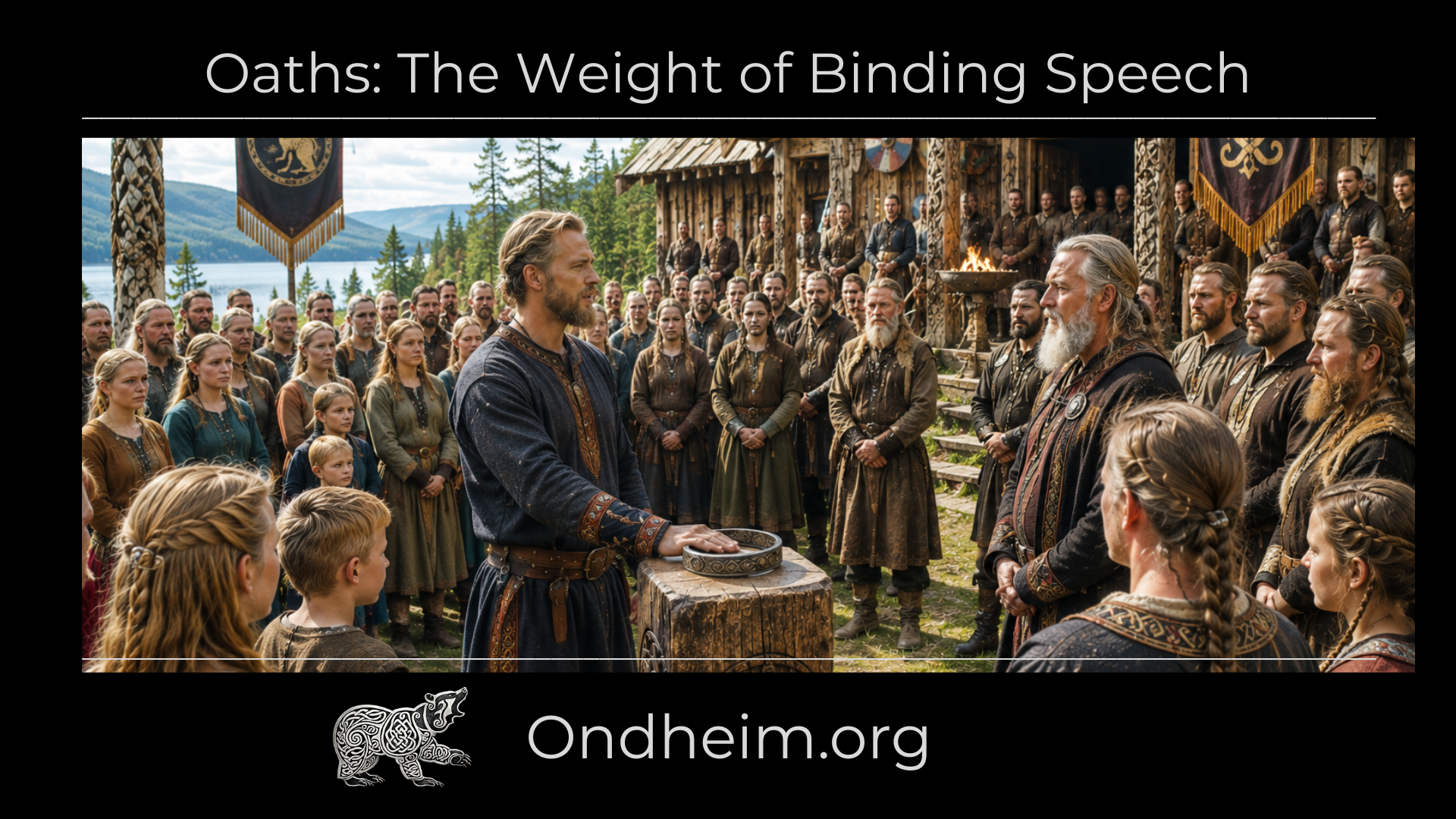
The Dead Remain Among the Folk

People hear "Hel" and they think "Hell." Same root, same idea — a place of punishment for the wicked.

That's Christian overlay talking, not the sources.

The Norse Hel, as Gylfaginning describes it, is the realm of the dead ruled by Hel, Loki's daughter. Those who die of sickness, age, or ordinary causes go there — and so does Baldr, among the most beloved of the gods. That fact alone should end the confusion. You don't send the best-loved god to a torture chamber.

Hel isn't a Satan figure opposing the gods. The realm isn't punishment for moral failure. The atmosphere in the sources is solemn, grave, distant — tied to mortality itself, not to damnation. It looks more like the older Indo-European underworld traditions than anything in later Christian theology.

But the bigger difference isn't geography. It's how the living understand the dead.

Modern culture treats death as a clean break. The person departs, exists elsewhere, done. The old way never thought of a person that way. Identity lived inside kinship — ancestry, memory, oath, inherited worth, obligation, the continuing life of the folk. You weren't an isolated soul standing alone before the cosmos. You were a link.

So the dead didn't vanish from the community. They stayed woven into it: through ancestor veneration, burial mound custom, naming traditions, inherited luck and hamingja, reputation wisdom, the sheer weight of remembered deeds. The Hávamál puts it the way it always does — plainly (Hávamál 77):

Cattle die, | and kinsmen die,

And so one dies | one's self;

But a noble name | will never die,

If good renown | one gets.

That wasn't poetry for comfort. It described how things worked. A name spoken again in the family line. A child with her great-grandmother's temperament. Stories told around the hearth for generations. Skills, habits, strengths, obligations moving down through descendants. The honored dead remembered in feast and seasonal observance. The boundary between living and dead was never sealed shut.

Which is why trying to force the lore into one rigid afterlife system never quite works. The sources preserve overlapping possibilities — Hel, Valhalla, Fólkvangr, the mound traditions, ancestor presence, the continuing tie between living and dead — without handing us a single universal doctrine for every soul. The old way had room for mystery. It didn't need a perfectly organized sorting system to take death seriously.

Modern people hunger for certainty on this — one heaven, one hell, everything filed correctly. The sources don't oblige. What they emphasize instead, over and over, is continuity: kinship, relationship, memory, inherited worth, the unbroken life of the people across generations.

That's also why reputation carried the weight it did. Your deeds didn't end at death. They kept shaping your descendants — family standing, inherited reputation, the strengths and burdens carried by everyone connected to you. The dead kept influencing the living through consequence and remembrance.

The old sources don't give us a neat unified doctrine of the soul, and we shouldn't pretend they do. What the patterns show, consistently, is identity as something interwoven — through kinship, ancestry, obligation, memory — across generations. You stand in a living chain. The dead shaped you; you'll shape the unborn.

Hel isn't paradise and it isn't torment. It's one part of a larger relationship between the living and the dead — solemn, unavoidable, and real.

What endures isn't a map of the afterlife. It's the continuity itself. The dead remain in descendants, in memory, in inherited worth, in story, in reputation, in the ongoing life of the folk. The living carry them forward.

And through that carrying, the folk remain unbroken.

William J. McNamara Jr.
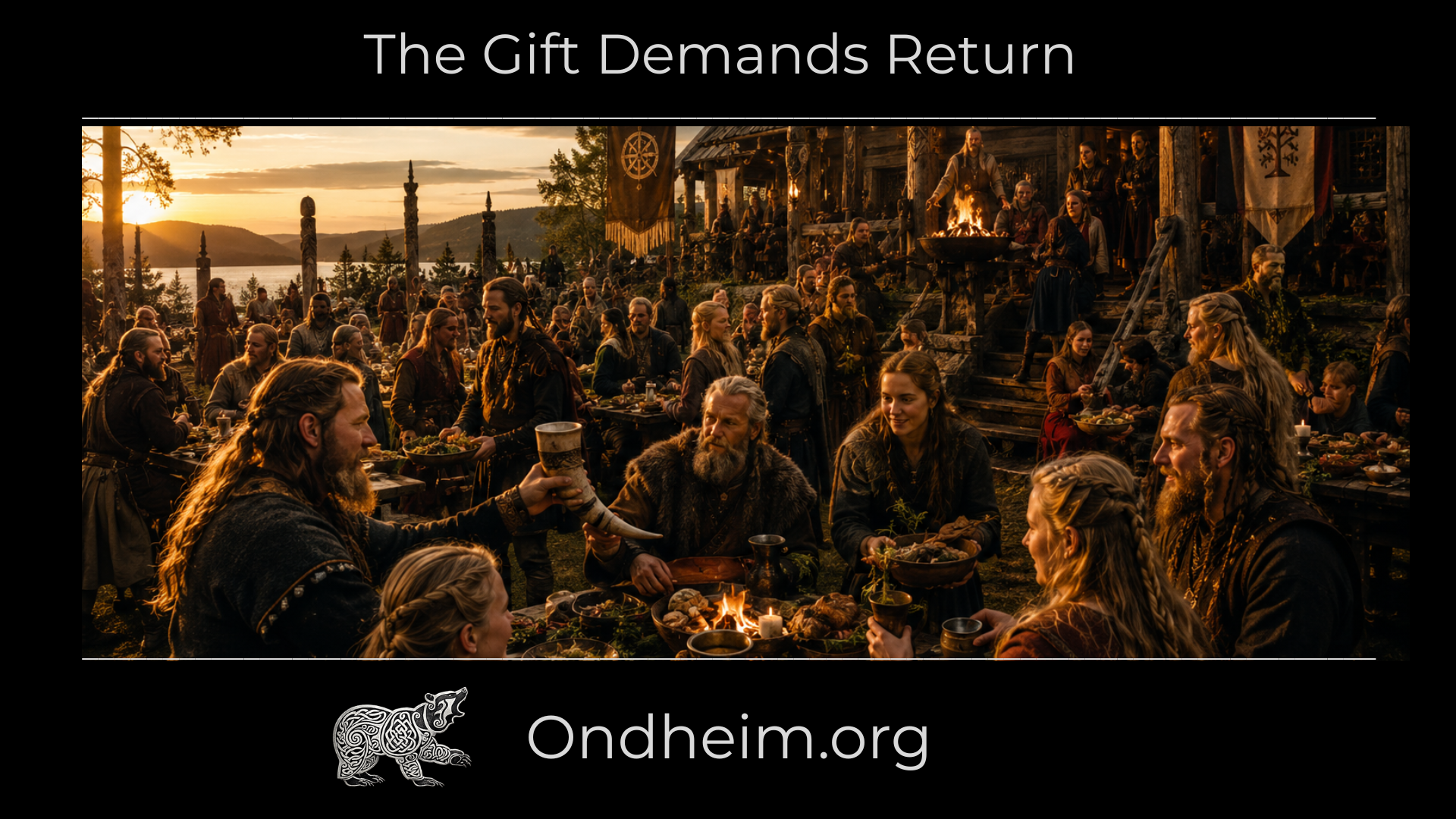
Frith Is Not Peace | Ondheim Firesides

Frith is often translated simply as “peace.” But within the older Germanic worldview, frith meant far more than the absence of conflict. It was trust, obligation, right conduct, mutual responsibility, and the maintenance of harmony within the hall and among the gathered folk.

This Ondheim Fireside explores why “frith is not peace” — and why understanding that distinction matters when examining ancestral worldview and modern Theodish thought.

Related Reading:
https://ondheim.org/2026/03/19/frith-is-not-peace/

Explore additional Firesides and educational material:
https://ondheim.org/firesides/

Learn more about Ondheim Theodish Fellowship:
https://ondheim.org

#Theodism #Heathenry #Frith #GermanicTradition #NorseTradition #Ondheim #OndheimFiresides

Welcome to Ondheim Fireside Chats

An introduction to the Fireside Chats series and the ongoing effort to preserve oral teaching, worldview, memory, and communal discussion within the Ondheim Theodish Fellowship.


HAIL THE FOLK.
HAIL THE ANCESTORS.


Frith defines the boundary, oaths bind the word, kin carry obligation, and the hall holds witness and memory. The shape of obligation gives these structure, and through symbel they are spoken into wyrd and given force.

For additional primary sources and public-domain texts related to kinship, obligation, feud, and Germanic social structure, see our Links page.

Worth Is Earned, Not Claimed

A system of order has to produce something. Otherwise it’s just rules for their own sake.

Frith maintains the relationships. The boundary defines where they exist. The thews govern how they’re upheld. Right Good Will guides how the folk carry them.

But none of it means anything without a result.

The result is worth.

Worth is not assumed. It’s not granted. It’s not claimed through words alone.

Worth is earned.

The lore keeps coming back to the same pattern: action, reputation, and the memory of what a man actually did.

The Hávamál says it plainly (Hávamál 77):

Cattle die, | and kinsmen die,

And so one dies one’s self;

But a noble name | will never die,

If good renown one gets.

What endures isn’t intention. It’s demonstrated conduct — witnessed, remembered, weighed by the folk who were there.

And the Hávamál is just as blunt about the alternative (Hávamál 16):

The sluggard believes | he shall live forever,

If the fight he faces not;

But age shall not grant him | the gift of peace,

Though spears may spare his life.

Dodging every challenge doesn’t preserve you. It just delays the reckoning. What lasts is what you did, how you did it, and how it’s remembered.

Strip it down and worth is demonstrated reliability inside the structure of the tribe. Not a feeling. Not a self-assessment. Three things: observed, tested, remembered. A man has worth when he fulfills obligations, acts consistently, upholds the thews, and strengthens frith. Nobody can declare that about himself. It can only be recognized — by others, over time.

Reputation is worth made visible. It’s how the tribe measures reliability, consistency, capability — and it’s functional, not vanity. A strong reputation means your words are trusted, responsibility can be placed on you, leadership can emerge from you. A weak one means your words get questioned, your responsibility stays limited, trust gets withheld. Reputation is earned over time and lost through failure. There’s no shortcut in either direction.

Rank works the same way. Within the tribe, rank isn’t decoration — it’s the recognition of proven worth. Advancement isn’t given lightly, because rank reflects what’s already been demonstrated: consistent action, fulfilled obligation, reliability under pressure. It’s not a reward for wanting it. It’s the acknowledgment of what’s been done. That keeps authority grounded and the structure stable. Rank is past worth made visible.

And here’s the part people miss: worth doesn’t lighten the load. It increases it. The more you’ve proven, the more is expected of you, the more your actions carry weight, the more your failures matter. Worth is not a shield. It’s a weight you carry forward. Claiming worth while ducking responsibility is misunderstanding the whole thing.

Words alone never created worth. Boast and declaration mean nothing without fulfillment — which is why speech gets tested, oaths bind, and reputation gets remembered. Claim worth without proof and you lose trust, damage your standing, and weaken your place. And once lost, it doesn’t come back easy. False worth collapses under scrutiny. Always.

Each part of the system feeds this. Frith provides the environment where reliability can be shown. The inner yard provides the boundary within which it’s recognized. The thews define what’s expected. Right Good Will gives trust room to be extended and tested. Without the structure, worth can’t be measured. Without the man’s actions, it can’t be earned.

So what does earning it actually take? Act consistently — one act doesn’t make a pattern. Fulfill obligations fully — partial effort doesn’t build reliability. Speak only what you can uphold — your words bind your future. Accept consequence when you fail — accountability restores what avoidance destroys. Seek responsibility, not recognition — worth follows action, not hunger for status. Understand it takes time — worth can’t be rushed. And keep going after it’s earned — worth is maintained, not achieved once and pocketed.

Worth is not given. It’s built over time through action, tested through challenge, remembered through reputation. Not what you claimed — what you proved.

What is proven remains.

William J. McNamara Jr.
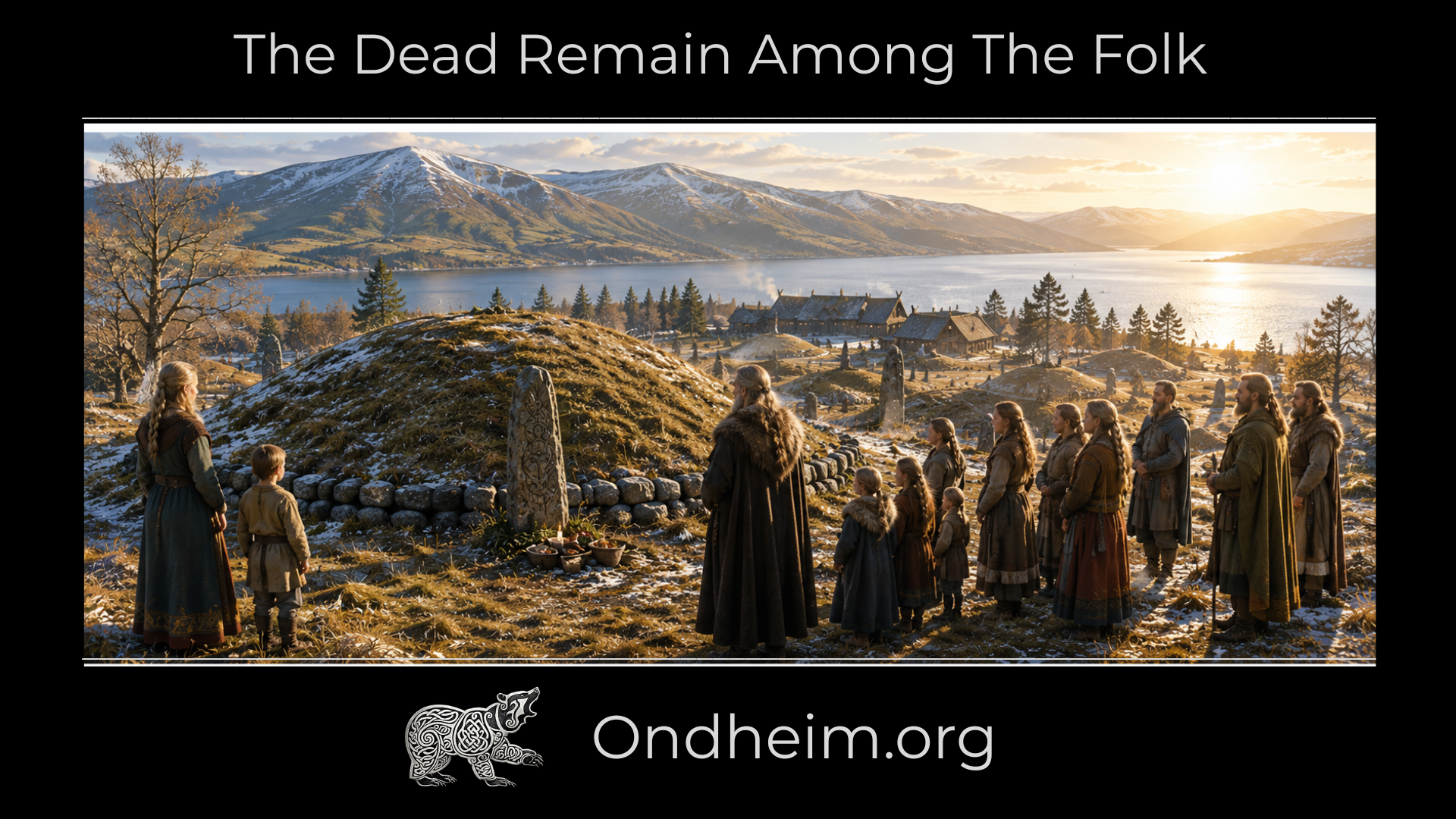
Thews: The Law That Lives

People hear the word "law" and they picture a book. Rules written down somewhere, sitting on a shelf, doing the work by existing.

That was never how it worked.

In the old way, there was no book. There was the tribe — and the tribe had expectations. You knew what was owed, you did what was owed, and if you didn't, somebody said something. That was the law. Not ink on a page. The lived pattern of a people.

The old word for that pattern is thew. Thews are the living law of the tribe — formed through action, held through expectation, and proven over time.

The Hávamál doesn't hand you a rulebook. It hands you patterns. (Hávamál 16):

The sluggard believes | he shall live forever,

If the fight he faces not;

But age shall not grant him | the gift of peace,

Though spears may spare his life.

That's not a statute. It's an observation about how the world works, offered so you'll live like you understand it. The lesson isn't "memorize this." The lesson is "this is true — act accordingly."

That's the difference between written law and living law. Written law sits still and waits to be consulted. Living law moves through the folk — taught, watched, corrected, repeated — until it's just how things are done.

A thew exists when three things are true: the folk know it, the folk practice it, and somebody enforces it when it breaks. Take away any one of those and it weakens. Take away all three and it's gone, whatever anyone claims.

A law nobody upholds isn't a law. It's a wish.

You've seen what happens in a group where nobody corrects anyone. Somebody coasts. Somebody else notices the coasting and figures, why should I carry more than him? Within a year the standard isn't the standard anymore — it's whatever the laziest person can get away with. That's erosion, and it doesn't announce itself. It just quietly lowers the ceiling until the boundary is holding nothing.

The thews are what make the inner yard possible. The boundary says where order exists. Frith is the condition of that order — what it feels like when it's working. The thews are how it's maintained: how we speak, how we act, what we owe, what happens when someone wrongs the folk. Day to day, year to year, that's the mechanism.

And the mechanism needs hands on it. Thews don't enforce themselves. That takes authority — not arbitrary power, but standing that's been earned. Proven worth. Responsibility to the whole. Enforcement takes different shapes: a correction, a challenge, a judgment, a consequence. But it has to happen. Refuse to enforce and the order erodes. Let it erode and the boundary itself starts to go.

There's a balance here, and it matters. Thews without Right Good Will turn into something harsh — correction given to dominate instead of to preserve. But Right Good Will without thews is just sentiment with nothing behind it. The thews provide the form. Right Good Will governs how the form gets upheld.

You can see the thews in a man's reputation. Not in what he claims — in the pattern. Does he show up the same way every time? Does he hold the line when it's tested? Does he take correction without sulking and give it without cruelty? Reputation isn't decoration. It's the record of how a man has actually lived inside the expectations. Where thews are upheld, that record means something. Where they're ignored, it's just noise.

So what does it take to live inside the thews? Learn them — they're taught and observed, not absorbed by accident. Act like you mean it, consistently, because one good act doesn't make a pattern. Take correction when it comes. Give it when it's owed — looking the other way weakens the whole. Stand behind enforcement when the folk have to act. And understand, all the way down, that the law lives in what people do, not in what's written.

The law lives where it is upheld.

William J. McNamara Jr.

Right Good Will: Trust Within the Boundary

People hear “good will” and they picture niceness. Being pleasant. Getting along with everybody.

That’s not Right Good Will. That’s just manners.

Right Good Will is sterner than that. It’s the disciplined extension of trust, respect, and proper conduct toward the people inside your boundary — extended as a matter of duty, not because you feel like it.

Order alone isn’t enough. You can have the boundary drawn and the thews known and enforced, and still watch the whole thing fracture — because the folk treat each other badly inside it. Structure without decent conduct between people goes brittle. It breaks under strain.

The Hávamál draws the lines the way it always does — plainly. (Hávamál 42):

To his friend a man | a friend shall prove,

And gifts with gifts requite;

But men shall mocking | with mockery answer,

And fraud with falsehood meet.

Friend gets friendship. Gift gets gift. And mockery gets answered with mockery, fraud with falsehood. That’s not universal love. It’s directed, conditional, and bound to the relationship. You conduct yourself according to what the other man has actually shown you.

And where trust has been proven, it deepens. (Hávamál 44):

If a friend thou hast | whom thou fully wilt trust,

And good from him wouldst get,

Thy thoughts with his mingle, | and gifts shalt thou make,

And fare to find him oft.

Share your mind. Show up. Put the work in. Trust isn’t a feeling you have about someone — it’s a thing you build with them.

That’s the underlying principle. Right Good Will is the default stance inside the inangardr. You extend it to the folk within the boundary because it’s owed, not because you’re fond of everyone. It doesn’t require agreement. It doesn’t require warmth. It requires discipline: the benefit of the doubt, good faith, unity where it can be held, and hostility withheld unless it’s earned.

Frith is the condition — what ordered relationship feels like when it’s working. Right Good Will is a big part of how that condition gets maintained. Without it, suspicion replaces trust, and every correction turns into a fight, and the unity comes apart into factions. With it, disagreements stay contained, correction makes things stronger instead of splitting them, and relationships survive strain.

Same with the thews. The thews say what’s expected. Right Good Will governs how those expectations get carried out. Without it, enforcement goes harsh, authority gets resented, and correction gets personal. The thews provide the form. Right Good Will decides whether that form gets upheld like a tribesman or wielded like a weapon.

And then there’s trust itself. Trust isn’t handed out blind — it’s extended as a matter of thew, and then it’s tested by what people do. That’s the system: trust given, trust tested, trust confirmed or withdrawn. Right Good Will opens the door. What a man does determines whether it stays open.

Because Right Good Will has limits, and they matter. It’s not infinite. It’s not owed without condition. When someone inside the boundary keeps breaking obligation, acts in bad faith, works against the order — the good will gets reduced, and then withdrawn. That’s not a failure of frith. That’s frith defending itself. Keeping trust extended where it’s been violated over and over isn’t strength. It’s negligence.

So what does it ask of you? Start from trust inside the boundary — don’t assume hostility where none’s been proven. Act in good faith, like someone trying to hold the order together. Take correction without resentment; it’s maintenance, not attack. Give correction without hostility; the point is preservation, not dominance. Know the difference between how you conduct yourself inside and outside — Right Good Will isn’t extended to the utgardr the same way. Pull trust back when it’s been burned through. And put the integrity of the boundary ahead of your personal reaction, every time. Order before feeling.

Right Good Will isn’t kindness. It isn’t softness. It’s the discipline that keeps trust alive between people who have to count on each other.

Trust is given. It is also withdrawn.

William J. McNamara Jr.

Inangardr and Utgardr: The Shape of the World

The world isn’t divided into good and evil. It’s divided into what’s ordered and what isn’t. That’s the first thing to understand, because everything else follows from it.

The old words for that division are inangardr — the inner enclosure — and utgardr — the outer expanse. This isn’t geography. It’s the shape of existence: where order can live, and what it costs to keep it there.

The lore opens with the pattern. (Grímnismál 40): “Out of Ymir’s flesh was fashioned the earth, and the ocean out of his blood; of his bones the hills, of his hair the trees, of his skull the heavens high.” The world wasn’t negotiated into being. It was built — decisively, out of chaos, into something that could hold.

And then it was enclosed. (Grímnismál 41): “Mithgarth the gods from his eyebrows made, and set for the sons of men.” They took the giant’s brows and made the enclosure, and set it for the sons of men — Miðgarðr, the middle-enclosure, the walled yard of humankind set inside a wider world that doesn’t run by our rules. Order, contained. The wild, kept outside.

That tells you the whole principle: order doesn’t exist everywhere. It exists where it’s established and maintained. Nowhere else.

Inangardr isn’t just a place on a map. It’s defined by what’s upheld inside it — shared obligation, maintained relationships, recognized structure, thews that people actually live. Utgardr isn’t evil. It’s just unbound: no shared law, no obligation, nothing the tribe’s authority can reach. The old worldview never taught that chaos gets eliminated. It taught that chaos gets held at bay.

The tribe itself is an inangardr. That’s how to think about it — not as a club or a crowd, but as a maintained enclosure of order, built the same way Miðgarðr was built: deliberately, and then defended. Inside it, frith gets maintained. Obligation binds. Reputation carries weight. Right Good Will gets extended as a matter of thew. None of that is automatic. Every bit of it is constructed, and it only holds as long as someone’s holding it.

Outside is utgardr, and you need to be clear-eyed about what that means. Out there are people not bound to the tribe, forces that don’t recognize its order, conditions where obligation doesn’t apply. That doesn’t make the outer world forbidden — trade happens, dealings happen. But the terms change. Trust isn’t assumed. Obligation isn’t guaranteed. A man’s word doesn’t carry the same weight out there, because there’s no structure underneath it to give it weight. Mistake utgardr for inangardr — treat the outside like the inside — and you invite disorder straight through the gate.

A boundary that isn’t maintained fails. That’s true in the cosmos and it’s true in the tribe. Keeping the inangardr standing takes clarity about who’s inside it, enforcement of the thews, active protection of frith, and correction when something threatens the order. When those slip, obligation weakens, trust collapses, reputation stops meaning anything.

And here’s what people miss: the boundary doesn’t usually fall all at once. It erodes. A little slack here, an unenforced breach there, and one day you look around and the inside doesn’t feel like the inside anymore. What’s left isn’t inangardr. It’s utgardr that nobody recognized soon enough.

Frith and the boundary need each other. Frith only exists inside the boundary — it can’t be extended where there’s no shared structure to hold it. And the boundary only holds because frith gives the people inside a reason to hold it. Each depends on the other. That’s why frith is not peace: peace pretends to be universal, but frith is a contained condition, and it dies without the wall.

So what does it ask of you? Know where the boundary is — not every space is the inner yard. Conduct yourself differently on each side of it: obligation governs one, caution governs the other. Uphold the thews inside, because the order runs on consistent action. Protect frith like it’s your job, because it doesn’t sustain itself. Learn to spot disorder coming through the gate, and act. And don’t confuse openness with strength — a boundary that admits everything holds nothing.

The world is divided. That’s not a judgment. It’s just the structure of things.

The boundary holds — or it does not.

William J. McNamara Jr.

Frith Is Not Peace

Ondheim Theodish Fellowship 🌲
https://ondheim.org

Introduction

Frith is often mistaken for peace.

It is not peace.

Peace suggests the absence of conflict. It implies quiet, comfort, and the avoidance of tension. Frith is none of these things.

Frith is order maintained through right relationship.

Within the Ondheim Theodish understanding, this order is not abstract. It is lived through obligation, upheld through action, and preserved through the thews—the customary laws and expectations that govern the tribe.

Where frith is strong, the folk stand together.
Where it is broken, the tribe begins to fail.

I.  What the Sources Show

The elder sources do not define frith in simple terms, but they consistently demonstrate the conditions under which ordered life can exist.

In Völuspá, the shaping of the world establishes structure out of chaos:

“Of Ymir’s flesh the earth was fashioned…
And of his skull the sky.”
— Völuspá 8 (Bellows, 1923)

The world does not emerge gently. It is formed through decisive action that imposes order on a prior, unstable condition.

In Hávamál, the importance of right conduct within human relationships is made clear:

“Cattle die, kinsmen die,
Oneself dies the same;
But the fame of one who has done well
Never dies.”
— Hávamál 76 (Bellows, 1923)

Reputation, conduct, and the memory of the folk are what endure. These are not passive qualities. They are maintained through action, accountability, and consistency.

Across the sources, one pattern is clear:

👉 Ordered life depends on maintained relationships, not the absence of conflict

II.  The Underlying Principle

Frith is the condition of rightly ordered relationship within the inangardr.

It is not emotional harmony.
It is not agreement.
It is not comfort.

Frith exists when:

  • roles are understood
  • obligations are fulfilled
  • boundaries are respected
  • trust is maintained through proven action

This reflects the same structure seen in the cosmos itself.

Just as Midgard is established as a defended enclosure within a wider and more chaotic reality, so too is the tribe an enclosure of order within the broader world.

Frith is what allows that enclosure to hold.

III.  Frith and Inangardr

Within the Ondheim understanding, frith exists inside the boundary of the inangardr—the ordered space of the tribe.

This is the inner world of the folk, where:

  • obligation is binding
  • trust is expected
  • relationships are governed by thews
  • and Right Good Will is extended as a matter of duty, not preference

Right Good Will requires that a theodsman give the benefit of the doubt, act in good faith, and uphold unity within the boundary unless proven otherwise.

Outside the boundary lies utgardr:

  • the uncontrolled
  • the unbound
  • the unpredictable

Frith does not eliminate conflict within the boundary.

It regulates it.

Disagreement may exist. Correction may be necessary. Testing may occur.

But these things happen within a structure that preserves the integrity of the whole.

👉 Frith is not the absence of tension.
👉 It is the containment of tension within order.

IV.  Why Peace Is the Wrong Concept

Peace, as commonly understood, seeks to avoid disruption.

Frith requires the opposite.

Frith demands:

  • accountability when wrong is done
  • correction when order is threatened
  • strength when the boundary is tested

A tribe that prioritizes comfort over order will lose both.

When necessary correction is avoided:

  • trust erodes
  • reputation becomes meaningless
  • obligation weakens

What remains may look like peace, but it is not frith.

It is the slow collapse of structure.

V.  Frith, Reputation, and Responsibility

Frith is sustained through people, not ideas.

Each member of the tribe contributes to it through:

  • keeping their word
  • fulfilling their obligations
  • acting in accordance with their standing

Reputation becomes the visible measure of this.

As established in the lore, what endures is not intention, but demonstrated worth.

Within Ondheim’s understanding:

👉 Frith is strengthened when words and deeds align
👉 Frith is weakened when they do not

This reflects the broader principle that human relationships—like those between gods and folk—are sustained through right action and reciprocal fulfillment over time.

Speech, oath, and deed are not separate things. They form a single chain of consequence.

VI.  What This Requires of the Folk

To maintain frith, a theodsman must:

  1. Honor obligations
    What is owed must be fulfilled without excuse.
  2. Speak with intent
    Words are not casual. They shape reputation and expectation.
  3. Accept correction
    Being corrected within the boundary is not an attack—it is preservation of order.
  4. Give correction when required
    Allowing disorder to stand unchallenged weakens the whole.
  5. Know one’s place and standing
    Order depends on clarity of role, not assumption.
  6. Extend Right Good Will
    Trust is given as a matter of thew, and maintained through action.
  7. Place the tribe above personal comfort
    Frith is not maintained by avoiding discomfort, but by upholding structure.

Conclusion

Frith is not peace.

It is the condition that allows peace to exist when it can—and to be restored when it is broken.

It is maintained through:

  • order
  • obligation
  • accountability
  • and the will to uphold them

Within Ondheim, frith is not assumed. It is actively maintained through thews, strengthened through Right Good Will, and proven through the actions of the folk.

Where frith is strong, the tribe endures.

Where it is neglected, no amount of comfort will preserve what follows.


“Frith is not given. It is kept.”


𝓦𝓲𝓵𝓵𝓲𝓪𝓶 𝓛𝓸𝓻𝓭

Ondheim Theodish Fellowship
Ondheim.org

Frith defines the boundary, oaths bind the word, kin carry obligation, and the hall holds witness and memory. The shape of obligation gives these structure, and through symbel they are spoken into wyrd and given force.

For additional primary sources and public-domain texts related to kinship, obligation, feud, and Germanic social structure, see our Links page.

Sources

Primary Texts

Bellows, Henry Adams (1923).
The Poetic Edda.

Brodeur, Arthur Gilchrist (1916).
The Prose Edda.
Gylfaginning
https://www.gutenberg.org/ebooks/18947

Ondheim Resources

Ondheim Theodish Fellowship
https://ondheim.org

Winternights 2025 Abanning

Alter With Ancestor candles On October 9, 2025, The Folk and guests of the Ondheim Theodish fellowship met at the homestead of Chris Thane and his family to celebrate Winternights.  The weather was clear, but cool and crisp, as is appropriate for the season.  In the tribal meetings of the weeks prior to the gathering, the folk spent time making homemade jar candles to be used in honor of those who had passed beyond the veil.  It is our tradition to create candles for the folk who have departed and light them from our needfyr to metaphysically invite them to our ritual gathering.

On the full moon a few days prior to the event, the hunters within the tribe gathered at the homestead of Chris Thane where he performed the traditional Ullr blot and weapon blessing for the hopes of a good hunting season.

The needfyr itself was lit two days prior to the event, as an opening to the meta-ritual in the tradition of our ancestors to hold holytides over the course of multiple days.  The needfyr was kept burning for three days in an oil lamp, and on the day of the gathering, the lantern was used to ignite the ritual fire thereby maintaining the fire for the entire time.  The gathering began in the early afternoon and was well attended by tribesmen and guests alike.  Most of the day was spent strengthening the community bonds that are such an integral part of Theodish belief.

The folk then shared a feast, and as the sun set, we came together for ritual.  The ritual was held in honor of the Disir and all the folk who passed beyond the veil, and gifts were given and offerrings made.  The ritual was well received, and omens were judged to be good.  After a brief break for dessert and more socialization, the symbel began.  Coming together in symbel is one of the greatest rituals the folk participate in.  The moment when all of our words and deeds flow directly from us into the well of wyrd and are witnessed by Gods, folk, and ancestors alike.  It is the most sacred of our rites.  Well-wrought words spoken in hall and ancestors and heroes remembered are the path to immortality within our faith.


Glaed Winternights to all!

William Lord

Ondheim Theodish Fellowship

Ondheim.org

Winternights 2025 Abanning

Mayday 2025 Abanning

On May 1st 2025, the folk of the Ondheim Theodish Fellowship came together at the home of Lord William & Lady Diane to celebrate MayDay and perform our tribal Sigrblot, as is the custom. The gathering was well attended, with members and guests alike. Despite a rough winter with major construction on the property, the folk came together and put the work in to prepare the land for the upcoming season and honor the landvaettir by caring for them. The tribal Hof was the location of a discussion on what Sigrblot means and why we do it. Educating the folk is a necessary part of tribal gatherings, and the foundation upon which we build the future of the organization. Much of the day was spent in relaxation, community building, and general merriment, which is always a priority. With our hectic lives in this host society we live in, time well spent with tribesmen is of paramount importance!


Sigrblot was offered, with gifts of tribal made mead brewed by freedmen John and Ali, and a ceremonial spear marked with the runes of the gift cycle and blooded by Lord William. The sacrifice was well received with omens in fire and natural surroundings, and the feast commenced!


As usual the feast was impressive, featuring brisket made from the cow procured by Chris Thane that the tribe came together and butchered together as our ancestors did. Their clan truly embraces the ancestral lifestyle of homesteading and animal husbandry. Feast was served under the canopy on a beautiful spring evening, followed after by Symbel.


Symbel featured many yielps and braggs of accomplishments of the folk, Gods, ancestors and heroes were hailed with words and song. Toasts were given both in English and elder tongues, and a midsummer song was sung by Joanna Karl. Deeds and stories shared and honored, even to the point of tears. It was a powerful and moving ritual honoring the Gods and the folk. The Gods and ancestors plate, as well as the mead over which symbel was spoken was offered on the Horg.


Hail The Gods! Hail the Ancestors! Hail The Folk!


mayday 2025 abanning


Mayday 2024 Abanning

On Saturday April 27th, the Ondheim Theodish Fellowship gathered at Thunreshof to celebrate May Day and perform our Sigrblot.  Despite weeks of heavy rains, we were granted the gift of a perfect spring day for our gathering.

In the tradition of our tribe, lunch was followed by workshops. Our workshops are designed as an effort to build upon the bonds of community between tribe and guests, as well as further the education and understanding of our members and friends.  First on the afternoons workshop list was Erik Karl’s presentation on linguistics and the roadmap between modern languages all the way back to Proto Indo European language.  A truly fascinating examination of how language has evolved over time!  Next up was a breakdown of the elements of Ritual and how to design and perform different rituals within our community and faith done by William Lord.  A face to face explanation of the “Anatomy of a ritual” article on our website with some question and answer time for those who are developing their own personal, ancestral, and landvaettir rituals, which is a very important process for the development of our spiritual paths and practices.


After some more socializing, practice sparring, and axe throwing practice, we moved on to ritual and the tribal Sigrblot was held, sacrificing a forged spear to Odin for victory in the trials of the coming year.  Ritual was powerful, and the post rituals omens all showed as well received.  Ritual was followed by feast, and the calling of the raffle winners, with so many prizes donated for the raffle, much money was raised for the tribe, and many wonderful prizes received, from jewelry to honey, to god statues, and even a tanned squirrel hide

done by one of the children of the tribe.  The generosity of the folk was incredible, and folk and guests alike won…


Symbel followed feast, and was an awesome event, filled with well spoken toasts, singing, and best of all, the official acknowledgement of the freeing of Jon and Ali thralls, as they have now earned their freedom and join the ranks of the full membership of the tribe.  Congratulations to them as they have proven their might, mettle, and worth!


Odin grant us the wisdom to discover the right!

Thor grant us the strength to make it endure!

Freyr grant us prosperity in our work and worthing!

All Hail the folk of the Ondheim Theodish Fellowship!

Mayday 2023 Abanning

On April 29th, 2023 The members of the Ondheim Theodish Fellowship gathered together to celebrate the arrival of spring and the planting season. This is the time we perform the Sigrblot or “Blot

for Victory” performed every year in the spirit of being victorious in the challenges and ordeals that we will assuredly face. The gathering was held at Thunreshof, the ancestral Hof on the land of Lord William and Lady Diane, and the weather reports leading up to the event called for torrential downpours all weekend. In preparation, the folk gathered, bought, and put up several rain shelter canopies, totaling an amazing 700 sq. feet of shelter to make the folk as comfortable as possible under the expected weather conditions. Our ancestors would not allow the weather to deter them from their plans, and neither will we!

We began our day with much rain, though not as much as was initially forecasted, which made the usual Mayday events (Kubb, archery, axe throwing, etc) less than ideal, but the folk gathered under the shelters, and shared conversation and knowledge, and built and strengthened our bonds of fellowship. We were blessed with the attendance of a neighboring tribe, Visdreng Volk, led by Will, a long time friend and respected Gothi and Hof builder, as well as some local Asatru folk that we have been maintaining frithful relations with as well as the usual goodfolk we have grown close to. Erik Karl led a discussion on the Viking Sail and shipbuilding techniques and theorized that sails were likely in use by our ancestors prior to the Oseberg ship. A very interesting presentation and well done. Afterwards, Chris Thane gave a demonstration and explanation of the swedish Maypole or grapevine-wreath used at our midsummer celebrations. We are planning to begin demonstrations of how to craft the items to be used in upcoming gatherings and events in order to help the folk prepare for thingtides and improve our traditional skills while promoting the mindset of our ancestors and internalizing their worldview. The resulting grapevine wreath was then put up as a raffle item. It is the goal we all share to learn, grow, and adopt the mindset of our ancestors despite the modern cultural indoctrination that our host society keeps us immersed in.


The ritual was powerful and moving, as was evidenced by the magnificent fireball when the mead was offered, making it clear that our gifts were accepted and Victory in the coming year was to be ours. Through mead, rune chants, and Galdr the Gods, Ancestors, and Landvaettir have been “given theirs”, and through their Raed and Speed, so shall we earn ours in the year to come!

The feast was plentiful and good, with all eating their fill, and multiple cases of mead ready for symbel. Symbel went late into the evening, with many great toasts and yielps made, songs in the elder tongues sang, deeds proclaimed, and goals laid out for the folk moving forward. It was a moving and energized event! It is through action that we grow and become more, and will ever be our goal to improve ourselves and Honor Ancestors, Gods, and the Folk!

Hail the Ancestors, Gods, and Landvaettir!
Hail The Ondheim Theodish Fellowship!

2023 mayday abanning

MayDay 2022 Abanning

On Saturday April 30, 2022, the Ondheim Theodish fellowship gathered at Thunreshof to celebrate the beginning of spring and Walpurgis / May Day.  The gathering was well attended, having most of the Theod and some guests as well.  The weather was absolutely beautiful, which was especially good given that only a week ago we had had a snowstorm with actual accumulation.  The folk came together around noon and the day began with kubb, axe throwing, and archery practice and contests, then lunch was served, consisting of Heroes and an amazing assortment of quiches supplied by Skylar and Patricia!  

Lunch and socializing were followed by one of our teenage kinfolk Jason giving a demonstration and workshop on making blankets, which was one part of his Eagle Scout project he is in the process of completing with his scout troop.   He is raising money and making blankets for the Snowball Express, which is an organization that is for children who have lost a parent or sibling in the military.  We are all dedicated to supporting service members and their families in any way they can.  The workshop went well, and blankets were made to add to the donations Jason will be making as a part of his project.

The folk then performed the Sigrblot ritual to ask The Gods and ancestors for victory in our goals and ordeals in the year ahead.  Gifts of might and maegn, as well as a spear were given to the Gods and our pledge to continue striving and working to achieve our goals to better ourselves and our community in the coming year.  In return we asked the Gods and ancestors for help and inspiration in our pursuits that we may better bring honor to our names.  May the Folk be granted victory in the coming year!

After the ritual, we began the feast, which consisted of an assortment of dishes from smoked brisket, lamb, and kielbasa to roasted pork loin, potatoes au gratin, mixed vegetables and pasta.  The folk feasted well, and much was placed on the sacral offering plate to Gods and ancestors.

After feast, we moved into the Symbel hall and held formal Symbel.  Symbel opened with a reciting in old Norse and translation into English of an excerpt from Sigrdrifumal.  Then the traditional three rounds of Symbel commenced with many good and worthy words were spoken and deeds recounted.  Songs in ancient tongues were sang, boasts and brags were made, tears shed, and all was good in the hall. The Ondheim Theod even accepted a new thrall into the fold.  It was a beautiful ritual, and the folk were truly inspiring to our guests.  May the Gods and ancestors SEE us as we are, and may we continue to build Worth, Frith, and lasting accomplishments both in the secular and sacral worlds we inhabit!

Hail The Folk!

Yule 2022 Abanning


Yule 2022 Abanning

On January 22, 2022, The Ondheim Theodish Fellowship came together at Thunreshof to celebrate Yule. The event was well attended with many tribesmen and guests. The day began with a delivery of a cord of hardwood to keep the fire burning courtesy of Josh thrall. The folk all unloaded the firewood and began to set up the firepit for the needfyr to be started. The Horg was decorated with the offerings, oil torches, and other ritual items. This year a deer hide was provided by the children to be used a Horg covering. This hide was tanned by their hands from a deer that was taken during this year’s hunting season. The folk began the day socializing around the fire, which as is often the case in a snowy winter day devolved into a rousing snowball fight. Much fun was had by all!

Moving inside to warm up, the folk had a lunch consisting of homemade chili and 6-foot hero sandwiches. During lunch the folk began discussions on many different Theodish and philosophical concepts as we often do at gatherings. It is a practice we refer to as “Lunch and Lore”. There is no better way to broaden ones understanding of a concept than to partake in a round table style discussion on it. It is always interesting to get the views of our guests mixed in with those of us who have studied the concepts from a Theodish perspective. Experiencing varied viewpoints forces us to analyze things more completely using alternate perceptions, which helps to solidify and internalize those values we embrace.

After the informal Lunch and Lore discussions, we were treated to a very well researched presentation on Viking burial practices, both in the past from the lore, as well as modern laws. Geri Thrall is a funeral director by trade, and her experience and firsthand knowledge of the field made for an extremely well organized and thorough analysis on what is legal and possible under modern health department and law codes with regards to Viking funerary rites. She even thoughtfully presented a printed copy of burial and cremation laws for the folk to peruse. It even prompted one of our guests to contact her regarding planning his own final arrangements.

As dusk approached, we moved outside and did our Yuletide ritual, offering the wishes and hopes for the coming year tied to a Julbokk and burned so that the Julbokk could bring those wishes to the Gods and ancestors to ask for their speed and raed(guidance) in the coming year that we could achieve the goals we are working towards. During and after the ritual, the omens in the fire and around us were observed and recorded and it was judged that the Offerings of mead charged with might and maegns(energies) was well accepted. The ritual fire was so large and so hot that the folk observed it was indeed possible to feel sun-burnt in the front while battling frostbite from the rear…

Moving inside, the folk shared a feast of impressive proportions supplied by the folk, and mostly made from the meat we received during hunting season or the “Yule Cow” as this is the second Yule that the Gods provided us with a cow for the simple price of slaughtering and butchering it. Most certainly a result of the good works we have undertaken to build our tribal luck. Of course, there was a tray placed on the feast table where the folk placed a portion of their meal on it for the Gods and Ancestors, to symbolically share the feast. The folk being sustained by the work of the folk together. What more can we ask for…

After feast, we cleared away the food and brought out the tribal mead horn and blot bowl, and Symbel began. Many fine toasts were made to Gods, Ancestors, Heroes, and the Folk. And much tribal business was handled. In the third round, much tribal business was put into the well. First off, Chris Karl who has stepped up to fulfill the needs in organizing and managing tribal affairs despite it not being his station to do so yet was raised to the arrung(rank) of Bondi, a leader among the freed folk. The next step in the round was the freeing of the thralls that had satisfactorily completed their time of service and learning. The list of Freed thralls included: Skylar, Patty, Billy, Joanna, Rob, Josh, and Geri. An impressive graduating class to be sure. We look forward to seeing the great deeds and accomplishments they will perform to raise the gefrain(worth) of the Ondheim Theodish Fellowship! HAIL THE FOLK!

It is common for the folk to socialize and celebrate around the fire after symbel, which was where the majority of folk headed after symbel was closed. At this time the Gods plate and symbel mead was offered. It was at this time that it became apparent that the nights holy works had not yet finished. Two of the newly freed Karls, Skylar and Patty decided to swear their Hold Oaths on the spot to Chris Bondi. The guests had all gone, but the tribesmen came together to witness the swearing at the Horg and the fire. When the oaths were exchanged, and many congratulations and drinks shared, William Lord called for the attention of the folk. Once the folk was assembled, William proceeded to recant Chris Bondi’s long list of service done for the tribe and folk, then explained that now that he had men in hold to him, Chris should be acknowledged as a Thane from that moment on, as the work he has done over the last year was indeed the work of a thane. In Theodish belief, we are our deeds, and all ranks and acknowledgments are solely merit based.


Downloadable PDF 2022-Yule Abanning-FINAL