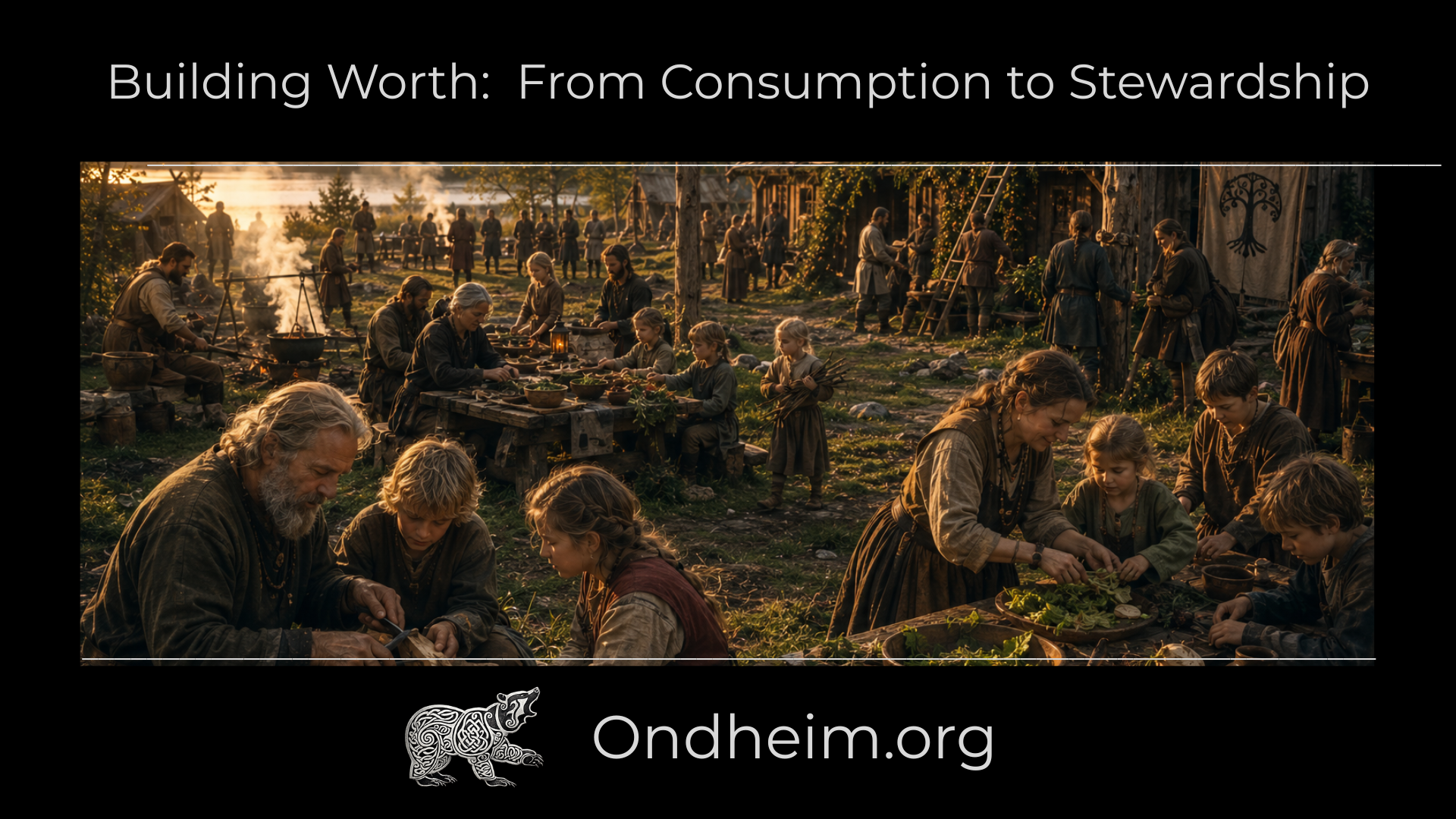
Building Worth: From Consumption to Stewardship

Modern life offers endless opportunities to watch without participating. People spend hours consuming shows, streams, videos, arguments, performances, trends, and carefully constructed online identities created by others. Entire days can disappear into passive observation without a person ever helping build, repair, teach, organize, preserve, or carry anything themselves.

Modern society provides constant stimulation, yet many people still feel strangely disconnected from their own lives.

Part of this disconnection emerges because modern culture increasingly trains people to become spectators rather than participants. People are encouraged to scroll rather than contribute, consume rather than build, and observe rather than invest themselves directly into something meaningful.

Yet human beings were never meant to exist solely as passive observers.

Most people instinctively recognize the difference between merely witnessing something and helping create or sustain it personally. A meal feels different when you helped prepare it. A gathering carries different emotional weight when your own labor helped organize it. A hall matters more when your own hands helped raise walls, repair benches, tend fires, or maintain the space over time.

Participation changes the relationship between people and the things surrounding them.

For many people, this process begins with encountering something that feels more real than much of modern life often does. A person discovers a gathering, craft, tradition, community, or way of living that possesses visible continuity and lived participation. Perhaps it is the sound of familiar voices around a fire, the rhythm of shared work, the sight of people relying upon one another naturally, or simply the feeling of entering a place where presence genuinely matters.

Modern life often leaves people drifting between distraction and consumption without ever becoming deeply tied to anything enduring. Then suddenly they encounter people who know one another across years, build together, gather repeatedly, remember together, and maintain obligations extending beyond temporary convenience.

Eventually a choice begins to emerge.

A person may remain an observer.

Or they may begin participating.

This is where transformation often begins quietly.

A person starts showing up consistently. They help carry chairs before gatherings. Tend fires. Prepare food. Learn songs, customs, responsibilities, stories, and expectations. They remain afterward helping clean once others have already left. Gradually they move from passive attendance into visible contribution.

At first these actions may appear small. Yet human beings form deep attachments through repeated participation and shared effort. Responsibility creates investment. Shared labor creates memory. Effort transforms experiences from temporary entertainment into meaningful parts of lived life.

A gathering changes once your own work helped make it possible.

A tradition changes once your absence would genuinely be noticed.

A community changes once others begin depending upon your presence and reliability.

Over time, communities naturally begin remembering who consistently carries responsibility well. Trust develops gradually through visible participation, reliability, contribution, and repeated investment in the well-being of the people around them.

Eventually something even more important begins developing.

Investment.

A person gradually stops asking only:
“What do I get from this?”

And begins asking:
“How do I help this continue?”

That shift changes people profoundly.

Modern culture often encourages emotional detachment from nearly everything. People are taught to consume experiences while avoiding obligation, permanence, or meaningful responsibility whenever possible. Yet once individuals genuinely invest themselves into something meaningful, they naturally begin caring deeply about its survival, continuity, and future.

And when people truly care about something, they willingly grow beyond what comfort alone would have demanded from them.

They learn more.
Work harder.
Accept greater responsibility.
Pursue greater skill.
Endure hardship more willingly.
And carry burdens they once would have avoided entirely.

Not because they were forced to.

Because the thing itself became meaningful.

This pattern appears repeatedly throughout older societies. Skills, traditions, responsibilities, and worldview were not preserved primarily through passive observation alone, but through participation, apprenticeship, fosterage, labor, and gradual assumption of responsibility within communal life.

A blacksmith learned by working beside experienced craftsmen over years of repeated labor. A lawspeaker developed through listening, participation, memorization, and responsibility. Young people within fosterage systems absorbed obligation, conduct, expectation, and worldview through lived experience within functioning households rather than abstract instruction alone.

Human beings become attached to what they help sustain.

This is one reason participation enriches life so deeply.

People long to feel that their effort matters, that their presence contributes something meaningful, and that the world around them became stronger because they invested themselves into maintaining it. Few experiences create deeper fulfillment than realizing something worthwhile continued partly because you helped carry it.

Purpose changes how people move through life.

Without purpose, even comfort often feels strangely empty. With purpose, even hardship can become bearable because the burden becomes connected to something believed to matter.

This is one reason many people surrounded by convenience, stimulation, and entertainment still experience deep dissatisfaction. Consumption distracts temporarily, but distraction alone rarely fulfills the deeper human desire for meaning, contribution, continuity, and belonging.

Participation also changes identity gradually over time.

A person who contributes consistently becomes dependable. A person who teaches becomes trusted. A person who carries responsibility begins investing emotionally in outcomes extending beyond themselves alone.

Over time, familiar faces become part of the structure of communal life itself. Gatherings no longer feel complete without certain people present. Traditions become layered with shared memory. Communities acquire emotional weight through years of repeated participation, labor, hardship, celebration, grief, and continuity carried together.

Human beings are shaped profoundly by what they repeatedly participate in together.

Eventually participation deepens into stewardship.

Not ownership in the sense of possession or domination, but stewardship in the sense of care, maintenance, responsibility, and protection.

People naturally protect what they help build.

A person who helped sustain gatherings over many years feels differently about the people gathered there. A person who helped preserve traditions understands their fragility differently from someone who merely consumed them passively. A person who carried responsibility during difficult periods understands what would be lost if nobody continued carrying that burden forward.

Importantly, stewardship cannot usually be forced artificially. People willingly carry responsibility once they believe something possesses enough meaning to preserve.

Participation leaves part of ourselves behind in the things we help sustain.

And surprisingly, this often creates one of the deepest forms of joy available within human life.

Not distraction.
Not entertainment.
Not stimulation.

But the joy emerging from shared effort, remembered labor, continuity, and meaningful participation carried across years.

Some of the strongest memories people carry throughout life are not moments of passive consumption, but moments of shared participation.

The meal prepared together.
The fire tended through the night.
The gathering prepared over many days.
The songs repeated until they became part of collective memory.
The shared labor slowly transforming strangers into trusted companions.

Human beings remember what they help build.

Eventually participation deepens further still.

Transmission.

A person who spent years learning naturally begins teaching others. Skills are passed forward. Stories are repeated. Songs are taught. Traditions are explained. New people are welcomed. Children gradually grow into participation themselves.

This changes the emotional weight of participation profoundly because meaning no longer ends with personal experience alone.

An elder watches younger hands organize gatherings once carried personally for decades. A teacher watches another finally master a difficult skill. A parent hears familiar lessons repeated naturally by their children. A craftsman watches techniques survive beyond the limits of their own lifetime.

And within those moments, people often encounter one of the deepest forms of fulfillment human life can offer:

The realization that something meaningful continued because people deliberately chose to carry it forward.

This is how continuity survives in every age.

Not through passive consumption.
Not through spectatorship.
Not through endless detached observation.

Continuity survives because people participate directly in maintaining, protecting, teaching, preserving, and transmitting the things that matter.

A healthy culture cannot exist entirely through consumers.

A meaningful community cannot survive entirely through spectators.

Human beings are fulfilled most deeply not when they merely consume life, but when they help shape, strengthen, sustain, and carry meaningful things forward together across generations.

— William Lord
Ondheim Theodish Fellowship
Ondheim.org

— William Lord
Ondheim Theodish Fellowship
Ondheim.org

Frith defines the boundary, oaths bind the word, kin carry obligation, and the hall holds witness and memory. The shape of obligation gives these structure, and through symbel they are spoken into wyrd and given force.

For additional primary sources and public-domain texts related to kinship, obligation, feud, and Germanic social structure, see our Links page.

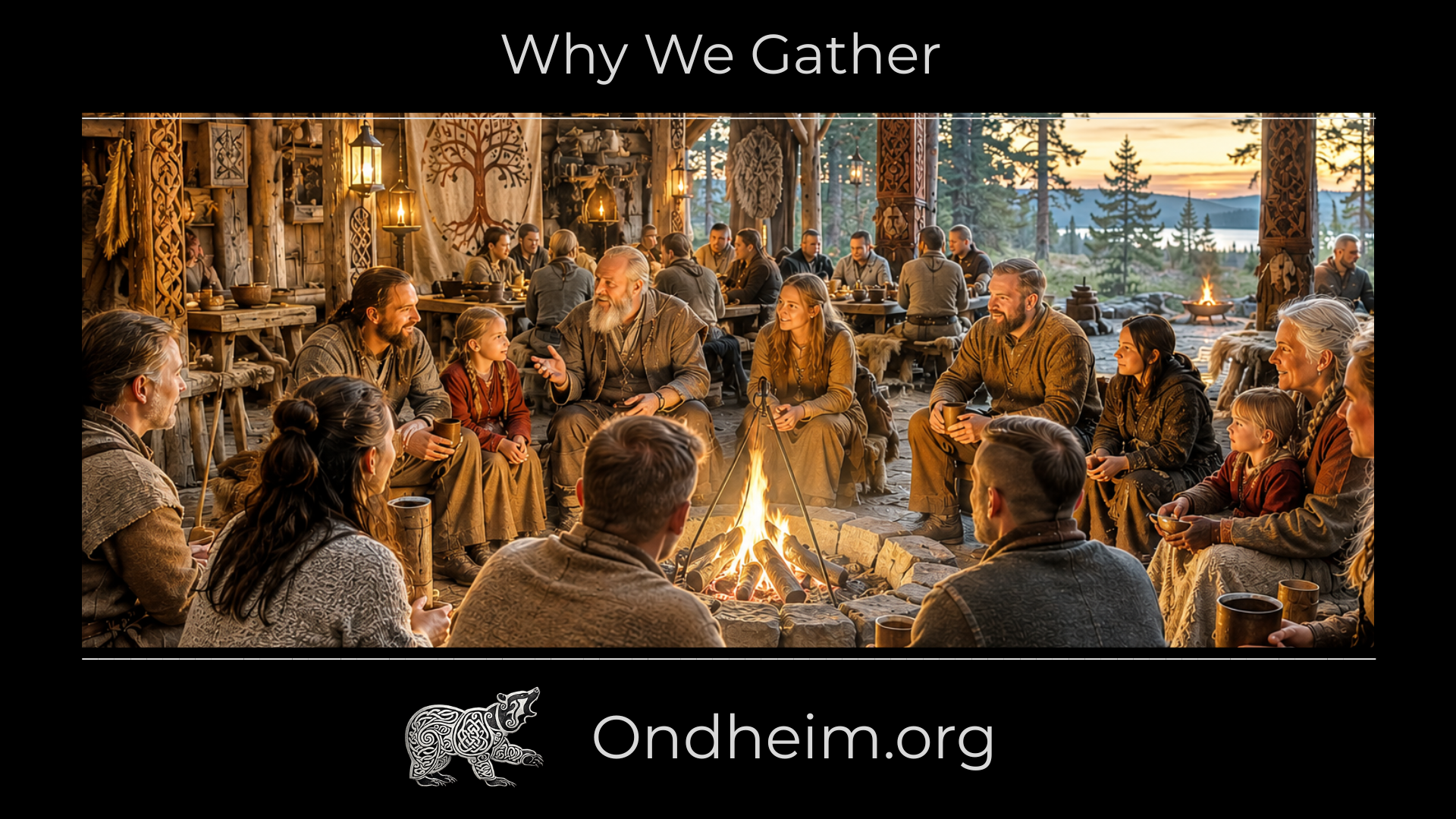
Why We Gather

Modern people live surrounded by constant communication, yet many have never felt more isolated from the people around them. We move through crowded stores, workplaces, and cities without truly knowing our neighbors. Families often eat separately. Friends speak through screens more often than across tables. Entire communities form and dissolve without leaving lasting obligations behind. Many people no longer belong to anything that consistently asks responsibility, participation, sacrifice, or continuity from them.

The modern world offers endless interaction, but very little rootedness.

For most of human history, human beings did not live this way. People survived through tribes, households, villages, halls, assemblies, and tightly bound communities where repeated gathering was not optional social entertainment, but part of the structure that allowed a people to endure across generations. Meals were shared. Labor was shared. Rituals were shared. Stories, grief, celebration, hardship, and victory were carried collectively because survival itself depended heavily upon cooperation and continuity within the group.

A person understood who they were partly because they understood where they belonged.

Gathering therefore served practical and civilizational functions within ancestral societies. Through repeated communal meals, seasonal feasts, assemblies, rituals, and shared labor, communities transmitted memory, practical knowledge, obligation, custom, law, and identity across generations. Children learned how adults behaved. Elders remained connected to the life of the folk. Reputation formed publicly through repeated interaction. Trust developed gradually through visible conduct over time.

This pattern appears clearly throughout surviving Germanic material. In Beowulf, the hall is not important merely as architecture or scenery. What matters is what takes place there among the gathered people themselves. Warriors, leaders, households, and guests gather repeatedly to share food, exchange gifts, speak publicly, remember deeds, establish obligation, and reinforce social bonds through witnessed participation within the community.

The poem preserves recognizable patterns of communal life in which gathering together reinforced continuity and social cohesion. Speech occurred before witnesses. Reputation formed publicly. Stories preserved memory. Obligation was strengthened through repeated participation among the folk.

Modern Heathen gatherings often draw inspiration from these preserved patterns of communal life. Not because modern people imagine themselves literally recreating the world of Beowulf, but because the poem preserves recognizable examples of how communal gathering, witnessed speech, storytelling, ritual drinking, and repeated participation helped maintain continuity among a people over time.

The same principle appears historically in assemblies and þing gatherings throughout the Germanic world. People did not gather solely because it felt emotionally fulfilling to do so. Communities gathered because law, dispute resolution, alliance, trade, ritual obligation, seasonal observance, and social continuity required repeated physical participation among the people themselves.

A society cannot maintain continuity when its members exist only as isolated individuals detached from one another.

Modern society has weakened many of the older structures that once reinforced repeated communal participation. People move constantly, work in isolation, communicate digitally rather than physically, and build relationships that can disappear overnight. Convenience increasingly replaces continuity. Consumption increasingly replaces participation. Many modern gatherings revolve around distraction rather than contribution, and many people gradually become observers of life rather than active participants within enduring communities.

People watch constantly, but often build very little together.

The result is a growing sense of rootlessness. Many people hunger for belonging while simultaneously resisting the obligations that meaningful belonging requires. They desire connection without sacrifice, acceptance without accountability, and identity without participation. Yet real community has never functioned that way.

A meaningful gathering is not simply a group of people occupying the same physical location temporarily. It develops gradually through consistency, contribution, mutual obligation, repeated interaction, and shared experience carried across time. Trust is not declared instantly into existence. It forms slowly through reliability, visible conduct, and continued participation within the life of the group itself.

This is one reason ritual and tradition matter so deeply within enduring communities.

Ritual creates repeated actions filled with shared meaning. Traditions connect the living not only to one another, but also to those who came before them and those who will inherit what is preserved afterward. Seasonal holy tides, shared meals, gatherings around fires, ancestor remembrance, storytelling, ritual drinking, music, and repeated communal observance all help reinforce forms of continuity that modern life often neglects or fragments.

These practices are not simply exercises in nostalgia.

They answer longstanding human needs tied directly to memory, continuity, obligation, and social rootedness.

Over time, repeated gathering changes people. Relationships deepen. Shared memories accumulate. Children grow into adults within the presence of familiar faces. Elders pass on stories, warnings, skills, and expectations shaped through lived experience. Grief is carried collectively rather than privately. Obligations become real because they are repeatedly witnessed by others who remain present across years rather than moments.

Human beings leave parts of themselves behind in communities where life is lived honestly together over long periods of time.

This continuity matters because a people without shared memory eventually loses coherence. Without repeated gathering, stories disappear, obligations weaken, customs fade, and identity slowly fragments into isolated individual experience detached from larger continuity.

Repeated gathering helps prevent this fragmentation by reinforcing memory through participation itself.

Over time, people begin understanding themselves not merely as isolated individuals pursuing personal fulfillment, but as members of something extending backward through earlier generations and forward toward those who will eventually inherit what the present generation preserves or neglects.

This is one reason gathering carries meaning deeper than social convenience alone.

Gathering reminds people that they are not alone in the world. It teaches responsibility toward others. It allows wisdom, memory, and expectation to move between generations. It transforms strangers into companions and, over time, companions into kin through repeated participation, obligation, and shared experience.

A culture survives when its people continue gathering together in meaningful ways across time.

In an age increasingly defined by fragmentation, distraction, impermanence, and shallow connection, the deliberate act of gathering regularly with intention may remain one of the most important things a people can still do to preserve continuity, memory, and human rootedness across generations.

— William Lord
Ondheim Theodish Fellowship
Ondheim.org

Frith defines the boundary, oaths bind the word, kin carry obligation, and the hall holds witness and memory. The shape of obligation gives these structure, and through symbel they are spoken into wyrd and given force.

For additional primary sources and public-domain texts related to kinship, obligation, feud, and Germanic social structure, see our Links page.

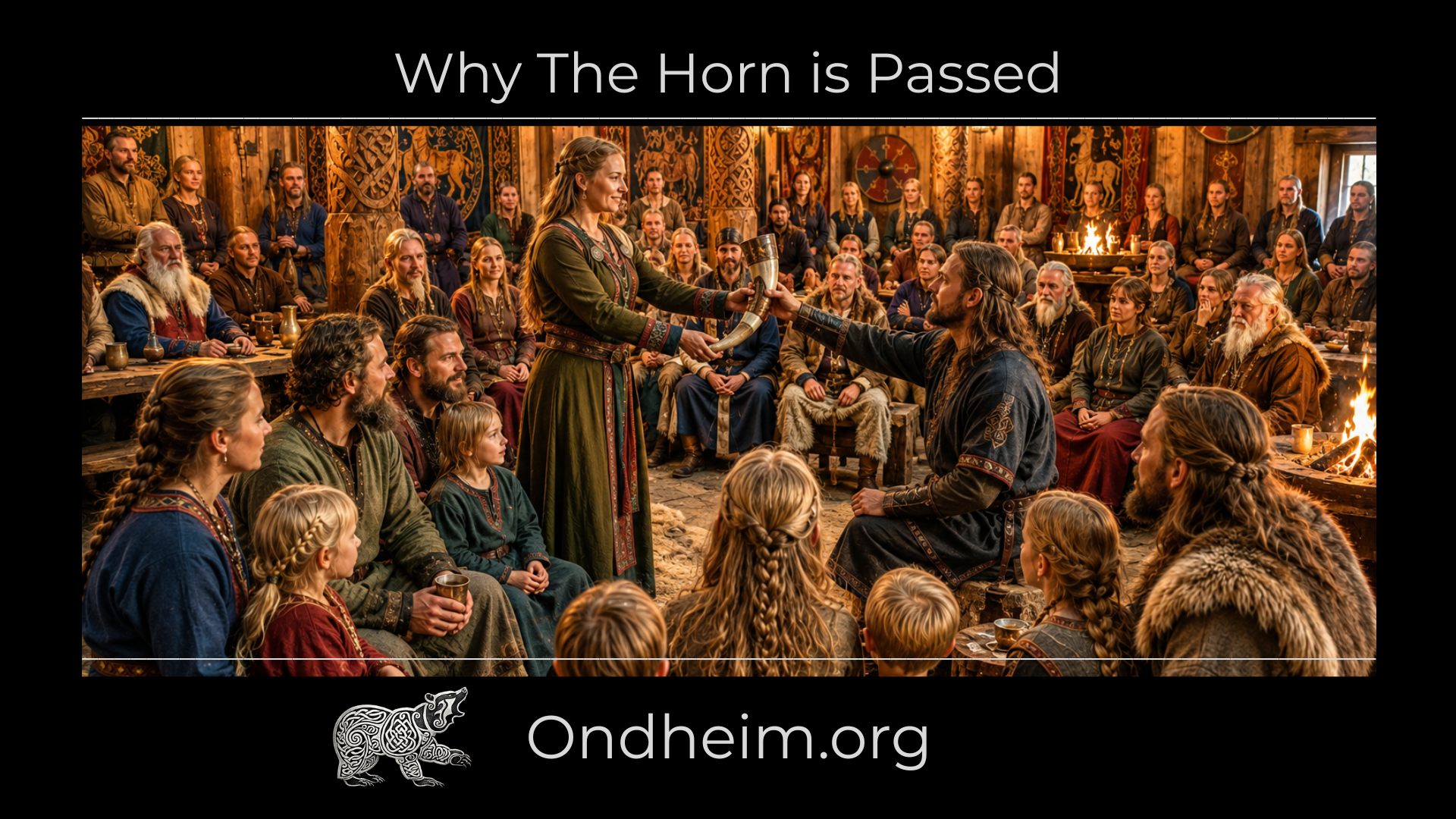
Why the Horn Is Passed

Why the Horn Is Passed

Speech, Witness, Frith, and the Continuity of the Folk

Modern speech is often careless.

Words are thrown outward constantly through reaction, argument, impulse, distraction, and performance. Most are forgotten almost immediately because modern life rarely expects speech to carry lasting consequence. Promises are made emotionally and abandoned easily. Opinions shift by the hour. People speak constantly without expecting their words to remain socially binding afterward.

The older traditions approached speech very differently.

Within Norse and broader Germanic societies, words carried real weight because communities depended heavily upon memory, reputation, obligation, and witnessed conduct. A boast invited future judgment. A promise established expectation. An oath bound the speaker to future action before those who would later remember whether those words had ultimately been carried through.

This is one reason formal speaking rituals mattered so deeply within the older world.

And this is why the horn was passed.

To modern eyes, the passing of the horn may appear simple: a ceremonial drinking custom, a social ritual, or little more than inherited tradition preserved through repetition. Yet beneath the outward act lies a sophisticated social structure designed to regulate speech, preserve memory, and maintain frith within the gathered folk.

Within symbel, only one person holds the horn at a time while the others listen. This immediately changes the nature of speech itself. Conversation slows down. Words become more deliberate. Silence gains importance because the structure requires attention rather than interruption. The gathered folk become participants in shared witness rather than isolated individuals speaking over one another.

The old traditions understood that speech spoken publicly before witnesses carries different consequence than words spoken carelessly into chaos.

As the horn moves through the hall, memory and obligation move with it.

This pattern appears repeatedly throughout the older Germanic world. In Beowulf, the cup-bearing queen Wealhþeow moves through the hall carrying the mead cup among gathered warriors and leaders. Speech, boasting, reputation, gift-giving, loyalty, and public obligation all unfold within this ritualized communal setting. Men do not merely speak privately for themselves. Their words are witnessed openly before the hall.

The hall itself becomes a place where reputation is formed socially through remembered conduct.

This matters because the older worldview understood speech as part of relationship rather than isolated self-expression. An oath sworn before the folk could not simply be withdrawn later because feelings had changed. A boast invited future testing. A declaration placed reputation at risk before witnesses who would later remember whether the speaker ultimately proved worthy of what had been spoken.

The structure of the ritual therefore binds speech to consequence.

This is one reason symbel carried such gravity within many Heathen traditions. The ritual created structured space where people could speak memory, oath, boast, gratitude, grief, praise, and obligation within a communal setting where those words would continue living afterward through witness and memory.

Without structure, strong emotion often becomes destructive.

The older traditions understood this clearly. Symbel was never meant to eliminate intensity or suppress difficult truths. Men might boast boldly. Oaths might be sworn. Ancestors might be remembered through grief, pride, or longing. Old conflicts and future ambitions could both rise openly before the gathered folk.

The structure existed so these powerful emotions could be expressed without destroying frith itself.

Frith is not merely silence. It is not passive peace, nor the absence of tension or disagreement. Frith exists where trust, obligation, responsibility, and right relationship are actively maintained within the boundary of the folk.

Ordered speech helps preserve that boundary because witness creates accountability and memory preserves consequence. The ritual structure allows truth, emotion, ambition, grief, and obligation to be expressed while still maintaining social cohesion.

The traditions also preserve examples of what happens when restraint breaks down. In Lokasenna, Loki enters the hall and unleashes accusation, insult, humiliation, and social destabilization against the gathered Gods themselves. The poem demonstrates both the immense power of speech within communal ritual space and the danger created when frith collapses beneath hostility and unchecked contempt.

The older traditions understood that speech could either strengthen the boundary or fracture it.

This is one reason ritual structure mattered.

Outside observers noticed similar patterns among Germanic peoples as well. In Germania, Tacitus describes communal drinking gatherings and councils where important matters were discussed publicly among the assembled folk. Though writing as a Roman outsider observing cultures not fully his own, his account still reflects the central role that witnessed speech, communal deliberation, and ritualized gathering played within early Germanic society.

Within many Theodish traditions, the passing of the horn itself is often carried out by a female horn bearer. To modern ears, this is sometimes misunderstood immediately through simplistic assumptions about dominance, submission, or rigid gender expectation. The older understanding is more subtle than this.

The horn bearer is not merely serving drink. She maintains the continuity and ordered flow of the ritual itself.

As the horn moves steadily through the folk from speaker to speaker and from oath to oath, the ritual maintains cohesion within the gathering. This reflects an older understanding that communities endure not merely through courage, force, or confrontation alone, but through the continued maintenance of relationship within the boundary.

A hall where conflict endlessly escalates eventually collapses. A tribe where resentment grows unchecked fractures over time. A gathering where speech becomes chaos cannot maintain continuity.

The preservation of frith therefore carried enormous importance.

Many people recognize this instinctively long before encountering formal ritual. A frightened child often calms differently in the presence of a mother. Her voice steadies panic. Her presence restores emotional balance. Even grown men who may answer aggression with greater aggression often respond differently when a respected woman steps between conflict and escalation.

This is not weakness. It is another form of social strength.

The older traditions understood that communities require more than courage and confrontation alone. They also require those capable of preserving cohesion when pride, anger, grief, or fear threaten to fracture the boundary holding the folk together.

The role of the horn bearer reflects this symbolically within the ritual structure itself.

And within symbel, something else often happens as well. As stories are spoken aloud and memory begins circulating through the hall, the distance between past and present can begin to feel less absolute for those gathered there.

Many people who have lost parents, grandparents, or respected elders recognize this experience immediately. During hardship or important decision, their voices sometimes return within memory with surprising clarity. A father’s warning resurfaces during ordeal. A mother’s comfort returns during grief, fear, or uncertainty. Advice that once seemed ordinary suddenly carries greater meaning once life creates the experience necessary to understand it fully.

The dead remain physically absent, yet they continue influencing the living through memory, inherited wisdom, example, tradition, and the relationships they helped shape within the folk itself.

Symbel creates a setting where this continuity becomes emotionally present in a direct and communal way. As the horn moves steadily through the gathered folk, stories are repeated, ancestors are recalled, oaths are witnessed, and younger generations hear the words and experiences carried forward by those who came before them.

For a time, the gathering no longer feels isolated within the present moment alone. The folk become conscious of themselves as part of something extending backward through earlier generations and forward toward those who will eventually inherit what is preserved, taught, and remembered.

This is one reason the ritual carries such emotional gravity for many Heathens.

The folk does not exist only within the present moment. It stretches backward through ancestors and forward through descendants yet unborn. Memory, speech, reputation, obligation, and story bind generations together across time.

That continuity survives only where the bonds of the folk are deliberately maintained.

It depends upon right good will.

The gathered folk must approach one another with respect, patience, responsibility, accountability, and willingness to interpret one another honestly within the boundary.

Without this, symbel collapses into ego, performance, hostility, or social competition.

The ritual only functions where the folk themselves willingly uphold the obligations necessary for frith to endure.

This is why right good will mattered so deeply within Theodish understanding. It does not remove accountability, require agreement in all things, or demand blindness toward wrongdoing. It means approaching one another first from the assumption that the bonds of the folk are worth preserving unless proven otherwise.

Without this, trust decays.

Without trust, witness loses meaning.

Without witness, speech becomes empty.

As the horn continues moving through the gathered folk, the ritual reinforces memory, accountability, and continuity simultaneously. Ancestors remain present through story and remembrance. Oaths become socially binding through witness. Reputation forms through words later measured against action. In this way, the ritual helps preserve frith not only within the moment itself, but across generations.

Long after those gathered in the hall are themselves gone, the words, lessons, examples, and obligations carried there may still continue shaping the folk that follows after them.

The continuity of the folk does not survive automatically. Each generation must deliberately choose to preserve it through remembrance, teaching, ritual participation, and the continued maintenance of relationship within the community itself.

The horn therefore becomes far more than a ritual object or drinking vessel. It serves as one of the mechanisms through which memory, obligation, witness, and continuity remain living realities within the folk rather than fading into abstraction or forgetting.

Through the passing of the horn, the living remain connected to one another, to those who came before, and to those who will one day inherit what the present generation chooses to preserve.

— William Lord
Ondheim Theodish Fellowship
Ondheim.org

Frith defines the boundary, oaths bind the word, kin carry obligation, and the hall holds witness and memory. The shape of obligation gives these structure, and through symbel they are spoken into wyrd and given force.

For additional primary sources and public-domain texts related to kinship, obligation, feud, and Germanic social structure, see our Links page.

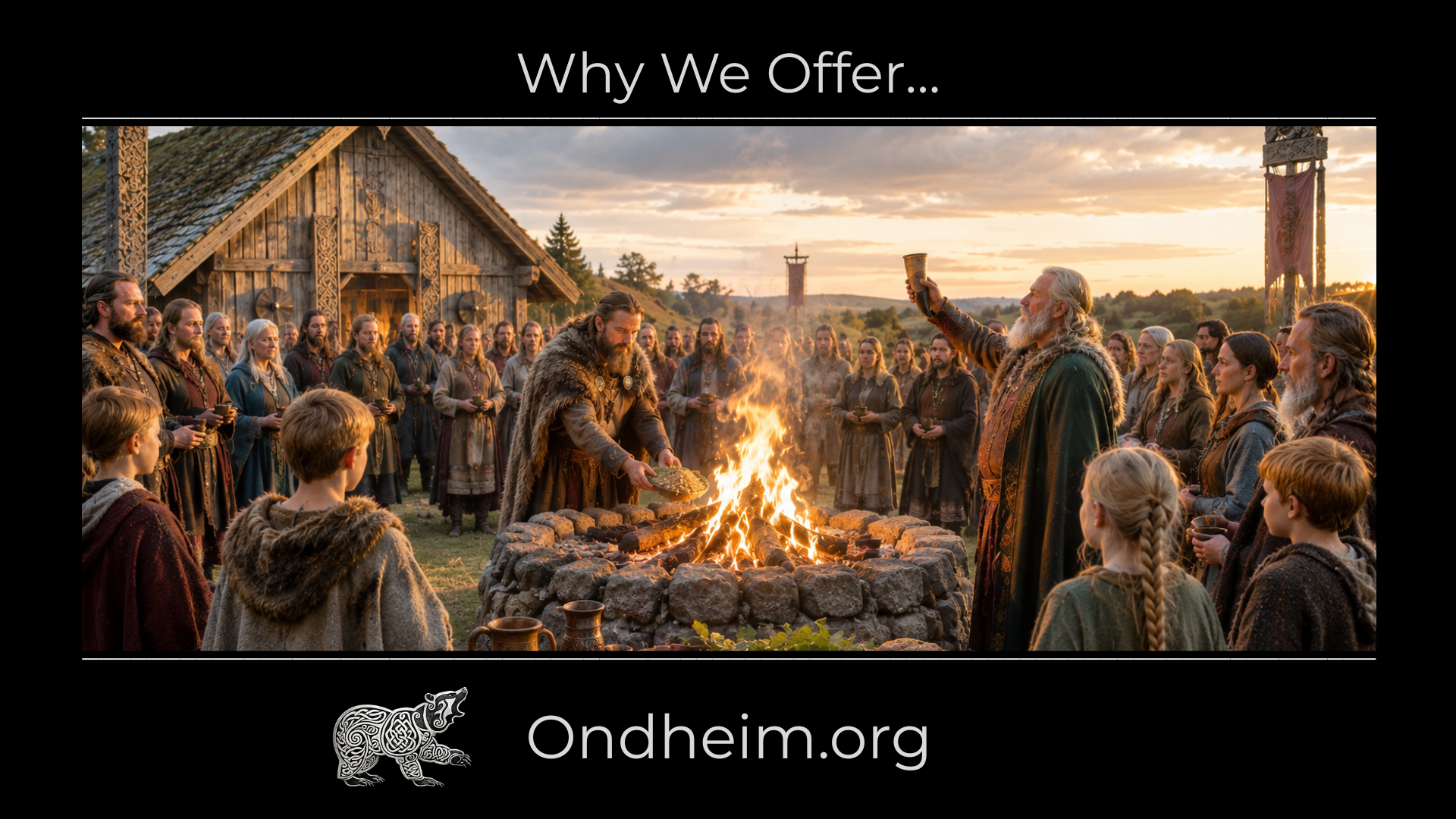
Why We Offer


Gift, Gratitude, and Right Relationship with the Holy Powers

The surviving Norse sources repeatedly preserve the idea that relationships are maintained through reciprocity. In Hávamál, friendship itself is described as something strengthened through exchange, remembrance, and continued participation rather than passive sentiment alone. One well-known passage advises:

“With gifts should friends gladden each other…”

The line is simple, but it reflects a much broader worldview. Relationships were not expected to maintain themselves automatically. Bonds between people required effort, consistency, mutual obligation, and visible acts of participation over time.

This same logic shaped the relationship between the folk and the Holy Powers.

Modern people often misunderstand offering because they approach it through assumptions inherited from very different religious and cultural frameworks. Some dismiss offering entirely as primitive superstition, imagining it as an attempt to bribe unseen forces through sacrifice or ritual payment. Others reduce it to little more than symbolism or personal psychology, treating ritual as a purely internal exercise with no relationship beyond the self.

The older worldview understood offering differently.

Offering was not primarily about purchasing favor, nor was it empty performance. It existed within a broader structure of maintained relationship between the folk and the powers surrounding them.

The Norse world did not view human beings as isolated or self-created. Survival depended upon layers of interdependence: family, tribe, land, weather, inherited knowledge, social obligation, and the labor of previous generations. A person inherited language, custom, protection, practical skill, memory, and social standing long before contributing anything of his own. Even the strongest individual still depended upon forces outside himself.

The Gods therefore were not understood merely as abstract symbols existing only within human imagination. They were viewed as real powers connected to the forces shaping existence itself: storm, fertility, wisdom, death, luck, craft, social order, victory, and the unseen patterns surrounding the lives of the folk.

To live well required maintaining right relationship not only within the human community, but within the larger structure of existence itself.

Offering existed inside that framework.

The surviving traditions preserve sacrifice and ritual exchange not as isolated acts of desperation, but as recurring acts that reinforced connection between the human and sacred worlds. Even outside observers such as Adam of Bremen recorded the centrality of sacrifice, feast, and communal ritual within Scandinavian religious life, though his perspective was that of a Christian outsider looking upon customs he did not fully share.

This is one reason the old phrase “a gift for a gift” carried such importance.

Modern readers sometimes misunderstand the phrase as though the Gods were imagined as machines dispensing blessings in direct exchange for ritual payment. That was never the older understanding. Sacrifice did not compel divine action, nor did ritual place the Holy Powers in debt to mankind.

What mattered was the relationship itself.

A simple offering given consistently and sincerely could carry greater meaning than extravagant public display performed without genuine reverence behind it. The act acknowledged dependence, gratitude, continuity, and participation within a greater order that did not begin with the individual alone.

This is also why offering was rarely separated entirely from communal life within the older traditions. Feasts, blóts, shared drink, seasonal rites, oath-taking, sacrifice, and remembrance existed within the same larger structure of maintained relationship. The folk gathered before the Gods together. They offered together, feasted together, and renewed the bonds connecting tribe, ancestors, land, and Holy Powers.

Offering therefore was never merely about obtaining things.

It was about maintaining alignment between the folk and the greater forces surrounding them.

This understanding also explains why neglect carried danger within the older worldview. Relationships ignored eventually weaken. This is true between friends, between family members, between lord and follower, between the living and the dead, and between the folk and the Gods themselves. What is no longer honored slowly fades from memory. What is no longer maintained loses strength within the life of the community.

The older traditions understood that continuity requires active participation.

Offering became one expression of that participation.

This is also why gratitude carried such importance. Modern culture often encourages people to imagine themselves entirely self-made, independent, and detached from obligation beyond personal desire. The older worldview regarded this as illusion. Every life rests upon inherited foundations: the labor of ancestors, the protection of community, the gifts of the land, and forces beyond human control.

Offering acknowledged this reality openly.

At the same time, offering was never meant to become hollow routine or performative spirituality. Ritual separated entirely from relationship eventually loses much of its meaning. The outward act matters, but the sincerity and consistency beneath the act matter more.

This is one reason continuity carried such importance within many older ritual structures. Relationship is not built through isolated moments alone. It is maintained over time through remembrance, gathering, sacrifice, feast, gratitude, and continued participation in the bonds connecting the folk to the Holy Powers.

The offering itself therefore becomes more than the object placed upon the altar or cast into the fire.

It becomes recognition of place within a larger order of existence.

The folk give because they recognize they have already received.

And through continued offering, relationship remains living rather than forgotten.

— William Lord
Ondheim Theodish Fellowship
Ondheim.org

Frith defines the boundary, oaths bind the word, kin carry obligation, and the hall holds witness and memory. The shape of obligation gives these structure, and through symbel they are spoken into wyrd and given force.

For additional primary sources and public-domain texts related to kinship, obligation, feud, and Germanic social structure, see our Links page.

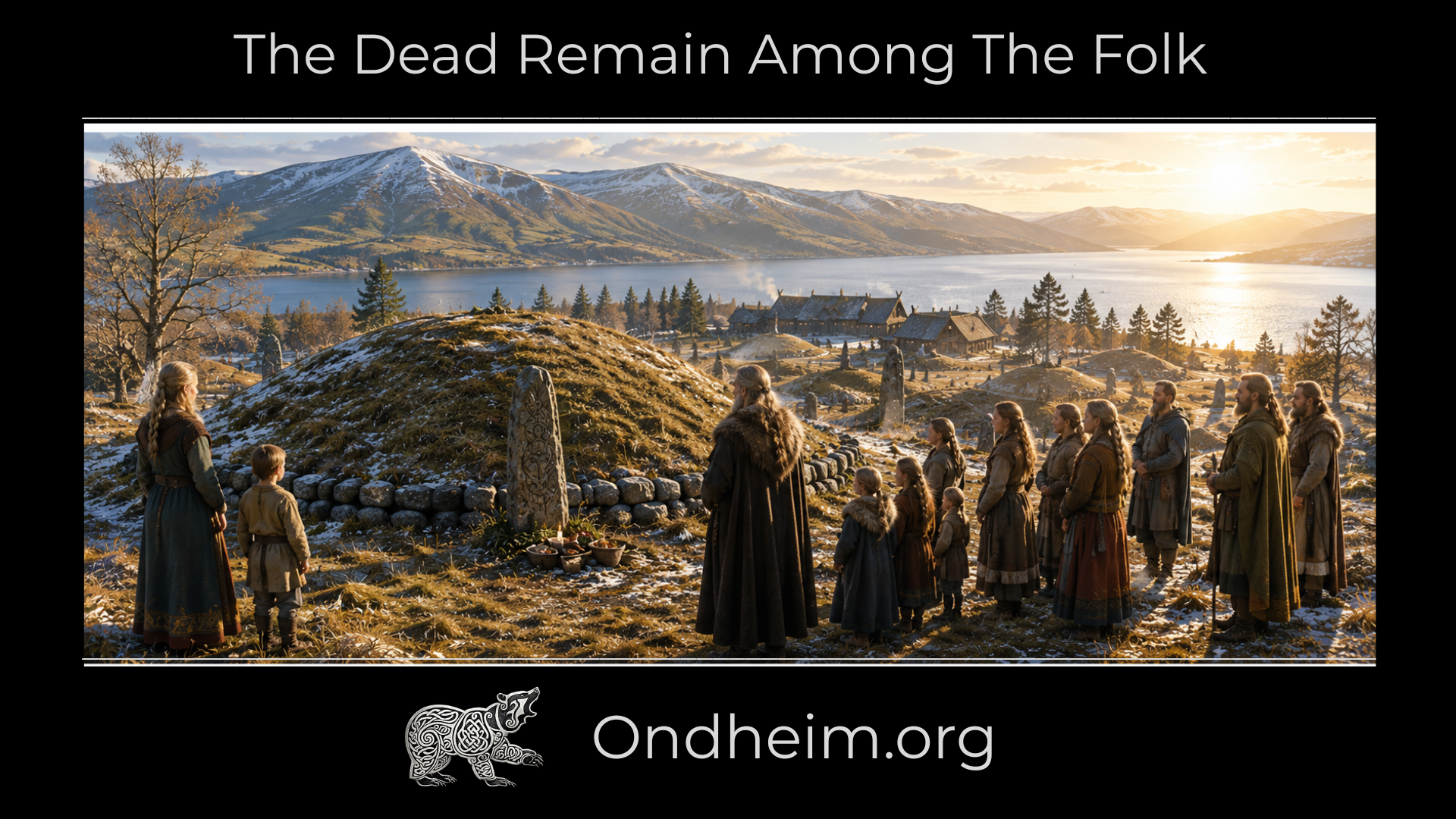
The Dead Remain Among the Folk

The Dead Remain Among the Folk

Death, Ancestors, and the Continuity of the Folk

Modern people often assume that Hel and Hell represent essentially the same idea. The similarity in language makes the conclusion feel immediate and obvious. Yet much of this confusion emerged not from the surviving Norse sources themselves, but from centuries of Christian influence gradually reshaping older Germanic words and concepts through later theological frameworks.

The two ideas emerge from very different worldviews.

Within much of Christian tradition, Hell is commonly understood primarily as a realm of punishment, condemnation, separation from God, or eternal suffering for the wicked. The older Norse understanding of Hel carries a very different atmosphere altogether.

The surviving sources present Hel primarily as the realm of the dead ruled by Hel, daughter of Loki, as described in Gylfaginning. Those who die through sickness, age, or ordinary causes are often said to go there. Even Baldr himself, among the most beloved of the Gods, dwells there after death. That fact alone reveals how different the older understanding actually was.

Hel is not presented as a Satan-like enemy standing in direct opposition to the Gods. Nor is the realm described primarily as punishment for moral failure. The atmosphere surrounding Hel is solemn, grave-like, distant, and deeply associated with mortality itself. In many ways, it resembles older Indo-European underworld traditions far more closely than later Christian visions of eternal damnation.

Yet the greatest difference between the worldviews may not lie primarily in the geography of the afterlife itself.

It lies in how the living understand the dead.

Modern culture often imagines death as sharp separation. The individual departs completely from the world of the living and exists elsewhere in isolation. The older Heathen worldview appears far less individualistic than this.

A person was not understood primarily as an isolated spiritual being standing alone before the cosmos. Identity existed within kinship, ancestry, memory, oath, inherited worth, obligation, and the continuing life of the folk itself.

The dead therefore did not simply vanish from the life of the community.

They remained woven into the continuity of family, memory, reputation, inheritance, and ancestral presence carried forward by the living.

This understanding appears repeatedly throughout the surviving traditions:
ancestor veneration,
burial mound customs,
naming traditions,
inherited luck and hamingja,
reputation wisdom,
and the continuing importance of remembered deeds.

Again and again, the surviving material returns to the same underlying reality: memory preserves continuity.

In Hávamál, the reader is reminded:

“Cattle die,
Kinsmen die,
You yourself shall also die.
But the fame of one who has earned it
Never dies.”

This was not merely poetic comfort.

It reflected a worldview in which death did not fully sever a person from the continuing life of the folk.

A name spoken again within the family line.
A child carrying the temperament or features of an ancestor long buried.
Stories repeated around the hearth across generations.
Inherited skills, habits, strengths, obligations, and expectations moving through descendants.
The honored dead remembered in feast, ritual, and seasonal observance.

The boundary between living and dead was never understood as completely closed.

This is one reason modern attempts to force Norse belief into rigid afterlife systems often feel incomplete. The surviving lore does not present one singular universal doctrine governing every soul after death. Instead, the traditions preserve multiple overlapping possibilities:
Hel,
Valhalla,
Fólkvangr,
burial mound traditions,
ancestor presence,
and continuing ties between the living and the dead.

The older worldview leaves room for uncertainty and mystery rather than imposing rigid theological systemization.

Modern people often hunger for total certainty:
a singular Heaven,
a singular Hell,
a perfectly organized afterlife structure,
a universal moral sorting system.

The surviving Heathen sources rarely provide this kind of complete doctrinal structure.

Instead, the traditions repeatedly emphasize continuity, kinship, relationship, memory, inherited worth, and the enduring life of the people across generations.

This also helps explain why reputation carried such enormous importance within Norse society. A person’s deeds did not end entirely with death. Their conduct continued shaping descendants, family standing, inherited reputation, memory within the folk, and the burdens or strengths carried forward by those connected to them.

The dead continued influencing the living through consequence and remembrance.

This understanding appears connected to broader Heathen concepts sometimes described today through terms like ancestral soul, folk soul, inherited luck, or spiritual continuity. The surviving sources themselves do not present a perfectly unified doctrine of the soul in the way later religions often attempted to systemize theology. Norse belief remained far less centralized and doctrinally rigid.

Yet the recurring patterns throughout the surviving material strongly suggest that Germanic peoples understood identity itself as deeply interconnected through kinship, ancestry, inherited obligation, memory, and continuity across generations.

A person existed within a living chain extending both backward and forward through time.

They were shaped by ancestors long dead while simultaneously carrying influence toward descendants not yet born.

This understanding changes the emotional meaning of death considerably.

Hel is not romanticized into paradise. The surviving descriptions remain solemn and closely tied to mortality, stillness, distance, and the unavoidable reality of death itself. Yet neither is Hel presented primarily as eternal torture or hopeless condemnation.

It is better understood as one part of a larger relationship between the living and the dead.

What remains most consistent throughout the surviving traditions is not a detailed map of the afterlife, but the continuing importance of ancestral continuity itself.

The dead endure through descendants, memory, inherited worth, story, reputation, and the ongoing life of the folk.

The living carry the dead forward.

And through that continuity, the folk themselves remain unbroken across generations.

— William Lord
Ondheim Theodish Fellowship
Ondheim.org

Frith defines the boundary, oaths bind the word, kin carry obligation, and the hall holds witness and memory. The shape of obligation gives these structure, and through symbel they are spoken into wyrd and given force.

For additional primary sources and public-domain texts related to kinship, obligation, feud, and Germanic social structure, see our Links page.