Modern culture has it backwards. It measures importance by volume — who’s loudest, who’s most visible, who got the most attention this week. Recognition first, substance if there’s time.
The old way ran the order in reverse. Achievement first. Recognition followed — if it followed at all — through witnessed conduct over time.
Worth wasn’t claimed loudly. It was built slowly, the way you build anything that has to hold weight: stone by stone, act by act, across years.
There’s a distinction worth making here, because reputation and worth aren’t the same thing, though they’re related. Reputation is what others remember about your conduct. Worth is deeper — it’s the capacity underneath: the ability to act consistently, carry obligation, endure hardship, and contribute something real to the folk. Reputation is how you’re perceived. Worth is what you’ve become through sustained effort.
The Hávamál understands formation, not instant transformation. Wisdom isn’t inherited and it isn’t downloaded — it’s cultivated through restraint, judgment, experience, and discipline.
“Cattle die, and kinsmen die, and so one dies one’s self; one thing I know that never dies, the fame of a dead man’s deeds.” (Hávamál 78)
What survives you isn’t your self-image. It’s the deeds, remembered by people who watched.
The sagas bear this out across centuries. Njáll (Njáls saga) isn’t remembered for physical prowess — he’s remembered for wisdom, restraint, counsel, judgment. His worth shows in how he thinks and advises, not in how loudly he announces himself. Egill’s (Egils saga) reputation wasn’t built in a single dramatic moment either. It came from decades of demonstrated skill, courage, intelligence, and force of personality — sustained, under pressure, over a lifetime.
That’s the pattern. Worth accumulates through pattern, not isolated event.
A man might fight bravely once. The question is whether he can be trusted repeatedly. He might speak wisely in a moment — can he counsel consistently across years? He might fulfill one oath — can he carry obligation through hardship, loss, and temptation? Worth is the answer to those questions, given in the form of a lived life.
This is why the old way put such weight on endurance. A single brave act gets attention. Worth requires sustained reliability — showing up the same way, holding the line, doing the work when nobody’s watching and when everybody is.
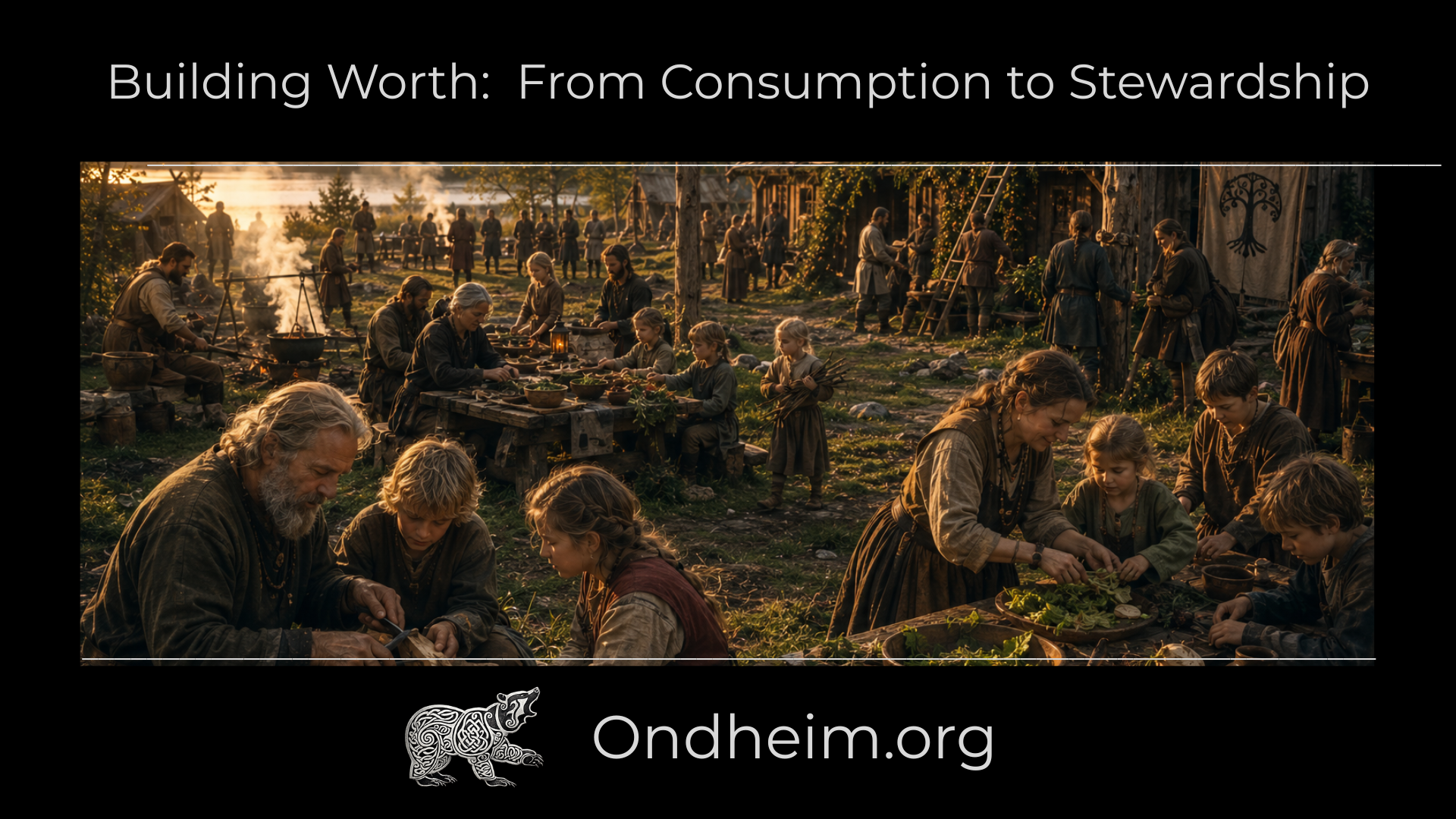
And work itself was part of the formation. Labor wasn’t just economic necessity; it shaped the man. Through work you learned discipline. Through repeated effort, skill. Through sustained contribution, others learned what they could expect from you. A farmer who tended his land faithfully for decades demonstrated reliability. A craftsman who produced consistently demonstrated mastery. A leader who judged fairly across many disputes demonstrated wisdom. Worth emerged through contribution, not declaration.
Boasting is where this gets teeth. In the old way, a boast wasn’t harmless self-promotion — it was a public claim that invited future testing. You put your worth before the judgment of others and accepted the consequences if reality didn’t match. That’s why worth couldn’t be manufactured with words. It had to be proven in deed, because the folk were going to check.
Leadership worked the same way. Authority wasn’t just inherited or seized — it had to be sustained through demonstrated capacity. A chieftain who judged poorly lost influence. A leader who failed to protect his people lost loyalty. A counselor whose advice kept failing lost trust. Worth was the foundation under authority. Without it, position went hollow.
So: build quietly. Act consistently. Fulfill obligation. Endure hardship without complaint. Contribute without demanding recognition. That’s not modesty as performance — it’s the actual mechanics of how worth gets made.
Worth cannot be claimed. It can only be built. And what gets built through sustained effort outlasts every loud proclamation.
Modern people live surrounded by constant communication, yet many have never felt more isolated from the people around them. We move through crowded stores, workplaces, and cities without truly knowing our neighbors. Families often eat separately. Friends speak through screens more often than across tables. Entire communities form and dissolve without leaving lasting obligations behind. Many people no longer belong to anything that consistently asks responsibility, participation, sacrifice, or continuity from them.
The modern world offers endless interaction, but very little rootedness.
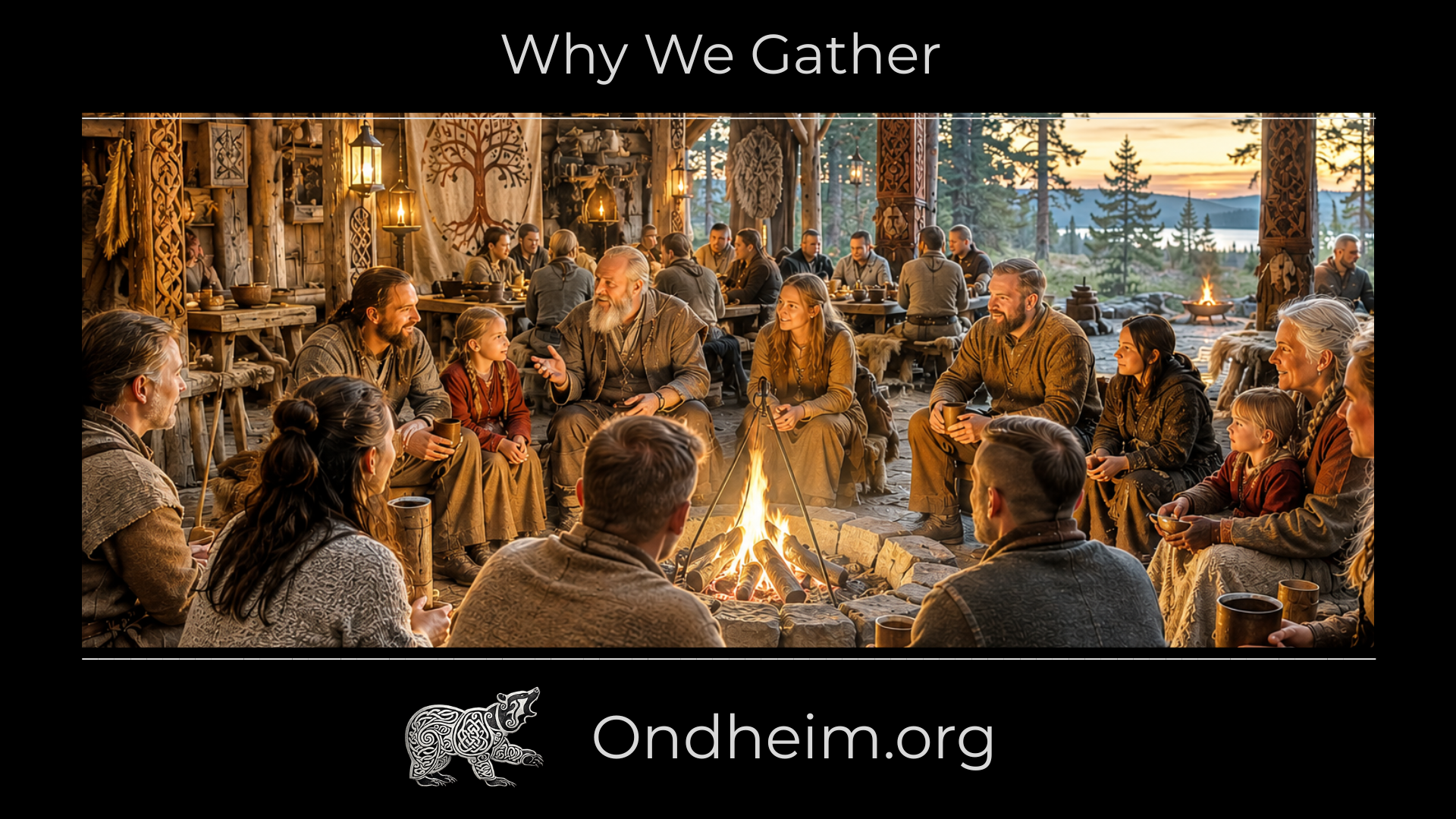
For most of human history, human beings did not live this way. People survived through tribes, households, villages, halls, assemblies, and tightly bound communities where repeated gathering was not optional social entertainment, but part of the structure that allowed a people to endure across generations. Meals were shared. Labor was shared. Rituals were shared. Stories, grief, celebration, hardship, and victory were carried collectively because survival itself depended heavily upon cooperation and continuity within the group.
A person understood who they were partly because they understood where they belonged.
Gathering therefore served practical and civilizational functions within ancestral societies. Through repeated communal meals, seasonal feasts, assemblies, rituals, and shared labor, communities transmitted memory, practical knowledge, obligation, custom, law, and identity across generations. Children learned how adults behaved. Elders remained connected to the life of the folk. Reputation formed publicly through repeated interaction. Trust developed gradually through visible conduct over time.
This pattern appears clearly throughout surviving Germanic material. In Beowulf, the hall is not important merely as architecture or scenery. What matters is what takes place there among the gathered people themselves. Warriors, leaders, households, and guests gather repeatedly to share food, exchange gifts, speak publicly, remember deeds, establish obligation, and reinforce social bonds through witnessed participation within the community.
The poem preserves recognizable patterns of communal life in which gathering together reinforced continuity and social cohesion. Speech occurred before witnesses. Reputation formed publicly. Stories preserved memory. Obligation was strengthened through repeated participation among the folk.
Modern Heathen gatherings often draw inspiration from these preserved patterns of communal life. Not because modern people imagine themselves literally recreating the world of Beowulf, but because the poem preserves recognizable examples of how communal gathering, witnessed speech, storytelling, ritual drinking, and repeated participation helped maintain continuity among a people over time.
The same principle appears historically in assemblies and þing gatherings throughout the Germanic world. People did not gather solely because it felt emotionally fulfilling to do so. Communities gathered because law, dispute resolution, alliance, trade, ritual obligation, seasonal observance, and social continuity required repeated physical participation among the people themselves.
A society cannot maintain continuity when its members exist only as isolated individuals detached from one another.
Modern society has weakened many of the older structures that once reinforced repeated communal participation. People move constantly, work in isolation, communicate digitally rather than physically, and build relationships that can disappear overnight. Convenience increasingly replaces continuity. Consumption increasingly replaces participation. Many modern gatherings revolve around distraction rather than contribution, and many people gradually become observers of life rather than active participants within enduring communities.
People watch constantly, but often build very little together.
The result is a growing sense of rootlessness. Many people hunger for belonging while simultaneously resisting the obligations that meaningful belonging requires. They desire connection without sacrifice, acceptance without accountability, and identity without participation. Yet real community has never functioned that way.
A meaningful gathering is not simply a group of people occupying the same physical location temporarily. It develops gradually through consistency, contribution, mutual obligation, repeated interaction, and shared experience carried across time. Trust is not declared instantly into existence. It forms slowly through reliability, visible conduct, and continued participation within the life of the group itself.
This is one reason ritual and tradition matter so deeply within enduring communities.
Ritual creates repeated actions filled with shared meaning. Traditions connect the living not only to one another, but also to those who came before them and those who will inherit what is preserved afterward. Seasonal holy tides, shared meals, gatherings around fires, ancestor remembrance, storytelling, ritual drinking, music, and repeated communal observance all help reinforce forms of continuity that modern life often neglects or fragments.
These practices are not simply exercises in nostalgia.
They answer longstanding human needs tied directly to memory, continuity, obligation, and social rootedness.
Over time, repeated gathering changes people. Relationships deepen. Shared memories accumulate. Children grow into adults within the presence of familiar faces. Elders pass on stories, warnings, skills, and expectations shaped through lived experience. Grief is carried collectively rather than privately. Obligations become real because they are repeatedly witnessed by others who remain present across years rather than moments.
Human beings leave parts of themselves behind in communities where life is lived honestly together over long periods of time.
This continuity matters because a people without shared memory eventually loses coherence. Without repeated gathering, stories disappear, obligations weaken, customs fade, and identity slowly fragments into isolated individual experience detached from larger continuity.
Repeated gathering helps prevent this fragmentation by reinforcing memory through participation itself.
Over time, people begin understanding themselves not merely as isolated individuals pursuing personal fulfillment, but as members of something extending backward through earlier generations and forward toward those who will eventually inherit what the present generation preserves or neglects.
This is one reason gathering carries meaning deeper than social convenience alone.
Gathering reminds people that they are not alone in the world. It teaches responsibility toward others. It allows wisdom, memory, and expectation to move between generations. It transforms strangers into companions and, over time, companions into kin through repeated participation, obligation, and shared experience.
A culture survives when its people continue gathering together in meaningful ways across time.
In an age increasingly defined by fragmentation, distraction, impermanence, and shallow connection, the deliberate act of gathering regularly with intention may remain one of the most important things a people can still do to preserve continuity, memory, and human rootedness across generations.
— William Lord Ondheim Theodish Fellowship Ondheim.org
Frith defines the boundary, oaths bind the word, kin carry obligation, and the hall holds witness and memory. The shape of obligation gives these structure, and through symbel they are spoken into wyrd and given force.
For additional primary sources and public-domain texts related to kinship, obligation, feud, and Germanic social structure, see our Links page.
People drink now to relax. To celebrate. To escape. Ritual drinking at modern gatherings is social lubrication — a way to loosen up.
The passing of the horn was nothing like that.
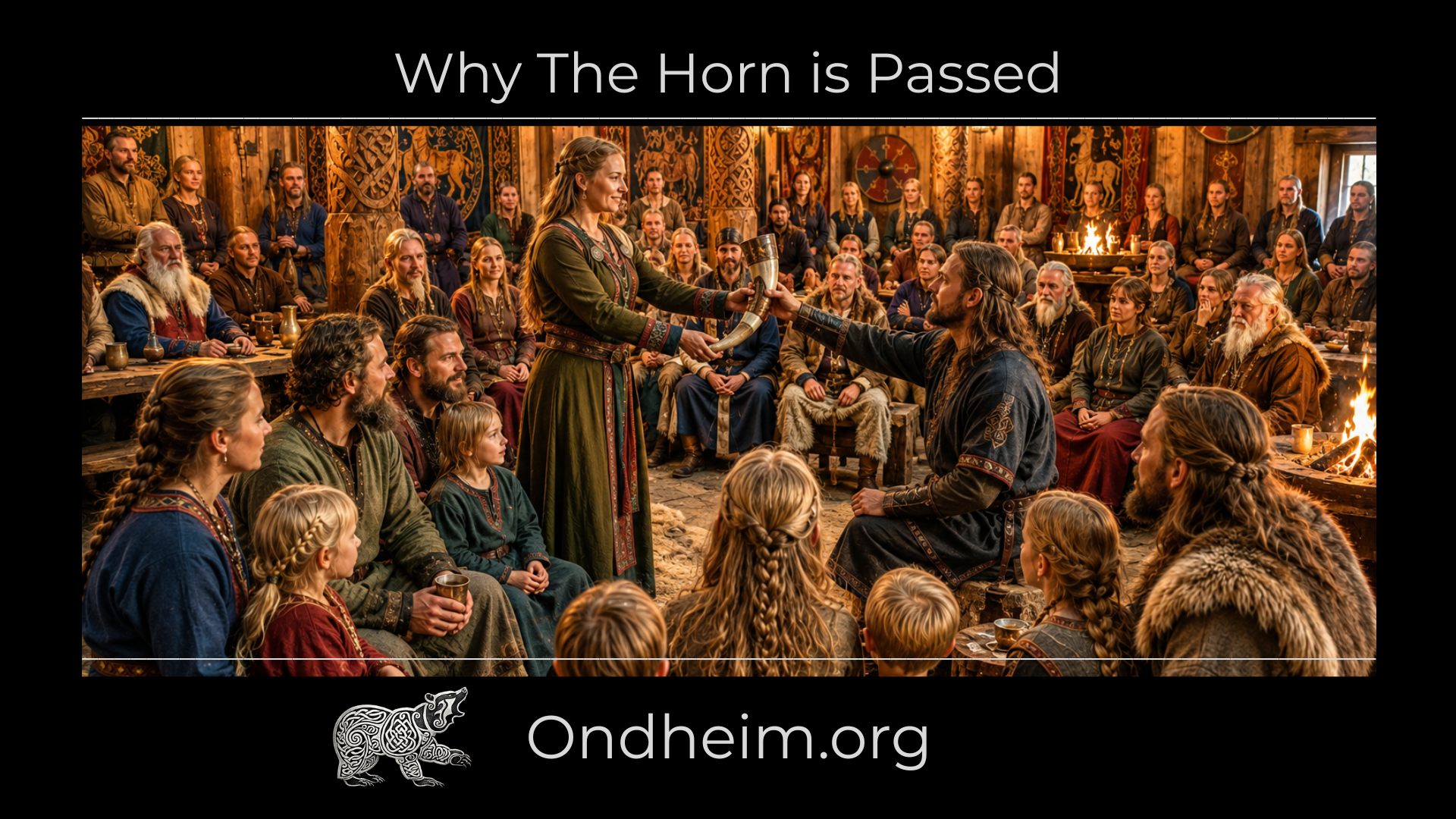
The horn moving hand to hand around the circle wasn’t about drinking. It was a structured ritual act — and through it, speech was witnessed, memory was affirmed, frith was maintained, and the folk held its continuity across time.
The sources show this plainly. In Beowulf, Wealhtheow the queen bears the cup through the hall in sequence, serving each warrior in turn. That’s not casual hospitality. It’s a formal act, and the order matters: to be served first is honor, to be served in turn is inclusion. The passing of the cup maps the social order where everyone can see it.
The sagas show the same pattern. Drinking is almost never just drinking — it accompanies oaths, boasts, toasts, formal declarations. The drink and the speech belong together.
And the Hávamál warns about what happens when the discipline fails (Hávamál 12):
Less good there lies | than most believe
In ale for mortal men;
For the more he drinks | the less does man
Of his mind the mastery hold.
The issue was never the horn. It was what the horn revealed when a man lost control of himself.
When the horn came to you, you drank and you spoke, and the folk listened. That simple structure did several things at once. It created order — each person spoke in turn, nobody drowned out, nobody overlooked. It created witness — what you said was heard by everyone present and couldn’t be denied later. It created accountability — words spoken before the folk carried consequence. It affirmed inclusion — every man who held the horn was confirmed as part of the folk. And it enacted continuity — the horn moving hand to hand, the unbroken chain made visible.
The horn was never just a vessel. It was an instrument of order.
The critical element was witness. Toasts to gods, to ancestors, to the folk. Boasts declared. Oaths sworn. Memory affirmed. All of it spoken while holding the horn, heard by all present. A boast made over the horn created public expectation. An oath sworn over the horn created binding obligation. A toast to the dead affirmed, before witnesses, that the chain remained unbroken.
That’s why the discipline of the horn ran so deep. To speak while holding it was to place your words before the judgment of the community.
The passing of the horn also held frith — the right order of the gathered folk, the condition of things working inside the boundary. Within the hallowed round, ordinary conflicts were set aside. Not resolved — set aside, in honor of the gathered folk and the holy powers. Each person received the horn in turn. Each was honored. No one excluded. The unbroken circle of passing hands showed the unbroken bonds of the folk.
To disrupt the passing — to refuse the horn, to speak out of turn, to break the order — was to break frith itself.
And the continuity was physical. The horn passing from elder to younger, hand to hand, enacted the transmission itself — tradition, obligation, identity, moving across time in a single gesture. Every man who held it stood in a chain reaching back to ancestors and forward to descendants. That’s why the toasts to the dead sat at the center of it. By drinking to those who came before, the living affirmed the chain was unbroken. The dead remembered. Their examples enduring. The folk continuing.
So what does it take to hold the horn rightly? Receive it with honor — it’s the folk affirming you belong. Speak with intention, because words over the horn carry weight. Listen with attention — every man’s speech deserves witness, including yours. Pass it with care, handing the chain to the next man unbroken. Hold frith inside the round — set the conflicts down while the horn moves. And remember what was spoken. You are the witness for others as they are for you.
The passing of the horn was never about drinking. It was how the folk maintained themselves — speech witnessed, accountability created, frith held, continuity enacted, hand to hand to hand.
This much was obvious within the older world. Strength fades. Wealth changes hands. The body weakens and eventually returns to the earth. Even great households and powerful leaders eventually pass from the living world into memory. Yet the surviving Norse and Germanic material repeatedly returns to a deeper question: what remains afterward?
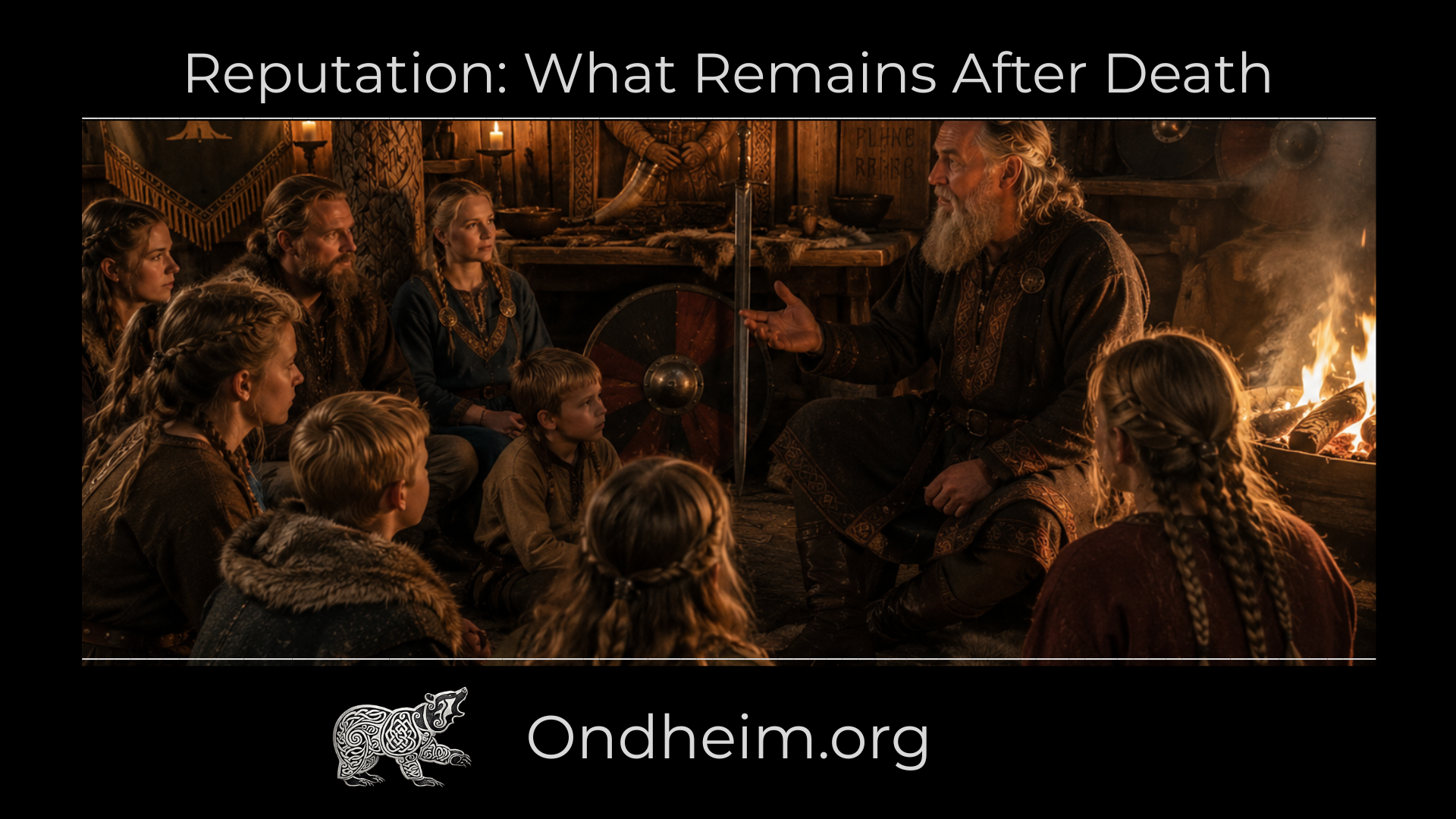
Within the older Heathen worldview, death was never understood as the final measure of a life. What endured was not comfort, self-image, status, or personal intention alone, but the memory of conduct carried forward by the living. A person continued through reputation, descendants, story, obligation, and the continuing consequences left behind through deed.
This is one reason the surviving lore places such emphasis upon reputation.
Not as vanity or shallow public praise, but as the accumulated memory of how a person repeatedly conducted themselves among the folk across time.
In Hávamál, the reader is reminded that all material things eventually perish:
“Cattle die, and kinsmen die, And so one dies one’s self; But I know one thing that never dies: The fame of a dead man’s deeds.”
The point is direct and practical. Wealth fades. The body fails. Even family lines shift across generations. Yet the memory of conduct can continue influencing the living long after death itself. The old traditions therefore treated reputation not as superficial image management, but as part of the enduring social memory of the community.
This reflects an important difference between the older worldview and many modern assumptions about identity. Modern people often define themselves inwardly through emotion, self-perception, personal authenticity, or intention. The older traditions were far more concerned with what a person consistently proved through visible conduct over time.
A man became known through how he carried obligation, whether he upheld his word, how he behaved under hardship, how he treated his own, and whether his conduct strengthened or weakened the people around him.
In this way, reputation represented accumulated witnessed behavior rather than self-definition.
The saga literature preserves this understanding repeatedly. In Njáls saga, even Njáll’s lack of a beard becomes a recurring point of insult aimed not merely at him personally, but at the standing and perceived strength of his household itself. The attacks carry social implications capable of provoking feud, dishonor, and violence because reputation affected not only the individual, but also the standing of the family line and the trust surrounding it within the wider community.
Likewise, in Egil’s Saga, Egil Skallagrímsson remains remembered centuries later not because he lived quietly or comfortably, but because his poetry, loyalties, violence, feuds, intellect, and force of character left enduring weight attached to his name. His reputation survived him because his conduct continued being remembered and spoken about long after the life of the body ended.
The sagas repeatedly preserve this understanding: what a person does among the folk continues echoing after death through memory, descendants, story, obligation, and the continuing consequences of action.
Within the older worldview, reputation and worth were deeply connected, though they were not identical. Worth was earned inwardly through discipline, sacrifice, reliability, courage, restraint, and right conduct. Reputation was how those qualities gradually became visible among the folk through repeated interaction across time.
A person might speak proudly about themselves. They might proclaim honor loudly before others. Yet reputation was never fully self-assigned. It formed gradually through the judgment of those who repeatedly witnessed a person’s conduct under real conditions across years of communal life.
This is one reason reputation could not be manufactured instantly.
A boast might attract attention briefly, but lasting reputation developed slowly through fulfilled obligation, steadiness under pressure, visible reliability, and the repeated carrying of responsibility over time.
The older traditions consistently suggest that isolated moments rarely defined a person completely. What mattered more was the enduring pattern created through repeated conduct. The person who carried burden steadily, honored obligation when it became difficult, and remained dependable through hardship gradually developed a reputation others learned to trust. Likewise, the person who spoke greatly but repeatedly failed in action eventually revealed the true weight of their character.
Within the older worldview, words alone possessed little lasting value without deed supporting them.
This is one reason oaths carried such gravity within Norse and broader Germanic societies. An oath was not casual emotional speech. It was a binding word placed publicly into the future, allowing others to measure the worth of the speaker afterward through whether the promise was ultimately fulfilled.
Reputation forms where word and action repeatedly meet.
A fulfilled oath strengthened trust because it demonstrated reliability under consequence. A broken oath damaged more than personal pride alone. It weakened confidence, frith, and trust not only in the individual, but in the stability of relationship itself.
The old traditions understood that people eventually forget many promises spoken casually in passing. What they remember is whether a person carried what they bound themselves to once hardship arrived.
This is why careless speech was viewed as dangerous. A person who swore endlessly without the discipline or strength to fulfill those words slowly weakened the worth attached to their own name.
Reputation therefore affected far more than the individual alone.
Within tribe, family, and community, frith depends heavily upon trust. Trust depends upon reliability. Reliability repeatedly demonstrated across time gradually becomes reputation. In this way, reputation formed part of the social structure helping communities maintain stability and continuity across generations.
Those whose reputation proved strong were trusted with responsibility, leadership, counsel, and obligation because their conduct repeatedly demonstrated steadiness and dependability. Those whose reputation became uncertain weakened trust around themselves and gradually eroded confidence within the community.
The older traditions therefore treated reputation not as vanity, but as part of the framework allowing lasting social order to endure.
A reliable person strengthens the folk around them because others learn that their word, conduct, and obligation can be trusted. An unreliable person creates uncertainty because no one fully knows whether responsibility placed upon them will ultimately hold.
Within the Heathen worldview, reputation also continues beyond death itself. The dead remain present through memory, inherited influence, story, descendants, and the continuing life of the folk. A person’s reputation shapes how their name is spoken afterward, how descendants remember them, whether their memory becomes a source of honor or warning, and what influence continues after the body itself has returned to the earth.
This understanding rests near the heart of ancestor veneration within many Heathen traditions. The honored dead are remembered not merely because they once existed, but because their conduct, sacrifice, wisdom, failures, and responsibilities continue shaping the living long afterward.
A family strengthened by the memory of its forebears carries more than genetics alone. It carries example, expectation, warning, inherited reputation, and accumulated memory.
The old traditions also understood that reputation without substance rarely endures for long. False reputation may rise quickly through appearance, manipulation, boast, or temporary recognition. Yet hardship eventually exposes what lacks real foundation beneath it. Time reveals character gradually because pressure forces conduct into the open where others can finally judge its substance clearly.
Only sustained action gives lasting strength to a name.
Every man dies.
What remains afterward is the measure of the life lived among others and the memory carried forward by the folk who continue speaking that name after death.
Within the older worldview, this is why reputation mattered so deeply. Not because people feared being forgotten alone, but because worth continued influencing the living through memory, descendant lines, deed, obligation, and the enduring continuity of the folk itself.
— William Lord Ondheim Theodish Fellowship Ondheim.org
Frith defines the boundary, oaths bind the word, kin carry obligation, and the hall holds witness and memory. The shape of obligation gives these structure, and through symbel they are spoken into wyrd and given force.
For additional primary sources and public-domain texts related to kinship, obligation, feud, and Germanic social structure, see our Links page.
Modern religion runs on belief and feeling. People chase emotional resonance, personal experience, subjective meaning.
The old way ran on something more concrete: offering.
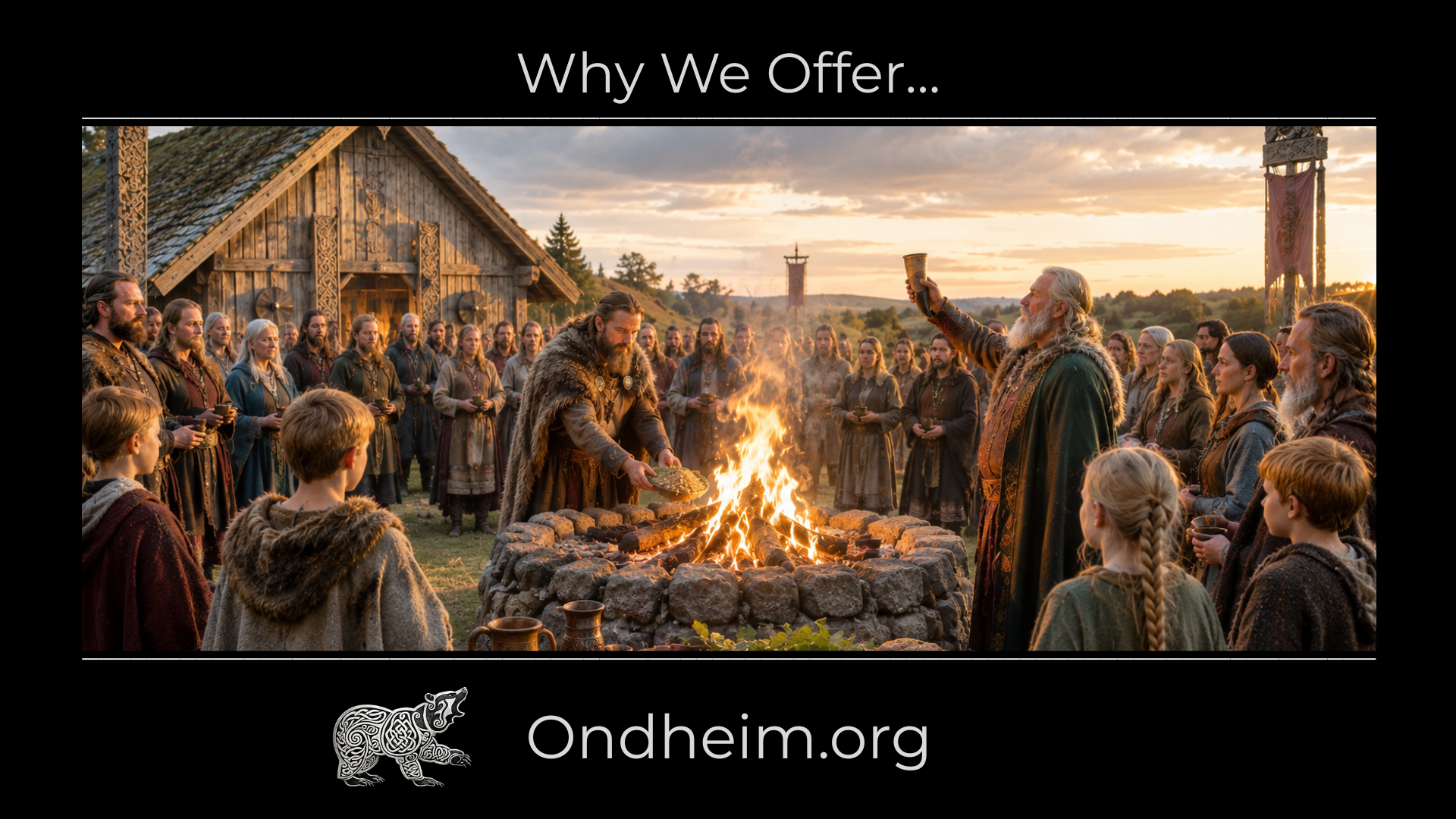
To offer was to give. To give was to affirm relationship. And through repeated giving — generation after generation — the bonds between humans and gods, between the living and the dead, were maintained and deepened.
The sources are full of it. Hákonar saga góða describes the sacrificial feasts: animals offered, and then the folk sharing the feast together. The offering wasn’t thrown away. It was given to the gods and shared communally — binding the folk to the powers and to each other in the same act.
And the logic underneath is stated directly in the Hávamál (Hávamál 41):
Friends shall gladden each other | with arms and garments,
As each for himself can see;
Gift-givers’ friendships | are longest found,
If fair their fates may be.
The friendships that last are the ones where giving goes both ways. That governed men among men — and it governed men and the holy powers too.
Because offering rests on reciprocity, and reciprocity isn’t bargaining. It’s deeper than that. It’s the understanding that a relationship only exists where both sides contribute.
A friendship where one man always gives and the other only takes doesn’t survive. A marriage where one carries everything and the other carries nothing breaks. The holy powers are no different: the relationship is maintained through ongoing exchange, or it isn’t maintained at all.
Humans give to the gods. The gods give protection, prosperity, wisdom, favor. Neither side gives unconditionally and neither side receives without owing. That’s not crude. That’s honest.
Offering is also gratitude — but gratitude made concrete. You can feel thankful in private and it costs you nothing. To offer is to take that thankfulness and put weight behind it: to surrender something you value, on purpose, to someone greater.
That’s why the offering had to be genuine. A worthless gift tossed off carelessly said exactly what the giver thought of the relationship. A valuable gift, given with full intention, said the bond mattered. The quality of the offering showed the quality of the relationship. There’s no faking that.
The old way of naming what this maintained is right relationship. The cosmos is ordered, everything has its place, and right relationship means honoring that order in how you act. Offering did that four ways at once: it acknowledged the gods’ power and place — they’re greater, and the folk said so openly. It admitted dependence honestly — the folk need the gods’ favor, and pretending otherwise would be a lie. It paid what was owed — what’s been received calls for giving in return. And it kept the continuity — repeated offering across time, the unbroken relationship.
Neglect the offering and you neglect the relationship. Neglected relationships weaken. There’s no version of this where they don’t.
And it was never just individual. When the folk gathered for blót and offered together, they affirmed two bonds at once — with the gods, and with each other. Shared giving made shared bonds. The man who offered alongside the folk showed he belonged. The man who refused set himself apart. Participation was membership, made visible.
What was offered varied — animals at the great blóts, food and drink at smaller observances, valued objects at shrines and holy places. The forms change. The requirements don’t. An offering has to be given freely — not extracted, not compelled. Given with intention — knowing to whom it’s made and why. Given genuinely — something of real value, not a token tossed to check a box. And given regularly — because a relationship isn’t maintained by one grand gesture, it’s maintained by showing up.
So what does it take to offer rightly? Understand why it matters — it maintains relationship, not just tradition. Give what’s genuinely valuable, not what’s convenient. Know to whom you’re giving and why. Give regularly, not once. Stand with the folk in their shared offerings. And receive gratefully — take the gods’ gifts with the same seriousness you bring to giving your own.
We offer because relationship requires giving. We offer because gratitude has to be made concrete or it isn’t real. We offer because the holy powers deserve honor and the folk deserve continuity.
You can’t maintain a relationship on feeling alone. You maintain it by giving.
People hear "Hel" and they think "Hell." Same root, same idea — a place of punishment for the wicked.
That's Christian overlay talking, not the sources.
The Norse Hel, as Gylfaginning describes it, is the realm of the dead ruled by Hel, Loki's daughter. Those who die of sickness, age, or ordinary causes go there — and so does Baldr, among the most beloved of the gods. That fact alone should end the confusion. You don't send the best-loved god to a torture chamber.
Hel isn't a Satan figure opposing the gods. The realm isn't punishment for moral failure. The atmosphere in the sources is solemn, grave, distant — tied to mortality itself, not to damnation. It looks more like the older Indo-European underworld traditions than anything in later Christian theology.
But the bigger difference isn't geography. It's how the living understand the dead.
Modern culture treats death as a clean break. The person departs, exists elsewhere, done. The old way never thought of a person that way. Identity lived inside kinship — ancestry, memory, oath, inherited worth, obligation, the continuing life of the folk. You weren't an isolated soul standing alone before the cosmos. You were a link.
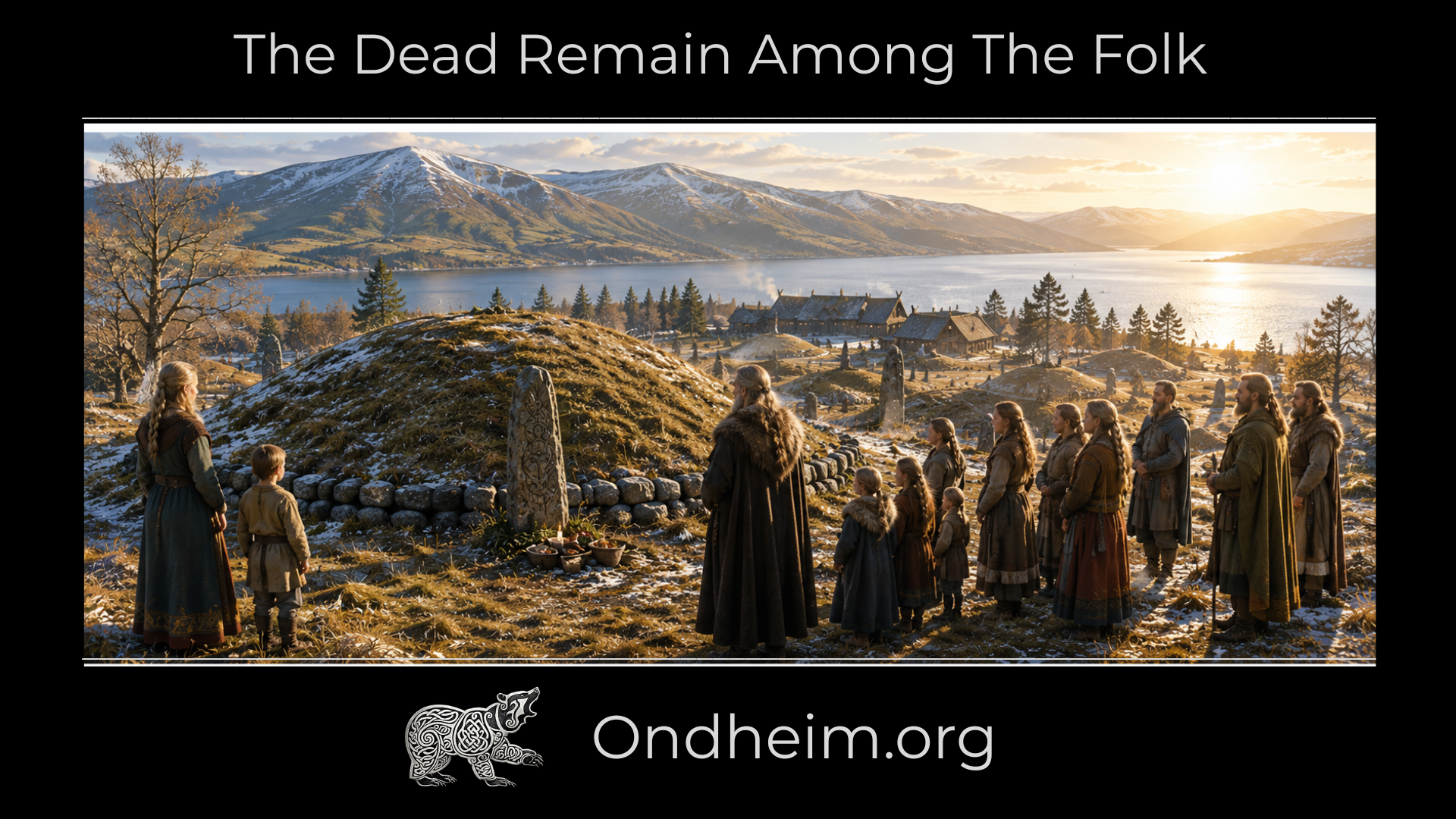
So the dead didn't vanish from the community. They stayed woven into it: through ancestor veneration, burial mound custom, naming traditions, inherited luck and hamingja, reputation wisdom, the sheer weight of remembered deeds. The Hávamál puts it the way it always does — plainly (Hávamál 77):
Cattle die, | and kinsmen die,
And so one dies | one's self;
But a noble name | will never die,
If good renown | one gets.
That wasn't poetry for comfort. It described how things worked. A name spoken again in the family line. A child with her great-grandmother's temperament. Stories told around the hearth for generations. Skills, habits, strengths, obligations moving down through descendants. The honored dead remembered in feast and seasonal observance. The boundary between living and dead was never sealed shut.
Which is why trying to force the lore into one rigid afterlife system never quite works. The sources preserve overlapping possibilities — Hel, Valhalla, Fólkvangr, the mound traditions, ancestor presence, the continuing tie between living and dead — without handing us a single universal doctrine for every soul. The old way had room for mystery. It didn't need a perfectly organized sorting system to take death seriously.
Modern people hunger for certainty on this — one heaven, one hell, everything filed correctly. The sources don't oblige. What they emphasize instead, over and over, is continuity: kinship, relationship, memory, inherited worth, the unbroken life of the people across generations.
That's also why reputation carried the weight it did. Your deeds didn't end at death. They kept shaping your descendants — family standing, inherited reputation, the strengths and burdens carried by everyone connected to you. The dead kept influencing the living through consequence and remembrance.
The old sources don't give us a neat unified doctrine of the soul, and we shouldn't pretend they do. What the patterns show, consistently, is identity as something interwoven — through kinship, ancestry, obligation, memory — across generations. You stand in a living chain. The dead shaped you; you'll shape the unborn.
Hel isn't paradise and it isn't torment. It's one part of a larger relationship between the living and the dead — solemn, unavoidable, and real.
What endures isn't a map of the afterlife. It's the continuity itself. The dead remain in descendants, in memory, in inherited worth, in story, in reputation, in the ongoing life of the folk. The living carry them forward.
And through that carrying, the folk remain unbroken.



You must be logged in to post a comment.