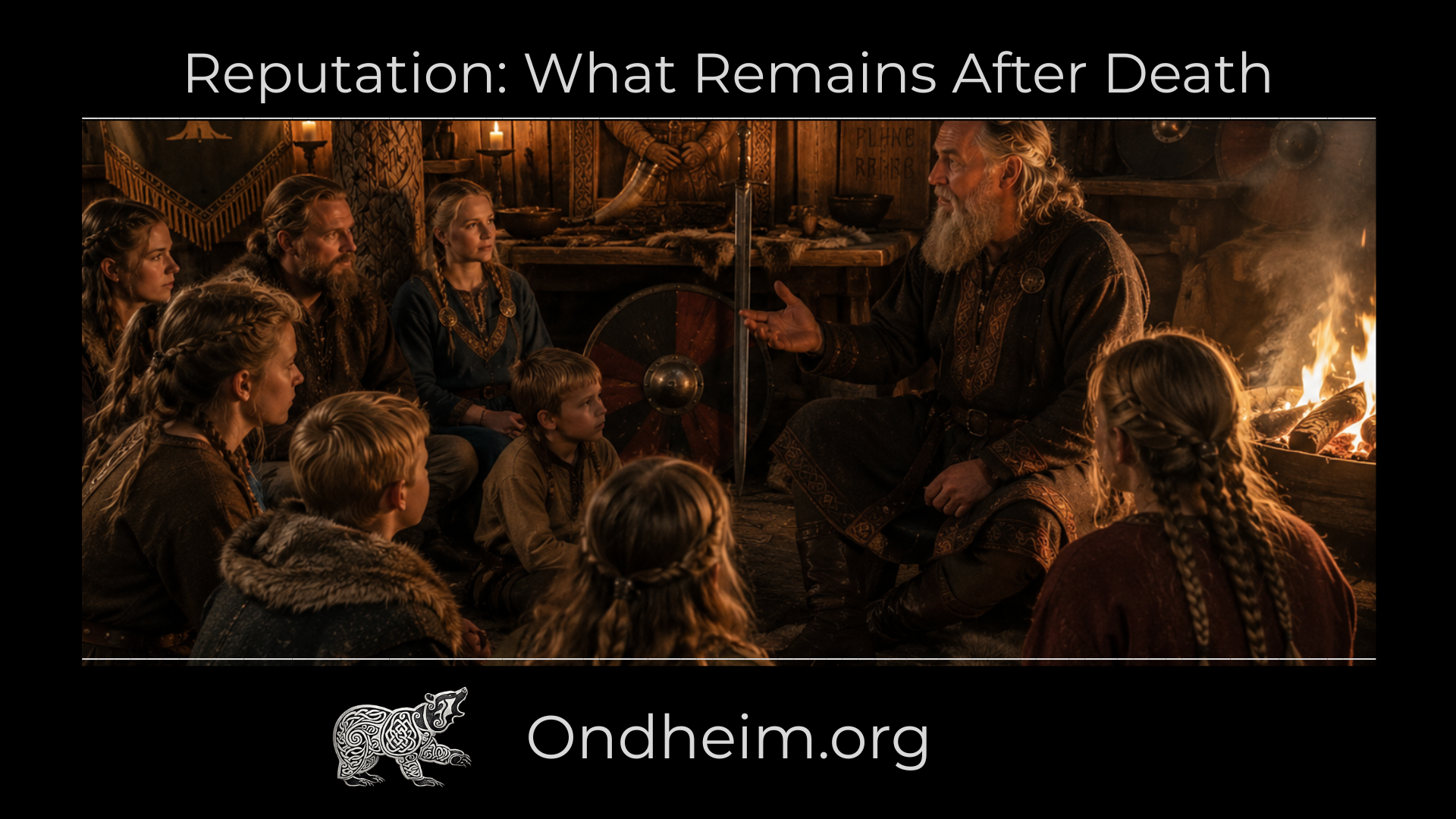
Reputation:  What Remains After Death

Every man dies.

This much was obvious within the older world. Strength fades. Wealth changes hands. The body weakens and eventually returns to the earth. Even great households and powerful leaders eventually pass from the living world into memory. Yet the surviving Norse and Germanic material repeatedly returns to a deeper question: what remains afterward?

Within the older Heathen worldview, death was never understood as the final measure of a life. What endured was not comfort, self-image, status, or personal intention alone, but the memory of conduct carried forward by the living. A person continued through reputation, descendants, story, obligation, and the continuing consequences left behind through deed.

This is one reason the surviving lore places such emphasis upon reputation.

Not as vanity or shallow public praise, but as the accumulated memory of how a person repeatedly conducted themselves among the folk across time.

In Hávamál, the reader is reminded that all material things eventually perish:

“Cattle die, and kinsmen die,
And so one dies one’s self;
But I know one thing that never dies:
The fame of a dead man’s deeds.”

The point is direct and practical. Wealth fades. The body fails. Even family lines shift across generations. Yet the memory of conduct can continue influencing the living long after death itself. The old traditions therefore treated reputation not as superficial image management, but as part of the enduring social memory of the community.

This reflects an important difference between the older worldview and many modern assumptions about identity. Modern people often define themselves inwardly through emotion, self-perception, personal authenticity, or intention. The older traditions were far more concerned with what a person consistently proved through visible conduct over time.

A man became known through how he carried obligation, whether he upheld his word, how he behaved under hardship, how he treated his own, and whether his conduct strengthened or weakened the people around him.

In this way, reputation represented accumulated witnessed behavior rather than self-definition.

The saga literature preserves this understanding repeatedly. In Njáls saga, even Njáll’s lack of a beard becomes a recurring point of insult aimed not merely at him personally, but at the standing and perceived strength of his household itself. The attacks carry social implications capable of provoking feud, dishonor, and violence because reputation affected not only the individual, but also the standing of the family line and the trust surrounding it within the wider community.

Likewise, in Egil’s Saga, Egil Skallagrímsson remains remembered centuries later not because he lived quietly or comfortably, but because his poetry, loyalties, violence, feuds, intellect, and force of character left enduring weight attached to his name. His reputation survived him because his conduct continued being remembered and spoken about long after the life of the body ended.

The sagas repeatedly preserve this understanding: what a person does among the folk continues echoing after death through memory, descendants, story, obligation, and the continuing consequences of action.

Within the older worldview, reputation and worth were deeply connected, though they were not identical. Worth was earned inwardly through discipline, sacrifice, reliability, courage, restraint, and right conduct. Reputation was how those qualities gradually became visible among the folk through repeated interaction across time.

A person might speak proudly about themselves. They might proclaim honor loudly before others. Yet reputation was never fully self-assigned. It formed gradually through the judgment of those who repeatedly witnessed a person’s conduct under real conditions across years of communal life.

This is one reason reputation could not be manufactured instantly.

A boast might attract attention briefly, but lasting reputation developed slowly through fulfilled obligation, steadiness under pressure, visible reliability, and the repeated carrying of responsibility over time.

The older traditions consistently suggest that isolated moments rarely defined a person completely. What mattered more was the enduring pattern created through repeated conduct. The person who carried burden steadily, honored obligation when it became difficult, and remained dependable through hardship gradually developed a reputation others learned to trust. Likewise, the person who spoke greatly but repeatedly failed in action eventually revealed the true weight of their character.

Within the older worldview, words alone possessed little lasting value without deed supporting them.

This is one reason oaths carried such gravity within Norse and broader Germanic societies. An oath was not casual emotional speech. It was a binding word placed publicly into the future, allowing others to measure the worth of the speaker afterward through whether the promise was ultimately fulfilled.

Reputation forms where word and action repeatedly meet.

A fulfilled oath strengthened trust because it demonstrated reliability under consequence. A broken oath damaged more than personal pride alone. It weakened confidence, frith, and trust not only in the individual, but in the stability of relationship itself.

The old traditions understood that people eventually forget many promises spoken casually in passing. What they remember is whether a person carried what they bound themselves to once hardship arrived.

This is why careless speech was viewed as dangerous. A person who swore endlessly without the discipline or strength to fulfill those words slowly weakened the worth attached to their own name.

Reputation therefore affected far more than the individual alone.

Within tribe, family, and community, frith depends heavily upon trust. Trust depends upon reliability. Reliability repeatedly demonstrated across time gradually becomes reputation. In this way, reputation formed part of the social structure helping communities maintain stability and continuity across generations.

Those whose reputation proved strong were trusted with responsibility, leadership, counsel, and obligation because their conduct repeatedly demonstrated steadiness and dependability. Those whose reputation became uncertain weakened trust around themselves and gradually eroded confidence within the community.

The older traditions therefore treated reputation not as vanity, but as part of the framework allowing lasting social order to endure.

A reliable person strengthens the folk around them because others learn that their word, conduct, and obligation can be trusted. An unreliable person creates uncertainty because no one fully knows whether responsibility placed upon them will ultimately hold.

Within the Heathen worldview, reputation also continues beyond death itself. The dead remain present through memory, inherited influence, story, descendants, and the continuing life of the folk. A person’s reputation shapes how their name is spoken afterward, how descendants remember them, whether their memory becomes a source of honor or warning, and what influence continues after the body itself has returned to the earth.

This understanding rests near the heart of ancestor veneration within many Heathen traditions. The honored dead are remembered not merely because they once existed, but because their conduct, sacrifice, wisdom, failures, and responsibilities continue shaping the living long afterward.

A family strengthened by the memory of its forebears carries more than genetics alone. It carries example, expectation, warning, inherited reputation, and accumulated memory.

The old traditions also understood that reputation without substance rarely endures for long. False reputation may rise quickly through appearance, manipulation, boast, or temporary recognition. Yet hardship eventually exposes what lacks real foundation beneath it. Time reveals character gradually because pressure forces conduct into the open where others can finally judge its substance clearly.

Only sustained action gives lasting strength to a name.

Every man dies.

What remains afterward is the measure of the life lived among others and the memory carried forward by the folk who continue speaking that name after death.

Within the older worldview, this is why reputation mattered so deeply. Not because people feared being forgotten alone, but because worth continued influencing the living through memory, descendant lines, deed, obligation, and the enduring continuity of the folk itself.

— William Lord
Ondheim Theodish Fellowship
Ondheim.org

Frith defines the boundary, oaths bind the word, kin carry obligation, and the hall holds witness and memory. The shape of obligation gives these structure, and through symbel they are spoken into wyrd and given force.

For additional primary sources and public-domain texts related to kinship, obligation, feud, and Germanic social structure, see our Links page.
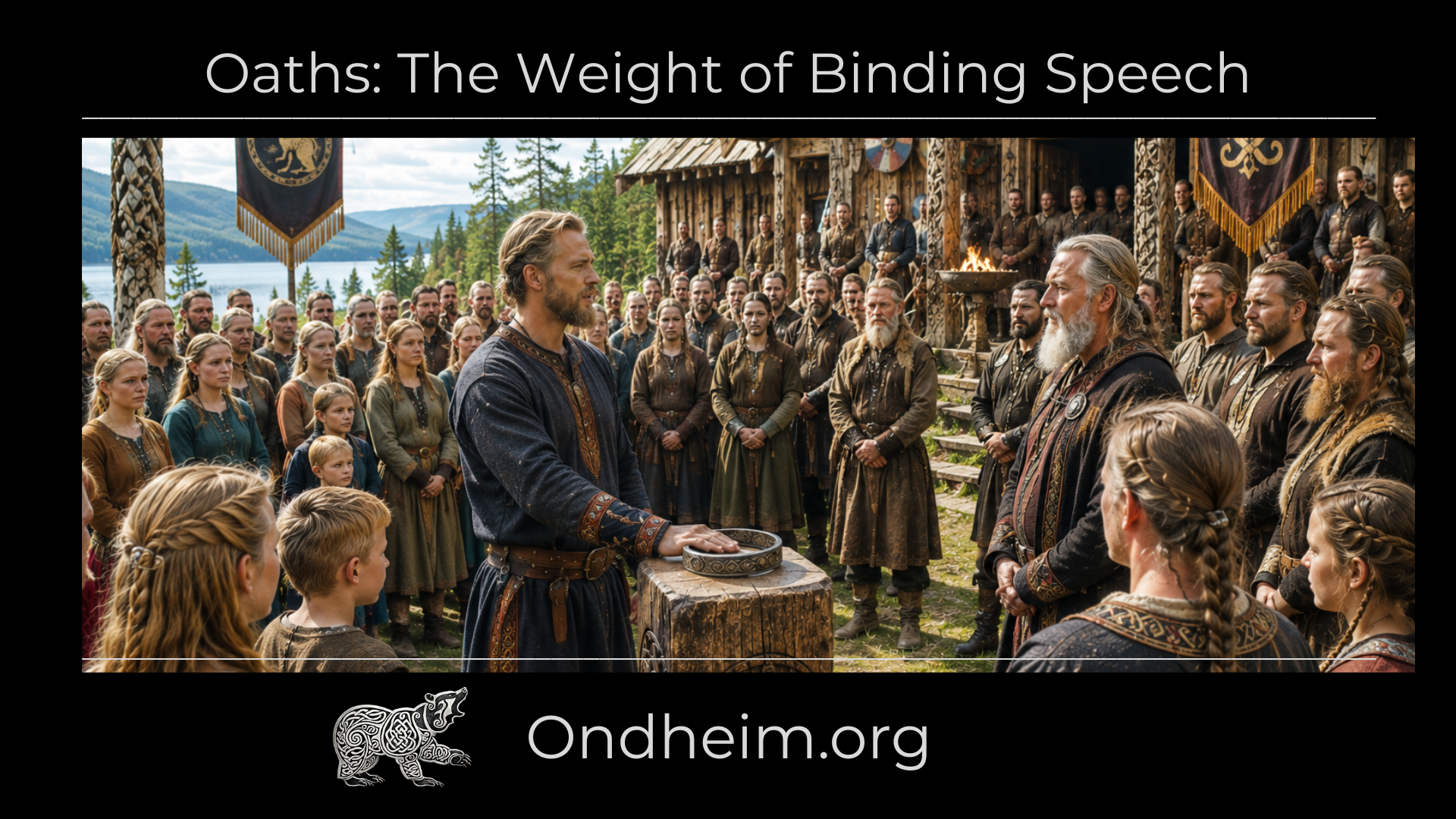
Oaths: The Weight of Binding Speech

Words are not without consequence.

Most speech passes quickly into the air and disappears with the moment that carried it. Opinions change. Emotions rise and fade. Intentions are spoken carelessly every day.

An oath is different.

An oath does not merely express desire or intention. It binds the speaker to future action. It places worth, reputation, and standing at risk before witnesses. Once spoken, it enters the unfolding of wyrd and becomes part of the weight a person carries thereafter.

The old traditions understood this clearly.

An oath was never meant to be casual speech.

It was meant to endure.

The surviving sources repeatedly warn against reckless promises and binding words spoken beyond one’s ability to fulfill. In Hávamál the warning is direct:

“Oaths thou shalt never swear,
But what thou wilt abide by;
For a halter awaits the false word spoken,
And vile is the wolf of vows.”

The meaning is unmistakable.

Do not swear lightly.

Do not bind yourself carelessly.

Do not speak beyond your strength to carry what has been promised.

Within the older worldview, speech was never entirely separate from deed. Words carried weight because they reflected the worth of the speaker. A man who spoke greatly yet failed in action damaged more than his reputation alone. He weakened trust itself.

This is one reason oath-breaking appears throughout the surviving lore not merely as personal failure, but as something corrosive to frith, standing, and social order.

A fulfilled oath strengthens the bonds between people.

A broken oath weakens the boundary that holds them together.

An oath does not exist in isolation once spoken.

It creates expectation.
It establishes obligation.
It shapes future consequence.

Whether fulfilled or broken, its effects continue outward beyond the moment itself. A fulfilled oath strengthens trust, reinforces standing, and contributes to ordered relationship within the folk. A broken oath introduces instability. It damages confidence and calls the reliability of the speaker into question.

The old world understood that words spoken publicly could not simply be discarded once inconvenient.

Speech shaped relationship.

And relationship shaped the future of the folk.

This is why oaths carried such gravity within the older traditions. They were not viewed merely as emotional declarations or private intentions. They carried social consequence. They bound the speaker to expectation before witnesses, ancestors, tribe, and Gods alike.

An oath shaped what was yet to come.

To swear an oath was therefore to place one’s worth at risk publicly.

The speaker effectively declared:

“I will prove these words through action.”

If fulfilled, worth increased.
Trust deepened.
Standing strengthened.

If broken, confidence eroded and reputation diminished.

This helps explain why the old traditions treated binding speech with such seriousness. The greater the standing of the individual, the greater the weight their oath carried. A careless oath spoken by a respected person could damage an entire web of trust surrounding them.

Within the old worldview, worth was never maintained through speech alone.

It had to be upheld continually through action over time.

The traditions remembered deeds long after words had faded.

Oaths therefore affected far more than the individual alone.

Frith depends upon trust:
the confidence that a person’s word carries meaning.

Without this:

  • families fracture,

  • alliances weaken,

  • obligation loses force,

  • and social order begins to decay.

A fulfilled oath reinforces unity within the boundary.

A broken oath introduces instability into the structure holding the folk together.

This is one reason the old traditions valued restraint in speech so highly. Silence carried no shame. Caution carried no dishonor. Better an oath left unspoken than a binding made carelessly and broken later through weakness, pride, or poor judgment.

The man who speaks carefully preserves his worth.

The man who swears endlessly risks destroying it.

Within Theodish tradition, one of the clearest expressions of binding speech is found in the Hold Oath.

A Hold Oath is not merely symbolic loyalty or social membership. It is a deliberate act of mutual obligation that binds individuals together within the structure of the folk itself. Through it, bonds of loyalty, responsibility, guidance, protection, service, honesty, and trust are formally acknowledged and accepted.

In Ondheim understanding, a Hold Oath is never viewed as one-sided submission.

Obligation flows in both directions.

The one swearing the oath accepts duties of loyalty, honesty, right conduct, and service within the boundary. In turn, those receiving the oath accept responsibilities of leadership, fairness, protection, guidance, and care toward the one entering the bond.

This mutual structure reflects one of the central ideas within Theodish worldview:

The folk is not held together merely through shared belief, but through living bonds of obligation maintained over time through action.

A Hold Oath therefore carries immense weight.

It ties reputation to conduct.
It binds the individual to the well-being of the tribe.
It places frith, trust, and worth at risk.

And once sworn, it becomes part of the continuing relationship between the individual, the folk, the ancestors, and the future yet to come.

This stands in sharp contrast to much of modern culture.

Modern society often treats promises casually. Words are spoken impulsively, emotionally, or performatively with little expectation that they must truly be carried to completion. Intent is often valued more highly than outcome.

The older understanding differs sharply from this.

An oath is not made meaningful because the speaker felt strongly in the moment it was spoken.

It becomes meaningful only when upheld afterward through action.

Many failures arise not from malice, but from overestimating one’s strength, seeking standing through grand speech, or binding oneself without understanding the weight involved.

The old warnings endure for good reason.

Do not swear what cannot be fulfilled.

Do not seek standing through speech alone.

Do not bind yourself beyond your ability to carry the weight of what has been spoken.

Words spoken before witnesses, Gods, ancestors, or tribe are not easily cast aside once given binding force.

And within the older worldview, that force extended beyond the individual alone.

A fulfilled oath strengthened trust across generations. It reinforced the standing of the family line and contributed to the continuity of the folk itself. Likewise, broken bindings and reckless speech left damage extending far beyond the self.

The old traditions understood that worth, obligation, reputation, and inherited standing were woven into the continuing life of the tribe across time.

A person’s word did not die with the moment in which it was spoken.

It endured:
through memory,
through reputation,
through consequence,
and through the relationships shaped by what had been promised and carried afterward.

An oath therefore becomes more than speech.

It becomes an act that binds present action to future consequence.

Within the Heathen understanding, this is why oaths were never taken lightly.

Once spoken, they must be borne.

And a word bound must be carried until fulfilled.

— William Lord
Ondheim Theodish Fellowship
Ondheim.org

Frith defines the boundary, oaths bind the word, kin carry obligation, and the hall holds witness and memory. The shape of obligation gives these structure, and through symbel they are spoken into wyrd and given force.

For additional primary sources and public-domain texts related to kinship, obligation, feud, and Germanic social structure, see our Links page.

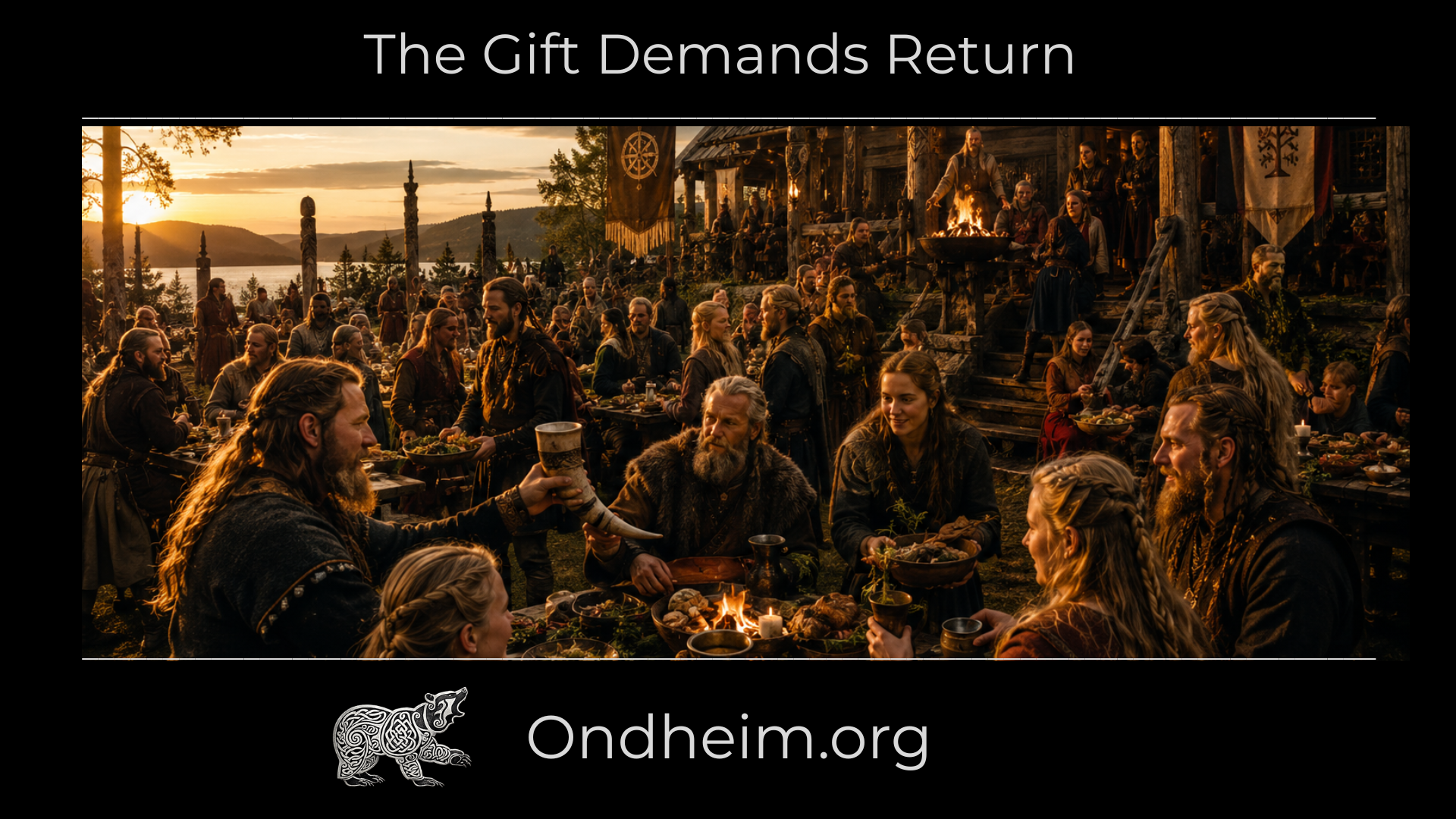
The Gift Demands Return

The Gift Demands Return

Reciprocity, Obligation, and the Bonds That Sustain the Folk


Nothing survives without exchange.

Not friendship.
Not tribe.
Not oath.
Not the relationship between the living and the Gods.
Not even memory itself.

The old world understood this deeply.

Modern people often imagine gifts as voluntary kindness:
freely given,
freely discarded,
without lasting obligation.

The Norse worldview approached giving very differently.

A gift created relationship.

And relationship carried consequence.

This principle appears plainly throughout Hávamál:

“A man should be a friend to his friend
And repay gift with gift.” (Hávamál 42)

And again:

“With weapons and weeds should friends gladden each other…” (Hávamál 41)

The meaning beneath these verses runs deeper than simple generosity. The gift itself was not the true center of the exchange. The relationship was.

A gift acknowledged connection.

A returned gift sustained it.

Without reciprocity, bonds weakened.

This principle extended through every layer of life within the older worldview:

  • friendship,

  • hospitality,

  • oath,

  • marriage,

  • alliance,

  • leadership,

  • ritual,

  • and the relationship between men, ancestors, and Gods alike.

Nothing stood entirely alone.

Everything existed within networks of obligation and return.

Modern people often hear this and instinctively reduce it to transaction:
“If I give this, I should receive that.”

But the older understanding was not purely transactional in the modern economic sense.

The gift cycle was relational.

An offering to the Gods did not compel divine action like payment from a merchant. The Gods were never imagined as machines dispensing blessings automatically in exchange for sacrifice. Yet relationship itself was strengthened through consistent honor, offering, remembrance, and reciprocity.

The cycle mattered because continuity mattered.

This is one reason sacrifice and offering carried such importance throughout the Norse world. To give before the Gods was not merely symbolic performance. It acknowledged dependence, gratitude, obligation, and relationship.

The folk gave:

  • offering,

  • honor,

  • praise,

  • and remembrance.

The Gods answered through:

  • strength,

  • opportunity,

  • wisdom,

  • luck,

  • and the ordering forces that sustain life itself.

Not always immediately.
Not always predictably.
And never through coercion.

But relationship endured through maintained exchange.

The same principle governed the relationship with the ancestors.

The living inherit far more than blood alone.

They receive:

  • language,

  • memory,

  • custom,

  • worth,

  • inherited luck,

  • land,

  • reputation,

  • and the consequences of those who came before them.

No man begins entirely from himself.

The old traditions understood this clearly. Again and again, the surviving sources emphasize continuity between generations:
through naming customs,
ancestral memory,
burial traditions,
reputation,
and inherited standing.

The dead continue giving long after death.

And the living answer through:

  • remembrance,

  • continuity,

  • honor,

  • and carrying the line forward.

This is one reason ancestor veneration mattered so deeply within the Heathen worldview. Forgetfulness weakens continuity. Remembrance strengthens it.

What is given must live on.

This same law governed the tribe itself.

No community survives through one-sided taking.

A hall where:

  • loyalty is never returned,

  • sacrifice goes unanswered,

  • hospitality is ignored,

  • or obligation is abandoned
    eventually collapses beneath distrust.

Reciprocity sustains social order because it creates predictability. Men who consistently return loyalty become dependable. Leaders who continually give of themselves strengthen trust. Folk who support one another during hardship reinforce frith and continuity.

Exchange creates stability.

Not because every gift must be perfectly equal, but because the relationship itself remains alive through continued return.

This distinction matters enormously.

The old world did not demand mathematical equality in all things. A great gift might be returned through:

  • service,

  • loyalty,

  • labor,

  • future support,

  • or enduring honor.

What mattered was not sameness.

What mattered was continuation.

A broken cycle weakens relationship.

A maintained cycle strengthens it.

This truth appears repeatedly throughout the surviving lore and social structure of the Norse world. Oaths created obligation. Hospitality created expectation. Friendship required maintenance. Even kingship itself depended heavily upon reciprocal bonds between lord and follower.

A lord who gave nothing eventually stood alone.

A follower who received endlessly without return became a burden upon the hall.

The relationship could not endure if exchange died.

This understanding also explains why betrayal carried such severe social consequences. False gifts, broken promises, failed obligations, and unreturned loyalty did more than damage individual relationships. They weakened trust itself—the invisible structure holding tribe and society together.

The gift cycle therefore was never merely about objects.

It was about maintaining living bonds.

Again and again, the older worldview returns to the same underlying pattern:

  • what is honored grows,

  • what is maintained endures,

  • and what is neglected slowly fades.

This is true:
between friends,
between tribe and tribe,
between the living and the dead,
and between the folk and the Holy Powers.

Nothing survives in isolation.

The world itself is sustained through continued exchange.

And the man who understands this learns to give deliberately,
receive honorably,
and return what is owed before the bonds holding the world together begin to weaken.

Because every true gift carries responsibility.

And what is given must live on.

— William Lord
Ondheim Theodish Fellowship
Ondheim.org

Frith defines the boundary, oaths bind the word, kin carry obligation, and the hall holds witness and memory. The shape of obligation gives these structure, and through symbel they are spoken into wyrd and given force.

For additional primary sources and public-domain texts related to kinship, obligation, feud, and Germanic social structure, see our Links page.

Welcome to Ondheim Fireside Chats

An introduction to the Fireside Chats series and the ongoing effort to preserve oral teaching, worldview, memory, and communal discussion within the Ondheim Theodish Fellowship.


HAIL THE FOLK.
HAIL THE ANCESTORS.


Frith defines the boundary, oaths bind the word, kin carry obligation, and the hall holds witness and memory. The shape of obligation gives these structure, and through symbel they are spoken into wyrd and given force.

For additional primary sources and public-domain texts related to kinship, obligation, feud, and Germanic social structure, see our Links page.

Worth Is Earned, Not Claimed

Ondheim Theodish Fellowship 
https://ondheim.org

Introduction

A system of order requires a purpose.

Frith maintains relationship.
The boundary defines where it exists.
Thews govern how it is upheld.
Right Good Will guides how the folk carry it.

But none of this exists without a result.

That result is worth.

Within the Ondheim understanding, worth is not assumed.
It is not granted.
It is not claimed through words alone.

Worth is earned.

What the Sources Show

The elder sources consistently place emphasis on action, reputation, and the enduring memory of what a person has done.

In Hávamál, this is stated plainly:

“Cattle die, kinsmen die,
Oneself dies the same;
But the fame of one who has done well
Never dies.”
Hávamál 76 (Bellows, 1923)

And further:

“The unwise man thinks he will live forever,
If he keeps himself from strife;
But old age leaves him not long in peace,
Though spears may spare his life.”
Hávamál 16 (Bellows, 1923)

Avoidance of challenge does not preserve a man.

What endures is what is done, how it is done, and how it is remembered.

Across the lore, a consistent pattern emerges:

👉 A person is known by their deeds
👉 Reputation follows action, not intention

The Underlying Principle

Worth is demonstrated reliability within the structure of the tribe.

It is not internal feeling.
It is not self-assessment.

It is:

  • observed
  • tested
  • remembered

A person has worth when they:

  • fulfill obligations
  • act consistently
  • uphold thews
  • strengthen frith

This cannot be declared.

It can only be recognized.

👉 Worth exists in the eyes of the folk, not the claims of the individual

Worth and Reputation

Reputation is the visible form of worth.

It is how the tribe measures:

  • reliability
  • consistency
  • capability

This is why reputation carries weight in the sources.

It is not vanity.

It is function.

A strong reputation means:

  • words are trusted
  • responsibility can be given
  • leadership can emerge

A weak reputation means:

  • words are questioned
  • responsibility is limited
  • trust is withheld

👉 Reputation is earned over time
👉 And lost through failure

Worth and Rank

Within Ondheim, rank is not symbolic.

It is the recognition of proven worth.

Advancement is not given lightly because:

👉 Rank reflects what has already been demonstrated

It is not a reward for intention.
It is not a recognition of desire.

It is acknowledgment of:

  • consistent action
  • fulfilled obligation
  • reliability under pressure

This ensures that:

  • authority is grounded
  • leadership is earned
  • structure remains stable

👉 Rank is past worth made visible

Worth and Responsibility

Worth does not reduce burden.

It increases it.

The more a person has proven themselves:

  • the more is expected of them
  • the more their actions carry weight
  • the more their failures matter

This reflects a core truth:

👉 Worth is not a shield
👉 It is a weight carried forward

To claim worth without accepting responsibility is to misunderstand it entirely.

False Claims of Worth

Words alone do not create worth.

Boast, claim, and declaration mean nothing without fulfillment.

This is why, within the tradition:

  • speech is tested
  • oaths are binding
  • reputation is remembered

To claim worth without proof results in:

  • loss of trust
  • damage to reputation
  • weakening of standing

And once lost, it is not easily restored.

👉 False worth collapses under scrutiny

Worth Within the System

Each element of the system supports the development of worth:

  • Frith provides the environment in which reliability can be demonstrated
  • Inangardr provides the boundary within which it is recognized
  • Thews define what actions are expected
  • Right Good Will allows opportunity for trust to be extended and tested

Without this structure, worth cannot be measured.

Without the actions of the individual, it cannot be earned.

What This Requires of the Folk

To earn worth, a theodsman must:

  1. Act consistently
    One action does not define a man—pattern does.
  2. Fulfill obligations fully
    Partial effort does not build reliability.
  3. Speak only what can be upheld
    Words bind future action.
  4. Accept consequence when failing
    Accountability restores what avoidance destroys.
  5. Seek responsibility, not recognition
    Worth follows action, not desire for status.
  6. Understand that time is required
    Worth cannot be rushed or forced.
  7. Continue even after it is earned
    Worth must be maintained, not simply achieved.

Conclusion

Worth is not given.

It is built over time through action, tested through challenge, and remembered through reputation.

It is the result of living within the structure of the tribe and meeting its expectations consistently.

Within Ondheim, worth is the measure of the individual—not what is claimed, but what is proven.

Where worth is real, the tribe grows stronger.

Where it is falsely claimed, the structure weakens.


“What is proven remains.”


𝓦𝓲𝓵𝓵𝓲𝓪𝓶 𝓛𝓸𝓻𝓭

Ondheim Theodish Fellowship
Ondheim.org

Frith defines the boundary, oaths bind the word, kin carry obligation, and the hall holds witness and memory. The shape of obligation gives these structure, and through symbel they are spoken into wyrd and given force.

For additional primary sources and public-domain texts related to kinship, obligation, feud, and Germanic social structure, see our Links page.

Sources

Primary Texts

Bellows, Henry Adams (1923).
The Poetic Edda.

Brodeur, Arthur Gilchrist (1916).
The Prose Edda.
https://www.gutenberg.org/ebooks/18947

Ondheim Resources

Ondheim Theodish Fellowship
https://ondheim.org

Thews: The Law That Lives

Ondheim Theodish Fellowship 🌲
https://ondheim.org

Introduction

Order does not maintain itself.

A boundary, once established, will fail if nothing governs what happens within it.

Frith cannot exist without structure.
Inangardr cannot endure without enforcement.

That structure is not abstract. It is not written once and forgotten.

It lives.

Within the Theodish tradition, this living structure is known as thews.

Thews are not rules imposed from outside.

They are the living law of the tribe—formed through action, upheld through expectation, and proven through time.

What the Sources Show

The elder sources do not present a single written code of law for daily life. Instead, they consistently demonstrate a system where conduct, expectation, and consequence are understood and enforced within the community.

In Hávamál, guidance is given not as rigid law, but as patterns of behavior:

“The unwise man thinks he will live forever,
If he keeps himself from strife;
But old age leaves him not long in peace,
Though spears may spare his life.”
Hávamál 16 (Bellows, 1923)

The lesson is not a rule to memorize, but a principle to live by.

Across the sagas, law is not distant. It is spoken, enforced, and remembered by the folk.

Judgment is carried through:

  • reputation
  • memory
  • consequence

From this, a pattern emerges:

👉 Law is not separate from life
👉 It exists within the behavior of the people themselves

The Underlying Principle

Thews are customary law made living through consistent action.

They are not static.

They are:

  • learned through participation
  • reinforced through expectation
  • upheld through consequence

A thew exists when:

  • it is known by the folk
  • it is practiced consistently
  • it is enforced when broken

If any of these fail, the thew weakens.

If all fail, it ceases to exist.

👉 A law not upheld is not a law

Thews and the Maintenance of Inangardr

Thews are what make inangardr possible.

Without them, there is no shared structure—only individuals acting without alignment.

Within the Ondheim understanding:

  • the boundary defines where order exists
  • frith defines the condition of that order
  • thews define how that order is maintained

They govern:

  • speech
  • conduct
  • obligation
  • response to wrongdoing

This is not theoretical.

It is lived.

👉 Thews are the mechanism by which order is sustained

Thews, Authority, and Enforcement

Thews do not enforce themselves.

They require:

  • recognition
  • agreement
  • and action

Within the tribe, authority exists to ensure that thews are upheld.

This authority is not arbitrary.

It is rooted in:

  • proven worth
  • earned standing
  • responsibility to the whole

Enforcement may take many forms:

  • correction
  • challenge
  • judgment
  • consequence

To refuse enforcement is to allow erosion.

To allow erosion is to weaken the boundary itself.

👉 A thew ignored is a thew undone

Thews and Right Good Will

Thews are not maintained through hostility.

They are maintained through Right Good Will, extended as a matter of duty within the boundary.

Right Good Will ensures that:

  • correction is given to preserve order, not to harm
  • judgment is grounded in truth, not impulse
  • unity is maintained even through disagreement

This creates balance:

  • without thews, there is no structure
  • without Right Good Will, enforcement becomes destructive

👉 Thews provide form
👉 Right Good Will governs how that form is upheld

Thews and Reputation

Thews are visible through reputation.

A theodsman’s standing reflects:

  • how consistently they uphold thews
  • how reliably they act within expectation
  • how they respond when tested

This is not symbolic.

It is functional.

Reputation determines:

  • trust
  • responsibility
  • authority

Where thews are upheld, reputation has meaning.

Where they are ignored, reputation collapses into empty claim.

What This Requires of the Folk

To live within thews, a theodsman must:

  1. Learn the thews
    They are not assumed. They are taught and observed.
  2. Act consistently within them
    One act does not establish reliability—pattern does.
  3. Accept correction without resistance
    Correction maintains order.
  4. Give correction when required
    Allowing breach weakens the whole.
  5. Support enforcement
    Thews only function when upheld collectively.
  6. Understand that law lives through action
    Not words alone.

Conclusion

Thews are not written law set apart from life.

They are law made living through the consistent actions of the folk.

They define what is expected.
They govern what is permitted.
They ensure that order is maintained within the boundary.

Without thews, frith cannot hold.
Without enforcement, the boundary cannot endure.

Within Ondheim, thews are not optional.

They are the structure that allows the tribe to exist as more than a gathering of individuals.


“The law lives where it is upheld.”


𝓦𝓲𝓵𝓵𝓲𝓪𝓶 𝓛𝓸𝓻𝓭

Ondheim Theodish Fellowship
Ondheim.org

Frith defines the boundary, oaths bind the word, kin carry obligation, and the hall holds witness and memory. The shape of obligation gives these structure, and through symbel they are spoken into wyrd and given force.

For additional primary sources and public-domain texts related to kinship, obligation, feud, and Germanic social structure, see our Links page.

Sources

Primary Texts

Bellows, Henry Adams (1923).
The Poetic Edda.

Brodeur, Arthur Gilchrist (1916).
The Prose Edda.
https://www.gutenberg.org/ebooks/18947


Ondheim Resources

Ondheim Theodish Fellowship
https://ondheim.org

Right Good Will: Trust Within the Boundary

Ondheim Theodish Fellowship 🌲
https://ondheim.org

Introduction

Order alone is not enough.

A boundary may be established.
Thews may be known and enforced.

But without the proper conduct between the folk themselves, that structure becomes brittle.

It fractures under strain.

Within the Theodish understanding, there is a required disposition that governs how one acts toward others inside the boundary.

This is known as Right Good Will.

It is not kindness.
It is not passive agreement.

It is the disciplined extension of trust, respect, and proper conduct within the inangardr.

What the Sources Show

The elder sources consistently emphasize measured conduct, restraint, and awareness in dealings with others.

In Hávamál, we are warned against careless judgment:

“A man should be loyal through life to friends,
And return gift for gift;
Laugh when they laugh, but with lies repay
A foe who lies.”
Hávamál 42 (Bellows, 1923)

And further:

“To his friend a man should be a friend,
And repay gift with gift;
Laughter with laughter let him repay,
But falsehood with treachery.”
Hávamál 44 (Bellows, 1923)

These passages show a structured approach to relationship:

  • loyalty within
  • reciprocity maintained
  • distinction made between friend and foe

This is not universal goodwill.

It is directed, conditional, and bound to relationship.

The Underlying Principle

Right Good Will is the default stance of proper conduct within the boundary.

It is extended:

  • to those within the inangardr
  • as a matter of duty
  • based on shared obligation

It is not based on personal feeling.

It does not require agreement.

It requires discipline.

Right Good Will means:

  • giving the benefit of the doubt
  • acting in good faith
  • maintaining unity where possible
  • withholding unnecessary hostility

👉 It is how order is carried between people

Right Good Will and Frith

Frith defines the condition of ordered relationship.

Right Good Will is one of the primary ways that condition is maintained.

Without it:

  • suspicion replaces trust
  • correction becomes conflict
  • unity breaks down into faction

With it:

  • disagreements remain contained
  • correction strengthens rather than divides
  • relationships endure strain

👉 Frith is the condition
👉 Right Good Will is the conduct that sustains it

Right Good Will and thews

Thews define what is expected.

Right Good Will governs how those expectations are carried out.

Without Right Good Will:

  • enforcement becomes harsh
  • authority becomes resented
  • correction becomes personal

With it:

  • enforcement remains measured
  • authority remains respected
  • correction remains functional

This balance is necessary.

👉 Thews without Right Good Will become rigid
👉 Right Good Will without thews becomes meaningless

Right Good Will and Trust

Trust is not assumed blindly.

It is extended as a matter of thew and maintained through action.

Within Ondheim:

  • a theodsman begins from a position of Right Good Will
  • that position is strengthened through proven reliability
  • or weakened through failure

This creates a stable system:

  • trust is given
  • trust is tested
  • trust is either confirmed or withdrawn

👉 Right Good Will opens the door
👉 Action determines whether it remains open

Limits of Right Good Will

Right Good Will is not infinite.

It is not extended without limit or without condition.

When a member of the boundary:

  • repeatedly breaks obligation
  • acts in bad faith
  • undermines order

Right Good Will may be reduced or withdrawn.

This is not a failure of frith.

It is a defense of it.

To continue extending trust where it is consistently violated is not strength.

It is negligence.

👉 Right Good Will is given freely
👉 But it is not maintained without cause

What This Requires of the Folk

To act with Right Good Will, a theodsman must:

  1. Begin from trust within the boundary
    Do not assume hostility where none is proven.
  2. Act in good faith
    Conduct should reflect intent to maintain order.
  3. Accept correction without resentment
    Correction is part of maintaining frith.
  4. Give correction without hostility
    The goal is preservation, not dominance.
  5. Distinguish between internal and external conduct
    Right Good Will is not extended equally to utgardr.
  6. Withdraw trust when necessary
    Continued failure must have consequence.
  7. Place the integrity of the boundary above personal reaction
    Order comes before feeling.

Conclusion

Right Good Will is not kindness.

It is not softness.

It is the disciplined conduct required to maintain trust within the boundary.

It allows:

  • thews to function without fracture
  • frith to endure under strain
  • the tribe to remain unified despite difference

Without it, order becomes brittle.

With it, order becomes resilient.

Within Ondheim, Right Good Will is not optional.

It is expected.


“Trust is given. It is also withdrawn.”


𝓦𝓲𝓵𝓵𝓲𝓪𝓶 𝓛𝓸𝓻𝓭

Ondheim Theodish Fellowship
Ondheim.org

Frith defines the boundary, oaths bind the word, kin carry obligation, and the hall holds witness and memory. The shape of obligation gives these structure, and through symbel they are spoken into wyrd and given force.

For additional primary sources and public-domain texts related to kinship, obligation, feud, and Germanic social structure, see our Links page.

Sources

Primary Texts

Bellows, Henry Adams (1923).
The Poetic Edda.

Brodeur, Arthur Gilchrist (1916).
The Prose Edda.
https://www.gutenberg.org/ebooks/18947

Ondheim Resources

Ondheim Theodish Fellowship
https://ondheim.org

Inangardr and Utgardr: The Shape of the World

Ondheim Theodish Fellowship 🌲
https://ondheim.org

Introduction

The world is not without structure.

It is divided.

Not into good and evil, nor into safe and dangerous, but into what is ordered and what is not.

This division is understood in the Norse worldview as:

inangardr — the inner enclosure
utgardr — the outer expanse

This is not merely a description of geography.

It is the shape of existence itself.

To understand this division is to understand where order can exist—and what is required to maintain it.

What the Sources Show

In the creation account preserved in Völuspá and the Prose Edda, the gods do not simply create a world. They establish boundaries.

After the slaying of Ymir, the gods shape the physical structure of existence:

“Of Ymir’s flesh the earth was fashioned…
And of his skull the sky.”
Völuspá 8 (Bellows, 1923)

But this alone is not enough.

The human world must be set apart.

Snorri records the act clearly:

“They made of his eyebrows a stronghold against the giants, and called it Midgard.”
Gylfaginning (Brodeur, 1916)

Midgard is not simply where humans live.

It is a fortified enclosure, deliberately constructed to separate ordered life from the forces that exist beyond it.

This establishes a clear pattern:

👉 The world of men exists within a boundary
👉 Outside that boundary, other forces remain

The Underlying Principle

The division between inangardr and utgardr reflects a fundamental truth:

👉 Order does not exist everywhere
👉 It exists where it is established and maintained

Inangardr is not defined by location alone.

It is defined by:

  • shared obligation
  • maintained relationships
  • recognized structure
  • upheld thews

Utgardr is not inherently evil.

It is:

  • unstructured
  • unbound
  • outside obligation
  • beyond the authority of the tribe

This distinction is critical.

The Norse worldview does not teach that chaos is eliminated.

It teaches that it is held at bay.

The Tribe as Inangardr

Within the Ondheim understanding, the tribe itself is an expression of inangardr.

It is the human enclosure of order.

Inside the tribe:

  • frith is maintained
  • obligation binds action
  • reputation carries weight
  • Right Good Will is extended as thew

This is not automatic.

It is constructed and maintained, just as Midgard was.

Without effort, it does not hold.

Without enforcement, it does not endure.

👉 The tribe is not merely a gathering of people
👉 It is a maintained boundary of order

Utgardr and the Outer World

Outside the boundary lies utgardr.

This includes:

  • those who are not bound by the tribe
  • forces that do not recognize its order
  • conditions where obligation does not apply

This does not make the outer world useless or forbidden.

Trade may occur. Interaction may occur.

But it must be understood clearly:

👉 Outside the boundary, frith does not exist

Expectations must change accordingly.

Trust is not assumed.
Obligation is not guaranteed.
Words do not carry the same weight.

To mistake utgardr for inangardr is to invite disorder into the boundary.

The Maintenance of the Boundary

A boundary that is not maintained will fail.

This is true in the cosmos, and it is true in the tribe.

The maintenance of inangardr requires:

  • clarity of membership
  • enforcement of thews
  • protection of frith
  • correction when order is threatened

When these fail:

  • obligation weakens
  • trust collapses
  • reputation loses meaning

The boundary does not disappear all at once.

It erodes.

And when it is gone, what remains is not inangardr.

It is utgardr, unrecognized and uncontrolled.

The Relationship Between Frith and the Boundary

Frith exists only within the boundary.

It cannot be extended where no shared structure exists.

This is why frith is not peace.

It is not a universal condition.

It is a contained condition, dependent on:

  • shared understanding
  • shared obligation
  • shared enforcement

Without the boundary, frith cannot be maintained.

Without frith, the boundary cannot hold.

👉 Each depends on the other

What This Requires of the Folk

To live within the boundary, a theodsman must:

  1. Know where the boundary lies
    Not all spaces are inangardr.
  2. Act differently inside and outside it
    Obligation governs one. Caution governs the other.
  3. Uphold thews within the boundary
    Order depends on consistent action.
  4. Protect frith actively
    It is not self-sustaining.
  5. Recognize when disorder enters
    And act to correct it.
  6. Avoid confusing openness with strength
    A boundary that admits everything holds nothing.

Conclusion

The world is not uniform.

It is divided between what is ordered and what is not.

Inangardr is the space where order is created, maintained, and defended.

Utgardr is everything beyond it.

This is not a moral judgment.

It is a structural reality.

Within Ondheim, the tribe stands as that boundary.

It is not self-sustaining. It must be upheld.

Where the boundary is strong, frith can exist.

Where it is neglected, order fails—and what remains is no longer the same world.


“The boundary holds—or it does not.”


𝓦𝓲𝓵𝓵𝓲𝓪𝓶 𝓛𝓸𝓻𝓭

Ondheim Theodish Fellowship
Ondheim.org

Frith defines the boundary, oaths bind the word, kin carry obligation, and the hall holds witness and memory. The shape of obligation gives these structure, and through symbel they are spoken into wyrd and given force.

For additional primary sources and public-domain texts related to kinship, obligation, feud, and Germanic social structure, see our Links page.


Sources

Primary Texts

Bellows, Henry Adams (1923).
The Poetic Edda.

Brodeur, Arthur Gilchrist (1916).
The Prose Edda.
Gylfaginning
https://www.gutenberg.org/ebooks/18947

Ondheim Resources

Ondheim Theodish Fellowship
https://ondheim.org