

People ask me how a heathen naming ceremony works, and I can hear what they’re really asking: give me the old words. The exact thing the Vikings said over a newborn. Like there’s a script in a drawer somewhere.
There isn’t. What we have is smaller than that, and honestly more interesting. The sources don’t give us a liturgy. They give us an act — water, and a name — and then they expect us to understand what that act weighed. So let me lay out what we actually have, and then I’ll show you the shape of the rite the way I’d do it, and I’ll tell you which parts are history and which parts are ours.
Here’s what we actually have. In the sagas, when a child is born, the formula is almost always the same: the child “was sprinkled with water and named.” That’s it. That’s the whole ceremony as the sources describe it. The Old Norse is ausa vatni — to sprinkle with water — and the naming rides right along with it. Water and a name, spoken together.
Egils saga (chs. 31, 35) gives it to us twice in the same family. Skallagrímr’s first son “was sprinkled with water and named Thorolf” — named for a dead kinsman, Thorolf Kveldulfsson, and the saga says it was the talk of all that the boy would turn out just like the man he was named for. Then the second son: “sprinkled with water and named, and his name was Egil.” And it wasn’t only sons — a daughter, Ásgerðr, gets the same rite, water and name, no less than the boys.
Rígsþula (sts. 7, 21, 34) does it three times over, once for each class of mankind: the thrall’s child, the karl’s child, the jarl’s child — each one sprinkled with water and named. Völsunga saga (ch. 13) has the infant Sigurd brought before the king and sprinkled and named — by the king, not the father, because the father was dead. Laxdæla saga (ch. 25): the boy “was sprinkled with water and called Bolli.” The act belonged to the father — or the head of the household — to perform. Nobody’s calling for a priest. Nobody’s reading from anything.
Now here’s the part people skip, and I’m not going to skip it, because it’s the whole weight of the thing. Before that water and that name, the child wasn’t kin yet. Not legally. In the old law, an infant that hadn’t been named and sprinkled could be exposed — left out — and it wasn’t murder. After the naming, it was. That’s not me being grim for effect. When Iceland took Christianity in the year 1000 (Íslendingabók), the old laws about infant exposure were deliberately left standing — the one heathen practice they refused to give up at the conversion. The naming was the line. On one side of it, a child the household couldn’t keep. On the other side, a person, with kin-rights, who couldn’t be unmade.
So when the father lifted that child and spoke its name, he wasn’t performing a blessing. He was making a decision, out loud, in front of everybody: this one is ours. That’s what ausa vatni was. Not magic water. A threshold.
The name itself usually came from the dead. That’s the best-attested custom we have — children named for dead relatives, with the open expectation that the child would take after the namesake. Thorolf for Thorolf, and everybody saying the boy would be another Thorolf. The scholars will tell you the idea underneath it was hamingja (Ellis Davidson) — the family’s luck, traveling with the name, settling onto the child. That’s interpretation, not something any saga states outright — but it’s honest interpretation, and it fits everything we see. Names built from Thor’s name are everywhere in the Viking Age — Þórólfr, Þorsteinn, Þorgrímr — worn like Mjölnir pendants were worn, right in the face of the new religion.
And with the naming came a gift. The sagas call it nafnfestr — “name-fastening.” When Ragnar (Ragnars saga loðbrókar, ch. 9) named his newborn son Sigurðr, he gave him a gold ring with the name. When Sigmund (Völsunga saga, ch. 8) named his son Helgi, he gave him a sword and land — and a leek, which the sagas treat as a symbol of growth and manhood. Kings did it too, when they gave grown men new names: a sword for the renaming, an arm-ring for the renaming. The gift fastens the name. Makes it hold. One old scholar, Grønbech (The Culture of the Teutons), read it deeper — said the father speaks a soul into the child with the name, and the gift fixes it there, hangs the family’s luck on the bearer. That’s his reading, not doctrine. But I’ll tell you, it rings true.
Now what we don’t have. And I want to be as plain about this as I was about the wedding, because the internet is full of naming scripts that dress modern invention up in old clothes.
Nobody knows when after the birth it happened. You’ll read “nine nights” everywhere — nine nights after birth, the father takes the child, all very solemn. It’s not in any saga. Not one passage gives an interval. Somebody made it up, everybody repeated it, and now it’s “tradition.” It isn’t. It’s a modern choice wearing old clothes.
Nobody attests any prayer at the naming. No god invoked, no set words, no blessing formula. The sagas describe water and a name and stop. The one exception sits right next to the rite, not inside it: in Eyrbyggja saga (ch. 11), after a boy is sprinkled and named Grímr, his father dedicates him to Þórr and renames him Þórgrímr for temple service. That’s real, and it’s notable — but it’s a dedication after the naming, not a prayer during it.
No priests. No godparents. No procession, no mead, no rune readings, no hammer held over the baby. Every modern naming rite you’ve seen with those things in it — and there are good ones out there — every bit of that beyond the water and the name is modern composition. Some of it’s beautiful. All of it should be labeled as what it is. The honest groups say so themselves (the Troth, the AFA, and Odin’s Warrior Tribe among them).
So here’s the shape of it, the way I’d do it. Some of this is history. Some of it is what I’d build on top of the history. I’ll tell you which is which.
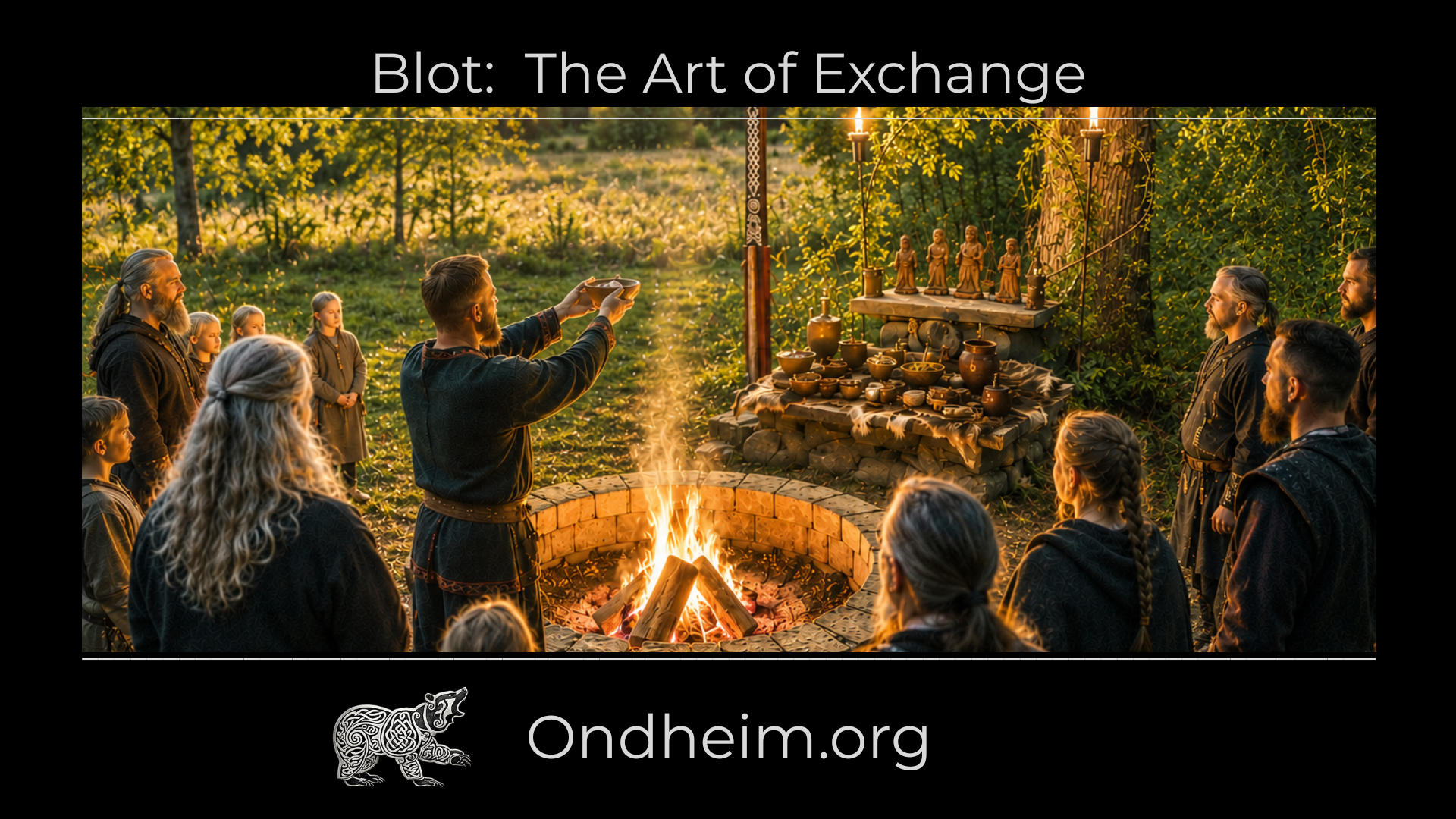
Gather the kin. A naming is a kin-event, same as a wedding. The child is being made kin, so the kin should be there to see it. Not an audience — witnesses. Like I said about weddings: your folk aren’t there to clap. They’re there to hold you to what you swear.
Hallow the space. Open the way you’d open anything that matters — with the hammer, marking the ground. Inside this boundary, words carry weight. That’s modern practice built on old instinct, and I’ll call it that.
The naming itself. This is the center, and it should be simple, because the history is simple. The father — or the mother, or whoever stands as head of the household; the sagas show fathers doing it, but the point is the household’s authority, not the father’s gender — takes the child, sprinkles water, and speaks the full name out loud before the folk. Water and a name. That’s the attested core, and I’d keep it bare. Don’t dress up the oldest thing we have.
Speak the name’s meaning. Say who the child is named for, and say it plain. “He’s named for my grandfather, who—” Tell the story. The sagas show us the expectation — the boy would turn out like his namesake — so say the expectation out loud. This is you telling the child, and the kin, what story this name carries and what you’re calling the child toward. This part is living tradition. The history gives us the custom; the words are ours.
Give the name-gift. The nafnfestr is attested, so give it attested weight. Something real — not a trinket. Ideally something with a story: a blade, a ring, a piece that belonged to the namesake if the family has one. The gift fastens the name. Say that when you give it.
Let the folk answer. Turn to the kin and ask it plain: do you witness this child as kin? And let them answer: we do. From this day the child has the protection of the folk, and the folk have the child’s name on their rolls. That’s the legal heart of the old rite translated into living practice — the child is now one of us, and there’s no un-saying it.
Then feast. I’m as serious about this as I was at the wedding. A naming without a feast is a meeting. The kin just gained a member. Eat together. That’s one of the oldest ways folk say “you’re one of us now.”
A few practical things, because somebody has to say them.
Keep it short. Twenty minutes. The guest of honor is a newborn, and newborns don’t do long ceremonies. Speak loud enough for the old folks in back, slow enough for the words to land, and then hand the baby back and eat.
Handle the legal name separately, the same way I said to handle the marriage license. The name you speak in the rite and the name on the birth certificate should be the same name — don’t get clever with two names — but the paperwork is paperwork. File it, done, then the rite is the rite.
And don’t perform it for the cameras. Same rule as the wedding. If people want a photo, give them a moment after. But the naming isn’t content. The second the parents are thinking about how this looks instead of what they’re doing, you’ve lost the thing.
Here’s the last thing. What you’re doing is speaking the first oath the kin ever speaks over a child. Not a promise the child makes — a promise the kin makes, to the child. We name you. We claim you. We give you a story to grow into and the luck of the family to carry, and we witness it so there’s no un-saying it. The water dries. The name doesn’t.
The ancestors would recognize that. Not the script — there never was a script. The act. Water, and a name, and the kin standing witness.
William J. McNamara Jr.






You must be logged in to post a comment.