
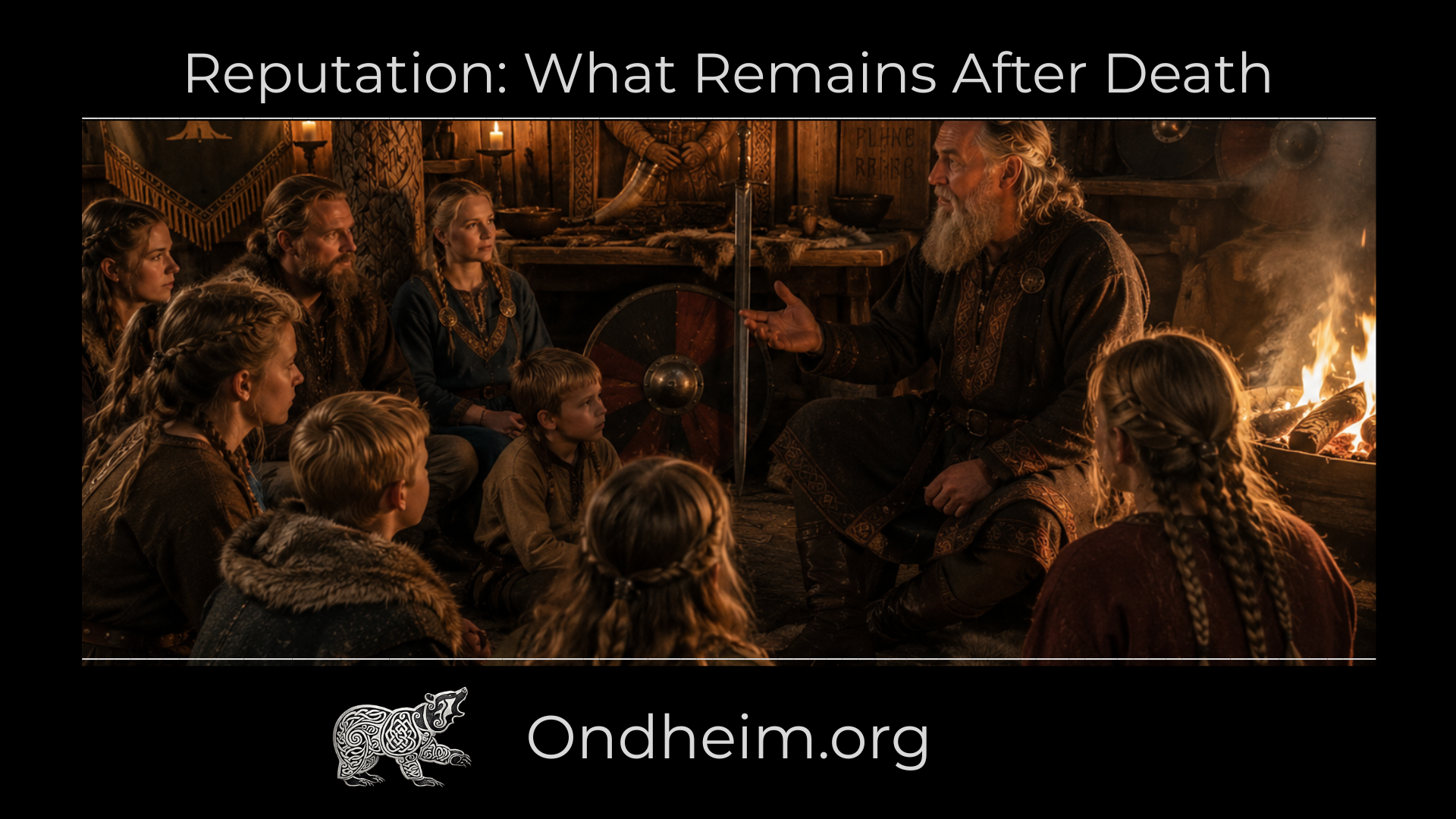

Every man dies.
This much was obvious within the older world. Strength fades. Wealth changes hands. The body weakens and eventually returns to the earth. Even great households and powerful leaders eventually pass from the living world into memory. Yet the surviving Norse and Germanic material repeatedly returns to a deeper question: what remains afterward?
Within the older Heathen worldview, death was never understood as the final measure of a life. What endured was not comfort, self-image, status, or personal intention alone, but the memory of conduct carried forward by the living. A person continued through reputation, descendants, story, obligation, and the continuing consequences left behind through deed.
This is one reason the surviving lore places such emphasis upon reputation.
Not as vanity or shallow public praise, but as the accumulated memory of how a person repeatedly conducted themselves among the folk across time.
In Hávamál, the reader is reminded that all material things eventually perish:
“Cattle die, and kinsmen die,
And so one dies one’s self;
But I know one thing that never dies:
The fame of a dead man’s deeds.”
The point is direct and practical. Wealth fades. The body fails. Even family lines shift across generations. Yet the memory of conduct can continue influencing the living long after death itself. The old traditions therefore treated reputation not as superficial image management, but as part of the enduring social memory of the community.
This reflects an important difference between the older worldview and many modern assumptions about identity. Modern people often define themselves inwardly through emotion, self-perception, personal authenticity, or intention. The older traditions were far more concerned with what a person consistently proved through visible conduct over time.
A man became known through how he carried obligation, whether he upheld his word, how he behaved under hardship, how he treated his own, and whether his conduct strengthened or weakened the people around him.
In this way, reputation represented accumulated witnessed behavior rather than self-definition.
The saga literature preserves this understanding repeatedly. In Njáls saga, even Njáll’s lack of a beard becomes a recurring point of insult aimed not merely at him personally, but at the standing and perceived strength of his household itself. The attacks carry social implications capable of provoking feud, dishonor, and violence because reputation affected not only the individual, but also the standing of the family line and the trust surrounding it within the wider community.
Likewise, in Egil’s Saga, Egil Skallagrímsson remains remembered centuries later not because he lived quietly or comfortably, but because his poetry, loyalties, violence, feuds, intellect, and force of character left enduring weight attached to his name. His reputation survived him because his conduct continued being remembered and spoken about long after the life of the body ended.
The sagas repeatedly preserve this understanding: what a person does among the folk continues echoing after death through memory, descendants, story, obligation, and the continuing consequences of action.
Within the older worldview, reputation and worth were deeply connected, though they were not identical. Worth was earned inwardly through discipline, sacrifice, reliability, courage, restraint, and right conduct. Reputation was how those qualities gradually became visible among the folk through repeated interaction across time.
A person might speak proudly about themselves. They might proclaim honor loudly before others. Yet reputation was never fully self-assigned. It formed gradually through the judgment of those who repeatedly witnessed a person’s conduct under real conditions across years of communal life.
This is one reason reputation could not be manufactured instantly.
A boast might attract attention briefly, but lasting reputation developed slowly through fulfilled obligation, steadiness under pressure, visible reliability, and the repeated carrying of responsibility over time.
The older traditions consistently suggest that isolated moments rarely defined a person completely. What mattered more was the enduring pattern created through repeated conduct. The person who carried burden steadily, honored obligation when it became difficult, and remained dependable through hardship gradually developed a reputation others learned to trust. Likewise, the person who spoke greatly but repeatedly failed in action eventually revealed the true weight of their character.
Within the older worldview, words alone possessed little lasting value without deed supporting them.
This is one reason oaths carried such gravity within Norse and broader Germanic societies. An oath was not casual emotional speech. It was a binding word placed publicly into the future, allowing others to measure the worth of the speaker afterward through whether the promise was ultimately fulfilled.
Reputation forms where word and action repeatedly meet.
A fulfilled oath strengthened trust because it demonstrated reliability under consequence. A broken oath damaged more than personal pride alone. It weakened confidence, frith, and trust not only in the individual, but in the stability of relationship itself.
The old traditions understood that people eventually forget many promises spoken casually in passing. What they remember is whether a person carried what they bound themselves to once hardship arrived.
This is why careless speech was viewed as dangerous. A person who swore endlessly without the discipline or strength to fulfill those words slowly weakened the worth attached to their own name.
Reputation therefore affected far more than the individual alone.
Within tribe, family, and community, frith depends heavily upon trust. Trust depends upon reliability. Reliability repeatedly demonstrated across time gradually becomes reputation. In this way, reputation formed part of the social structure helping communities maintain stability and continuity across generations.
Those whose reputation proved strong were trusted with responsibility, leadership, counsel, and obligation because their conduct repeatedly demonstrated steadiness and dependability. Those whose reputation became uncertain weakened trust around themselves and gradually eroded confidence within the community.
The older traditions therefore treated reputation not as vanity, but as part of the framework allowing lasting social order to endure.
A reliable person strengthens the folk around them because others learn that their word, conduct, and obligation can be trusted. An unreliable person creates uncertainty because no one fully knows whether responsibility placed upon them will ultimately hold.
Within the Heathen worldview, reputation also continues beyond death itself. The dead remain present through memory, inherited influence, story, descendants, and the continuing life of the folk. A person’s reputation shapes how their name is spoken afterward, how descendants remember them, whether their memory becomes a source of honor or warning, and what influence continues after the body itself has returned to the earth.
This understanding rests near the heart of ancestor veneration within many Heathen traditions. The honored dead are remembered not merely because they once existed, but because their conduct, sacrifice, wisdom, failures, and responsibilities continue shaping the living long afterward.
A family strengthened by the memory of its forebears carries more than genetics alone. It carries example, expectation, warning, inherited reputation, and accumulated memory.
The old traditions also understood that reputation without substance rarely endures for long. False reputation may rise quickly through appearance, manipulation, boast, or temporary recognition. Yet hardship eventually exposes what lacks real foundation beneath it. Time reveals character gradually because pressure forces conduct into the open where others can finally judge its substance clearly.
Only sustained action gives lasting strength to a name.
Every man dies.
What remains afterward is the measure of the life lived among others and the memory carried forward by the folk who continue speaking that name after death.
Within the older worldview, this is why reputation mattered so deeply. Not because people feared being forgotten alone, but because worth continued influencing the living through memory, descendant lines, deed, obligation, and the enduring continuity of the folk itself.
— William Lord
Ondheim Theodish Fellowship
Ondheim.org
Frith defines the boundary, oaths bind the word, kin carry obligation, and the hall holds witness and memory. The shape of obligation gives these structure, and through symbel they are spoken into wyrd and given force.
For additional primary sources and public-domain texts related to kinship, obligation, feud, and Germanic social structure, see our Links page.
You must be logged in to post a comment.