Building Worth: From Consumption to Stewardship

Modern culture has it backwards. It measures importance by volume — who’s loudest, who’s most visible, who got the most attention this week. Recognition first, substance if there’s time.

The old way ran the order in reverse. Achievement first. Recognition followed — if it followed at all — through witnessed conduct over time.

Worth wasn’t claimed loudly. It was built slowly, the way you build anything that has to hold weight: stone by stone, act by act, across years.

There’s a distinction worth making here, because reputation and worth aren’t the same thing, though they’re related. Reputation is what others remember about your conduct. Worth is deeper — it’s the capacity underneath: the ability to act consistently, carry obligation, endure hardship, and contribute something real to the folk. Reputation is how you’re perceived. Worth is what you’ve become through sustained effort.

The Hávamál understands formation, not instant transformation. Wisdom isn’t inherited and it isn’t downloaded — it’s cultivated through restraint, judgment, experience, and discipline.

“Cattle die, and kinsmen die, and so one dies one’s self; one thing I know that never dies, the fame of a dead man’s deeds.” (Hávamál 78)

What survives you isn’t your self-image. It’s the deeds, remembered by people who watched.

The sagas bear this out across centuries. Njáll (Njáls saga) isn’t remembered for physical prowess — he’s remembered for wisdom, restraint, counsel, judgment. His worth shows in how he thinks and advises, not in how loudly he announces himself. Egill’s (Egils saga) reputation wasn’t built in a single dramatic moment either. It came from decades of demonstrated skill, courage, intelligence, and force of personality — sustained, under pressure, over a lifetime.

That’s the pattern. Worth accumulates through pattern, not isolated event.

A man might fight bravely once. The question is whether he can be trusted repeatedly. He might speak wisely in a moment — can he counsel consistently across years? He might fulfill one oath — can he carry obligation through hardship, loss, and temptation? Worth is the answer to those questions, given in the form of a lived life.

This is why the old way put such weight on endurance. A single brave act gets attention. Worth requires sustained reliability — showing up the same way, holding the line, doing the work when nobody’s watching and when everybody is.

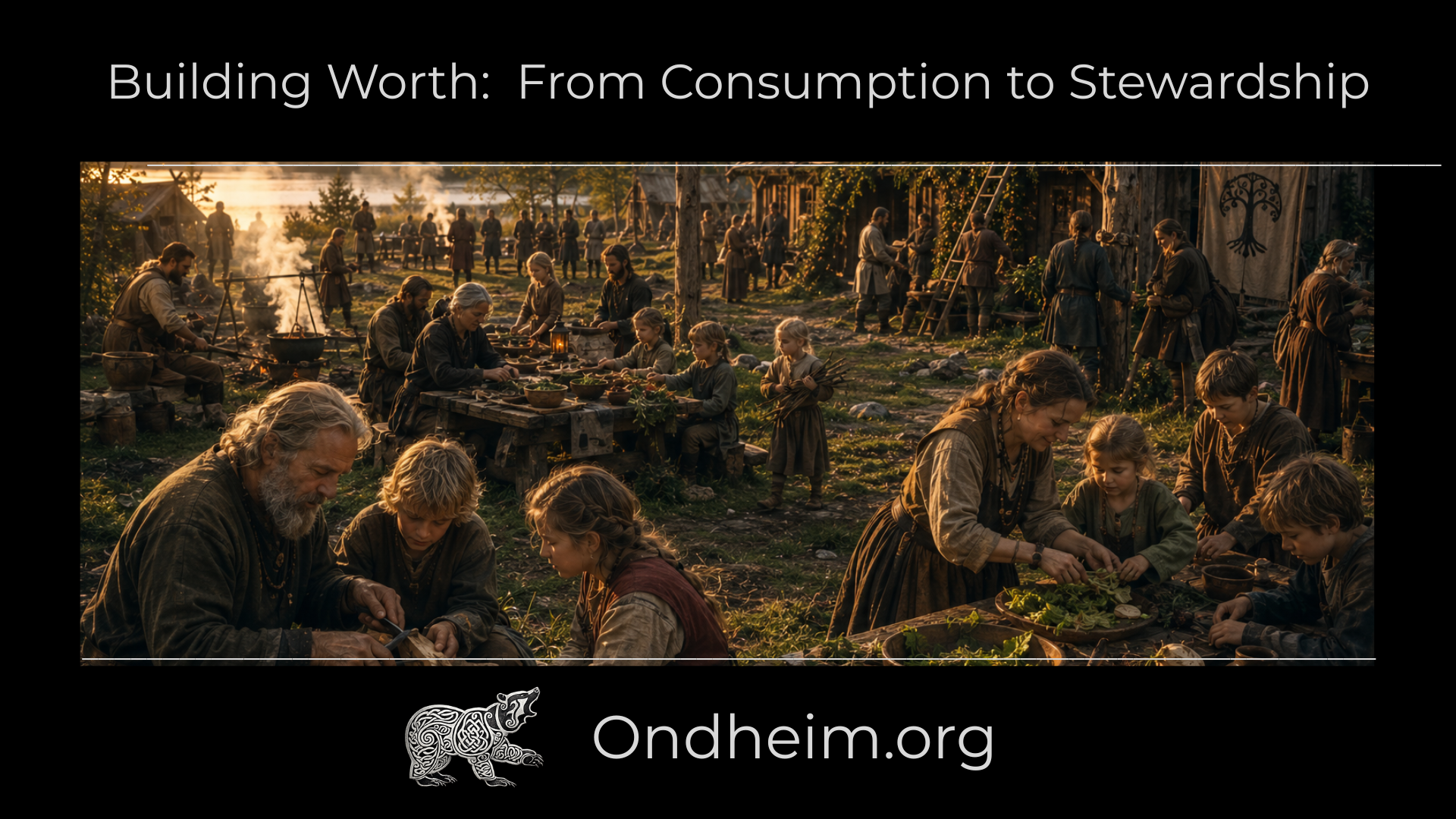
And work itself was part of the formation. Labor wasn’t just economic necessity; it shaped the man. Through work you learned discipline. Through repeated effort, skill. Through sustained contribution, others learned what they could expect from you. A farmer who tended his land faithfully for decades demonstrated reliability. A craftsman who produced consistently demonstrated mastery. A leader who judged fairly across many disputes demonstrated wisdom. Worth emerged through contribution, not declaration.

Boasting is where this gets teeth. In the old way, a boast wasn’t harmless self-promotion — it was a public claim that invited future testing. You put your worth before the judgment of others and accepted the consequences if reality didn’t match. That’s why worth couldn’t be manufactured with words. It had to be proven in deed, because the folk were going to check.

Leadership worked the same way. Authority wasn’t just inherited or seized — it had to be sustained through demonstrated capacity. A chieftain who judged poorly lost influence. A leader who failed to protect his people lost loyalty. A counselor whose advice kept failing lost trust. Worth was the foundation under authority. Without it, position went hollow.

So: build quietly. Act consistently. Fulfill obligation. Endure hardship without complaint. Contribute without demanding recognition. That’s not modesty as performance — it’s the actual mechanics of how worth gets made.

Worth cannot be claimed. It can only be built. And what gets built through sustained effort outlasts every loud proclamation.

Stone by stone. That’s the whole method.

William J. McNamara Jr.
Why We Gather

Modern people live surrounded by constant communication, yet many have never felt more isolated from the people around them. We move through crowded stores, workplaces, and cities without truly knowing our neighbors. Families often eat separately. Friends speak through screens more often than across tables. Entire communities form and dissolve without leaving lasting obligations behind. Many people no longer belong to anything that consistently asks responsibility, participation, sacrifice, or continuity from them.

The modern world offers endless interaction, but very little rootedness.

For most of human history, human beings did not live this way. People survived through tribes, households, villages, halls, assemblies, and tightly bound communities where repeated gathering was not optional social entertainment, but part of the structure that allowed a people to endure across generations. Meals were shared. Labor was shared. Rituals were shared. Stories, grief, celebration, hardship, and victory were carried collectively because survival itself depended heavily upon cooperation and continuity within the group.

A person understood who they were partly because they understood where they belonged.

Gathering therefore served practical and civilizational functions within ancestral societies. Through repeated communal meals, seasonal feasts, assemblies, rituals, and shared labor, communities transmitted memory, practical knowledge, obligation, custom, law, and identity across generations. Children learned how adults behaved. Elders remained connected to the life of the folk. Reputation formed publicly through repeated interaction. Trust developed gradually through visible conduct over time.

This pattern appears clearly throughout surviving Germanic material. In Beowulf, the hall is not important merely as architecture or scenery. What matters is what takes place there among the gathered people themselves. Warriors, leaders, households, and guests gather repeatedly to share food, exchange gifts, speak publicly, remember deeds, establish obligation, and reinforce social bonds through witnessed participation within the community.

The poem preserves recognizable patterns of communal life in which gathering together reinforced continuity and social cohesion. Speech occurred before witnesses. Reputation formed publicly. Stories preserved memory. Obligation was strengthened through repeated participation among the folk.

Modern Heathen gatherings often draw inspiration from these preserved patterns of communal life. Not because modern people imagine themselves literally recreating the world of Beowulf, but because the poem preserves recognizable examples of how communal gathering, witnessed speech, storytelling, ritual drinking, and repeated participation helped maintain continuity among a people over time.

The same principle appears historically in assemblies and þing gatherings throughout the Germanic world. People did not gather solely because it felt emotionally fulfilling to do so. Communities gathered because law, dispute resolution, alliance, trade, ritual obligation, seasonal observance, and social continuity required repeated physical participation among the people themselves.

A society cannot maintain continuity when its members exist only as isolated individuals detached from one another.

Modern society has weakened many of the older structures that once reinforced repeated communal participation. People move constantly, work in isolation, communicate digitally rather than physically, and build relationships that can disappear overnight. Convenience increasingly replaces continuity. Consumption increasingly replaces participation. Many modern gatherings revolve around distraction rather than contribution, and many people gradually become observers of life rather than active participants within enduring communities.

People watch constantly, but often build very little together.

The result is a growing sense of rootlessness. Many people hunger for belonging while simultaneously resisting the obligations that meaningful belonging requires. They desire connection without sacrifice, acceptance without accountability, and identity without participation. Yet real community has never functioned that way.

A meaningful gathering is not simply a group of people occupying the same physical location temporarily. It develops gradually through consistency, contribution, mutual obligation, repeated interaction, and shared experience carried across time. Trust is not declared instantly into existence. It forms slowly through reliability, visible conduct, and continued participation within the life of the group itself.

This is one reason ritual and tradition matter so deeply within enduring communities.

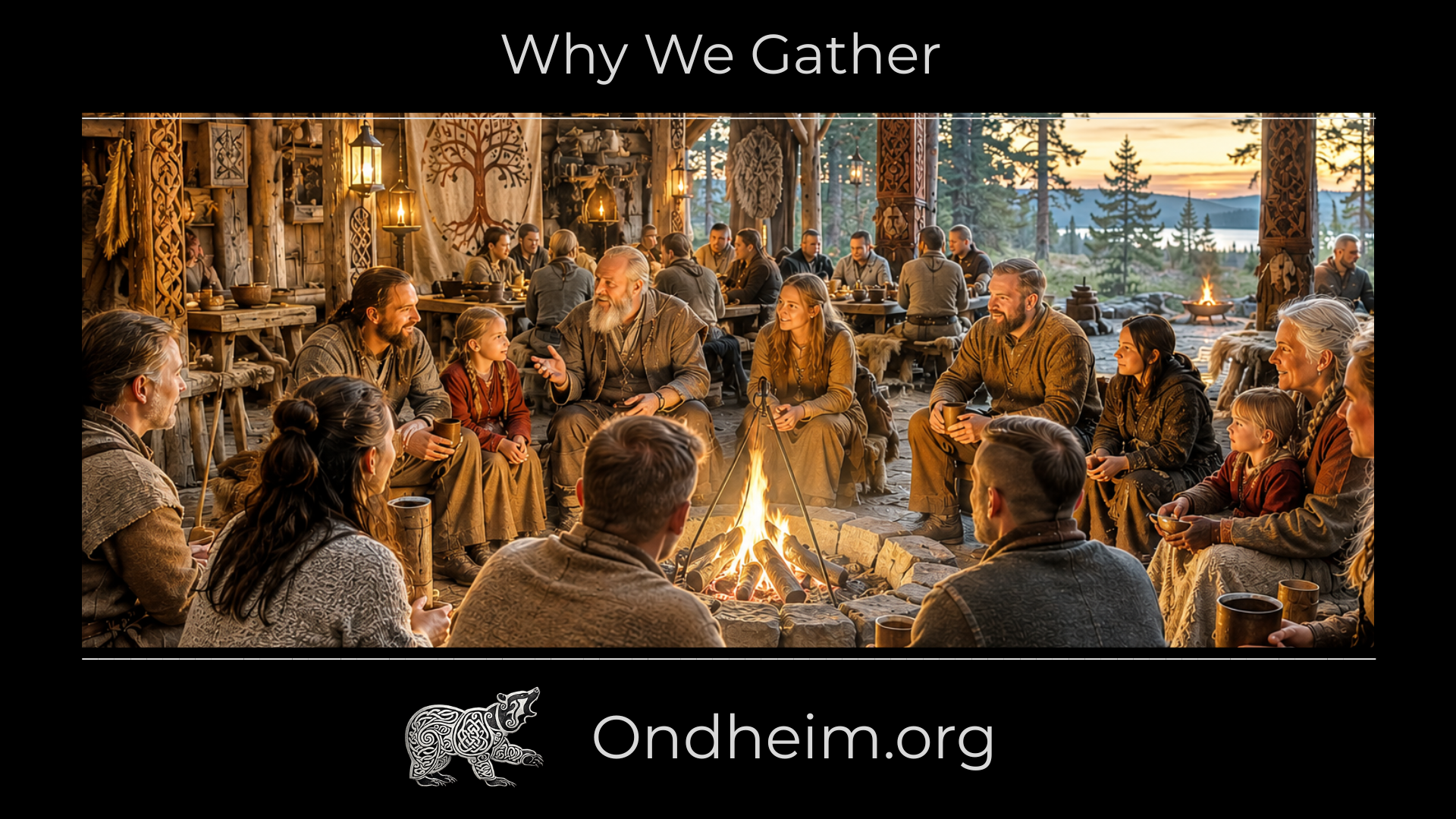
Ritual creates repeated actions filled with shared meaning. Traditions connect the living not only to one another, but also to those who came before them and those who will inherit what is preserved afterward. Seasonal holy tides, shared meals, gatherings around fires, ancestor remembrance, storytelling, ritual drinking, music, and repeated communal observance all help reinforce forms of continuity that modern life often neglects or fragments.

These practices are not simply exercises in nostalgia.

They answer longstanding human needs tied directly to memory, continuity, obligation, and social rootedness.

Over time, repeated gathering changes people. Relationships deepen. Shared memories accumulate. Children grow into adults within the presence of familiar faces. Elders pass on stories, warnings, skills, and expectations shaped through lived experience. Grief is carried collectively rather than privately. Obligations become real because they are repeatedly witnessed by others who remain present across years rather than moments.

Human beings leave parts of themselves behind in communities where life is lived honestly together over long periods of time.

This continuity matters because a people without shared memory eventually loses coherence. Without repeated gathering, stories disappear, obligations weaken, customs fade, and identity slowly fragments into isolated individual experience detached from larger continuity.

Repeated gathering helps prevent this fragmentation by reinforcing memory through participation itself.

Over time, people begin understanding themselves not merely as isolated individuals pursuing personal fulfillment, but as members of something extending backward through earlier generations and forward toward those who will eventually inherit what the present generation preserves or neglects.

This is one reason gathering carries meaning deeper than social convenience alone.

Gathering reminds people that they are not alone in the world. It teaches responsibility toward others. It allows wisdom, memory, and expectation to move between generations. It transforms strangers into companions and, over time, companions into kin through repeated participation, obligation, and shared experience.

A culture survives when its people continue gathering together in meaningful ways across time.

In an age increasingly defined by fragmentation, distraction, impermanence, and shallow connection, the deliberate act of gathering regularly with intention may remain one of the most important things a people can still do to preserve continuity, memory, and human rootedness across generations.

— William Lord
Ondheim Theodish Fellowship
Ondheim.org

Frith defines the boundary, oaths bind the word, kin carry obligation, and the hall holds witness and memory. The shape of obligation gives these structure, and through symbel they are spoken into wyrd and given force.

For additional primary sources and public-domain texts related to kinship, obligation, feud, and Germanic social structure, see our Links page.

Why the Horn Is Passed

People drink now to relax. To celebrate. To escape. Ritual drinking at modern gatherings is social lubrication — a way to loosen up.

The passing of the horn was nothing like that.

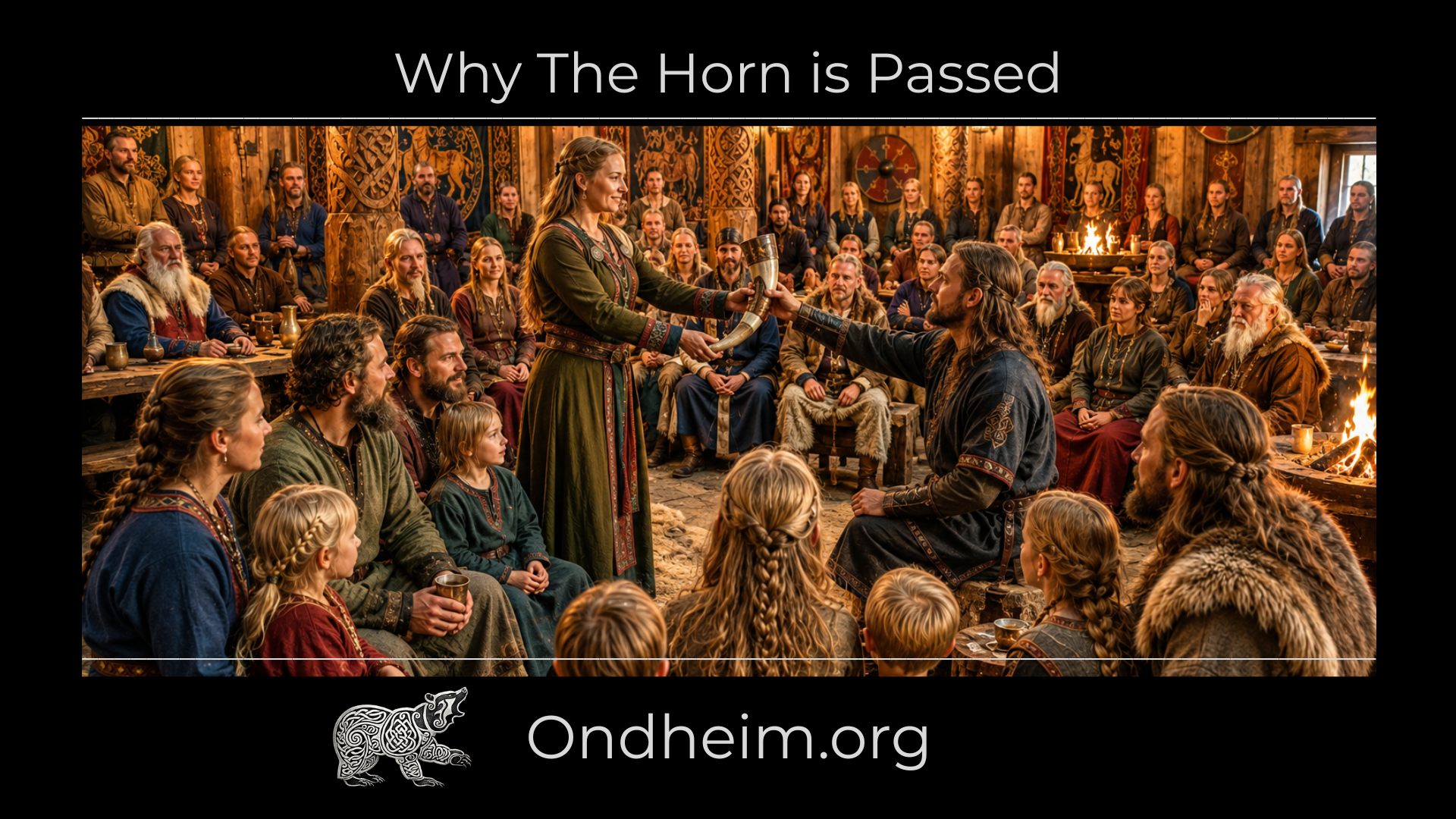
The horn moving hand to hand around the circle wasn’t about drinking. It was a structured ritual act — and through it, speech was witnessed, memory was affirmed, frith was maintained, and the folk held its continuity across time.

The sources show this plainly. In Beowulf, Wealhtheow the queen bears the cup through the hall in sequence, serving each warrior in turn. That’s not casual hospitality. It’s a formal act, and the order matters: to be served first is honor, to be served in turn is inclusion. The passing of the cup maps the social order where everyone can see it.

The sagas show the same pattern. Drinking is almost never just drinking — it accompanies oaths, boasts, toasts, formal declarations. The drink and the speech belong together.

And the Hávamál warns about what happens when the discipline fails (Hávamál 12):

Less good there lies | than most believe

In ale for mortal men;

For the more he drinks | the less does man

Of his mind the mastery hold.

The issue was never the horn. It was what the horn revealed when a man lost control of himself.

When the horn came to you, you drank and you spoke, and the folk listened. That simple structure did several things at once. It created order — each person spoke in turn, nobody drowned out, nobody overlooked. It created witness — what you said was heard by everyone present and couldn’t be denied later. It created accountability — words spoken before the folk carried consequence. It affirmed inclusion — every man who held the horn was confirmed as part of the folk. And it enacted continuity — the horn moving hand to hand, the unbroken chain made visible.

The horn was never just a vessel. It was an instrument of order.

The critical element was witness. Toasts to gods, to ancestors, to the folk. Boasts declared. Oaths sworn. Memory affirmed. All of it spoken while holding the horn, heard by all present. A boast made over the horn created public expectation. An oath sworn over the horn created binding obligation. A toast to the dead affirmed, before witnesses, that the chain remained unbroken.

That’s why the discipline of the horn ran so deep. To speak while holding it was to place your words before the judgment of the community.

The passing of the horn also held frith — the right order of the gathered folk, the condition of things working inside the boundary. Within the hallowed round, ordinary conflicts were set aside. Not resolved — set aside, in honor of the gathered folk and the holy powers. Each person received the horn in turn. Each was honored. No one excluded. The unbroken circle of passing hands showed the unbroken bonds of the folk.

To disrupt the passing — to refuse the horn, to speak out of turn, to break the order — was to break frith itself.

And the continuity was physical. The horn passing from elder to younger, hand to hand, enacted the transmission itself — tradition, obligation, identity, moving across time in a single gesture. Every man who held it stood in a chain reaching back to ancestors and forward to descendants. That’s why the toasts to the dead sat at the center of it. By drinking to those who came before, the living affirmed the chain was unbroken. The dead remembered. Their examples enduring. The folk continuing.

So what does it take to hold the horn rightly? Receive it with honor — it’s the folk affirming you belong. Speak with intention, because words over the horn carry weight. Listen with attention — every man’s speech deserves witness, including yours. Pass it with care, handing the chain to the next man unbroken. Hold frith inside the round — set the conflicts down while the horn moves. And remember what was spoken. You are the witness for others as they are for you.

The passing of the horn was never about drinking. It was how the folk maintained themselves — speech witnessed, accountability created, frith held, continuity enacted, hand to hand to hand.

The horn passes. The folk endure.

William J. McNamara Jr.

Oaths: The Weight of Binding Speech

Modern people make promises the way they make small talk — lightly, constantly, and with no intention of remembering them by next week. Words have gotten cheap.

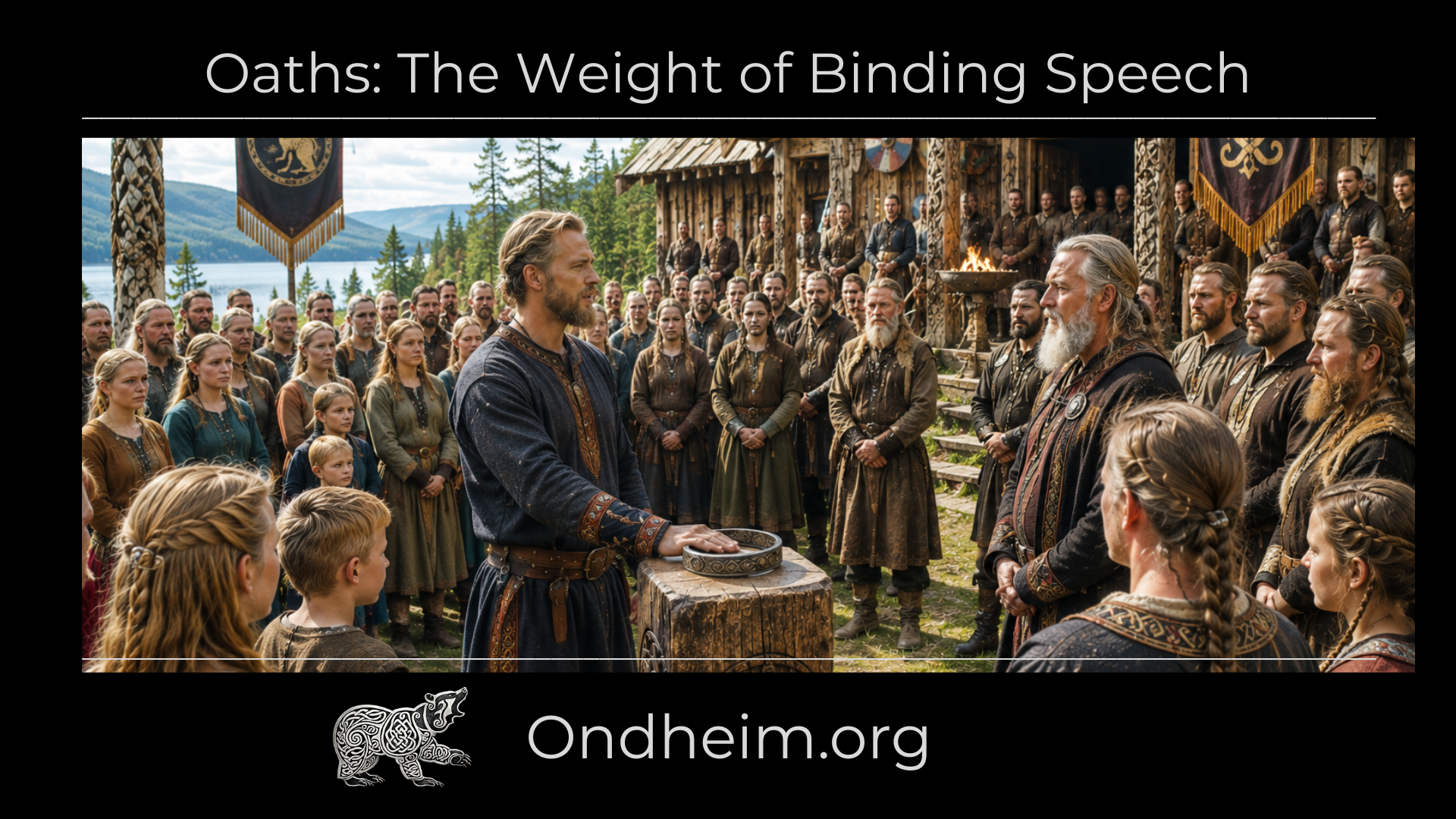
The old world didn't have that luxury. An oath wasn't a strong promise. It was a man binding himself to future action, witnessed by gods and men, with consequences for failure that ran deeper than embarrassment.

To swear was to put your honor, your reputation, and your standing in front of the folk for judgment.

The sources treat oath-breaking as one of the worst things a person can do. (Völuspá 39): "I saw there wading | through rivers wild / Treacherous men | and murderers too, / And workers of ill | with the wives of men; / There Nithhogg sucked | the blood of the slain, / And the wolf tore men; | would you know yet more?"

The treacherous — the oath-breakers, the ones whose word proved false — wading beside murderers. The violation of sworn word set alongside the taking of life. That's how heavily it weighed.

The sagas show the same thing from the other side: broken oaths don't just hurt the oath-breaker. They poison the ground around him. When a man's word proves worthless, nobody can plan with him, trust him, or stand beside him — and a man nobody can trust has no place in the tribe.

The Hávamál gives the positive law. (Hávamál 42): "To his friend a man | a friend shall prove, / And gifts with gifts requite; / But men shall mocking | with mockery answer, / And fraud with falsehood meet."

Loyalty isn't a feeling. It's a record — what you actually did, measured against what you said you'd do.

That's the weight of the oath: it bridges present speech and future deed. When a man swears, he's not describing how he feels right now. He's committing what he will do later — regardless of what changes, regardless of what it costs. That's what makes trust possible. When oaths are kept, the folk can depend on each other. Plans get made. Obligations get undertaken. The order holds.

When oaths break casually, trust erodes. And when trust erodes, everything the folk are built on starts to go.

Not every word is an oath, though. The sources show what made an oath binding: formality — sworn in structured settings, in symbel, at the assembly, before witnesses. Witness — gods, ancestors, or the gathered folk heard it and would remember. Intention — the man swearing understood the weight of what he was taking on. And specificity — the oath committed to particular action, not vague sentiment. Those four things turned speech into bond. Without them, words were promises or hopes. With them, they were oaths.

The gods were often called as witnesses, and that wasn't decoration. To swear by Óðinn or Þórr was to invite their judgment along with the folk's — which is why the broken oath carried spiritual consequence, not just social. The treacherous in Völuspá aren't just unpopular. They're damned.

Inside the tribe, oaths did the heavy work: they made commitments reliable, so men could depend on sworn word. They marked the serious transitions — entry into the tribe, taking office, marriage. They settled disputes by creating agreements that bound. And they proved seriousness — a man willing to swear showed he understood what he was undertaking.

A tribe where oaths are kept can function. A tribe where they're broken casually is already in decline.

Which is why the wise swore rarely. The Hávamál counsels restraint in speech across the whole poem, and it applies double to oaths. To swear lightly is to risk being bound to what you can't — or shouldn't — fulfill. To swear falsely is to destroy your own standing with your own mouth.

So the rule is simple: swear rarely, and only where it matters. Swear what you mean — never what you don't. Swear specifically — know exactly what you're committing to. And once sworn, fulfill it completely, whatever it costs. Changed circumstances don't release you. Difficulty doesn't release you. The oath stands until it's kept.

To honor the weight of oaths: understand what one is — a binding, not a gesture. Never swear lightly or carelessly. Keep every oath you swear, regardless of cost. Hold others to theirs, because accountability is collective, not private. Accept what oath-breaking earns — socially and spiritually. And teach the young the weight of words, so the chain doesn't break with you.

Oaths were the bedrock of trust. They turned speech into obligation, witnessed by gods and men, with consequences that ran past death.

In a world where words are cheap, the old corrective still holds: speak carefully, swear rarely, and keep absolutely what you've sworn.

The weight of the oath is the weight of the man who swears it.

What is sworn must stand.

William J. McNamara Jr.