
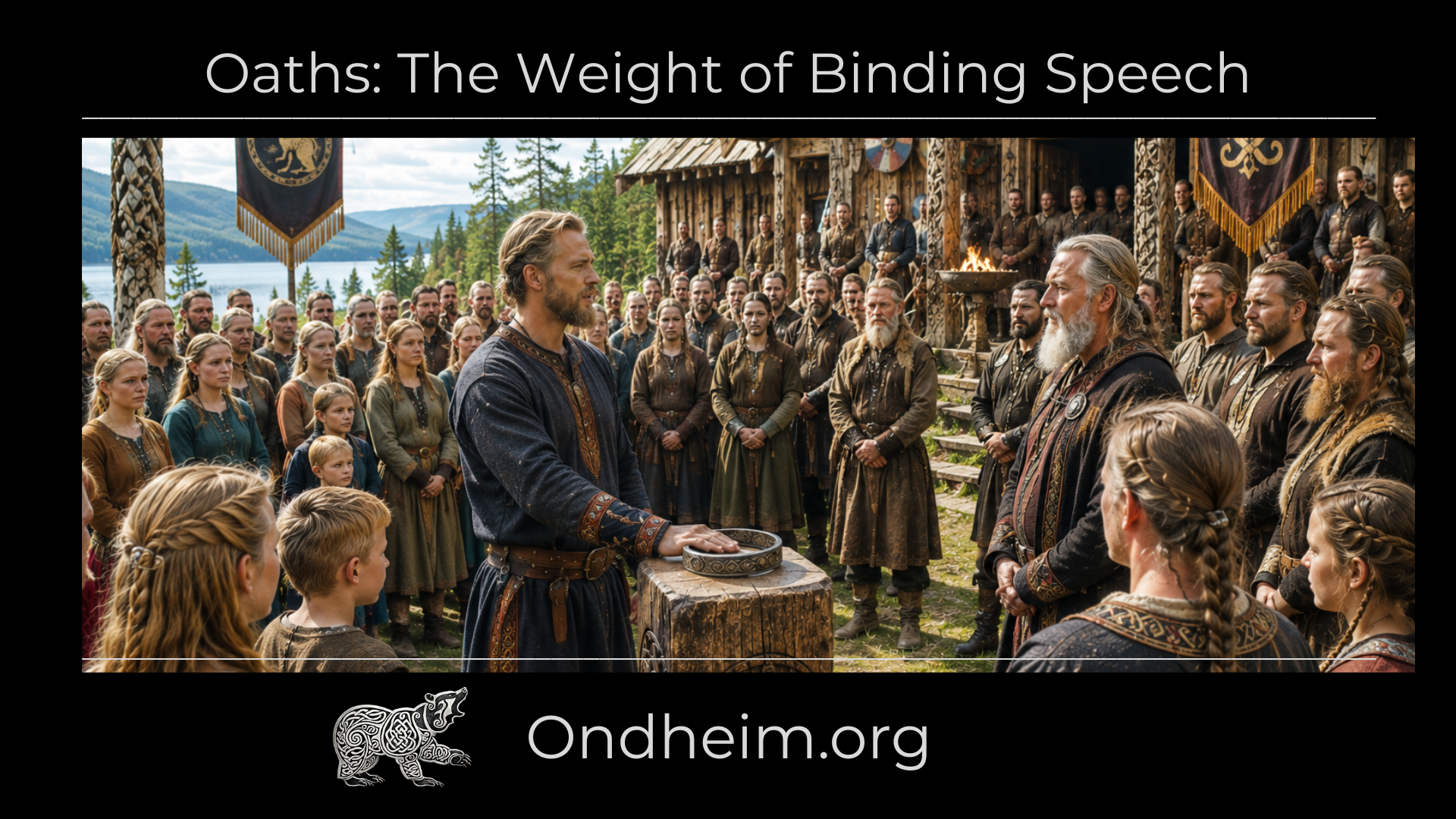
Modern people make promises the way they make small talk — lightly, constantly, and with no intention of remembering them by next week. Words have gotten cheap.
The old world didn't have that luxury. An oath wasn't a strong promise. It was a man binding himself to future action, witnessed by gods and men, with consequences for failure that ran deeper than embarrassment.
To swear was to put your honor, your reputation, and your standing in front of the folk for judgment.
The sources treat oath-breaking as one of the worst things a person can do. (Völuspá 39): "I saw there wading | through rivers wild / Treacherous men | and murderers too, / And workers of ill | with the wives of men; / There Nithhogg sucked | the blood of the slain, / And the wolf tore men; | would you know yet more?"
The treacherous — the oath-breakers, the ones whose word proved false — wading beside murderers. The violation of sworn word set alongside the taking of life. That's how heavily it weighed.
The sagas show the same thing from the other side: broken oaths don't just hurt the oath-breaker. They poison the ground around him. When a man's word proves worthless, nobody can plan with him, trust him, or stand beside him — and a man nobody can trust has no place in the tribe.
The Hávamál gives the positive law. (Hávamál 42): "To his friend a man | a friend shall prove, / And gifts with gifts requite; / But men shall mocking | with mockery answer, / And fraud with falsehood meet."
Loyalty isn't a feeling. It's a record — what you actually did, measured against what you said you'd do.
That's the weight of the oath: it bridges present speech and future deed. When a man swears, he's not describing how he feels right now. He's committing what he will do later — regardless of what changes, regardless of what it costs. That's what makes trust possible. When oaths are kept, the folk can depend on each other. Plans get made. Obligations get undertaken. The order holds.
When oaths break casually, trust erodes. And when trust erodes, everything the folk are built on starts to go.
Not every word is an oath, though. The sources show what made an oath binding: formality — sworn in structured settings, in symbel, at the assembly, before witnesses. Witness — gods, ancestors, or the gathered folk heard it and would remember. Intention — the man swearing understood the weight of what he was taking on. And specificity — the oath committed to particular action, not vague sentiment. Those four things turned speech into bond. Without them, words were promises or hopes. With them, they were oaths.
The gods were often called as witnesses, and that wasn't decoration. To swear by Óðinn or Þórr was to invite their judgment along with the folk's — which is why the broken oath carried spiritual consequence, not just social. The treacherous in Völuspá aren't just unpopular. They're damned.
Inside the tribe, oaths did the heavy work: they made commitments reliable, so men could depend on sworn word. They marked the serious transitions — entry into the tribe, taking office, marriage. They settled disputes by creating agreements that bound. And they proved seriousness — a man willing to swear showed he understood what he was undertaking.
A tribe where oaths are kept can function. A tribe where they're broken casually is already in decline.
Which is why the wise swore rarely. The Hávamál counsels restraint in speech across the whole poem, and it applies double to oaths. To swear lightly is to risk being bound to what you can't — or shouldn't — fulfill. To swear falsely is to destroy your own standing with your own mouth.
So the rule is simple: swear rarely, and only where it matters. Swear what you mean — never what you don't. Swear specifically — know exactly what you're committing to. And once sworn, fulfill it completely, whatever it costs. Changed circumstances don't release you. Difficulty doesn't release you. The oath stands until it's kept.
To honor the weight of oaths: understand what one is — a binding, not a gesture. Never swear lightly or carelessly. Keep every oath you swear, regardless of cost. Hold others to theirs, because accountability is collective, not private. Accept what oath-breaking earns — socially and spiritually. And teach the young the weight of words, so the chain doesn't break with you.
Oaths were the bedrock of trust. They turned speech into obligation, witnessed by gods and men, with consequences that ran past death.
In a world where words are cheap, the old corrective still holds: speak carefully, swear rarely, and keep absolutely what you've sworn.
The weight of the oath is the weight of the man who swears it.
What is sworn must stand.
William J. McNamara Jr.