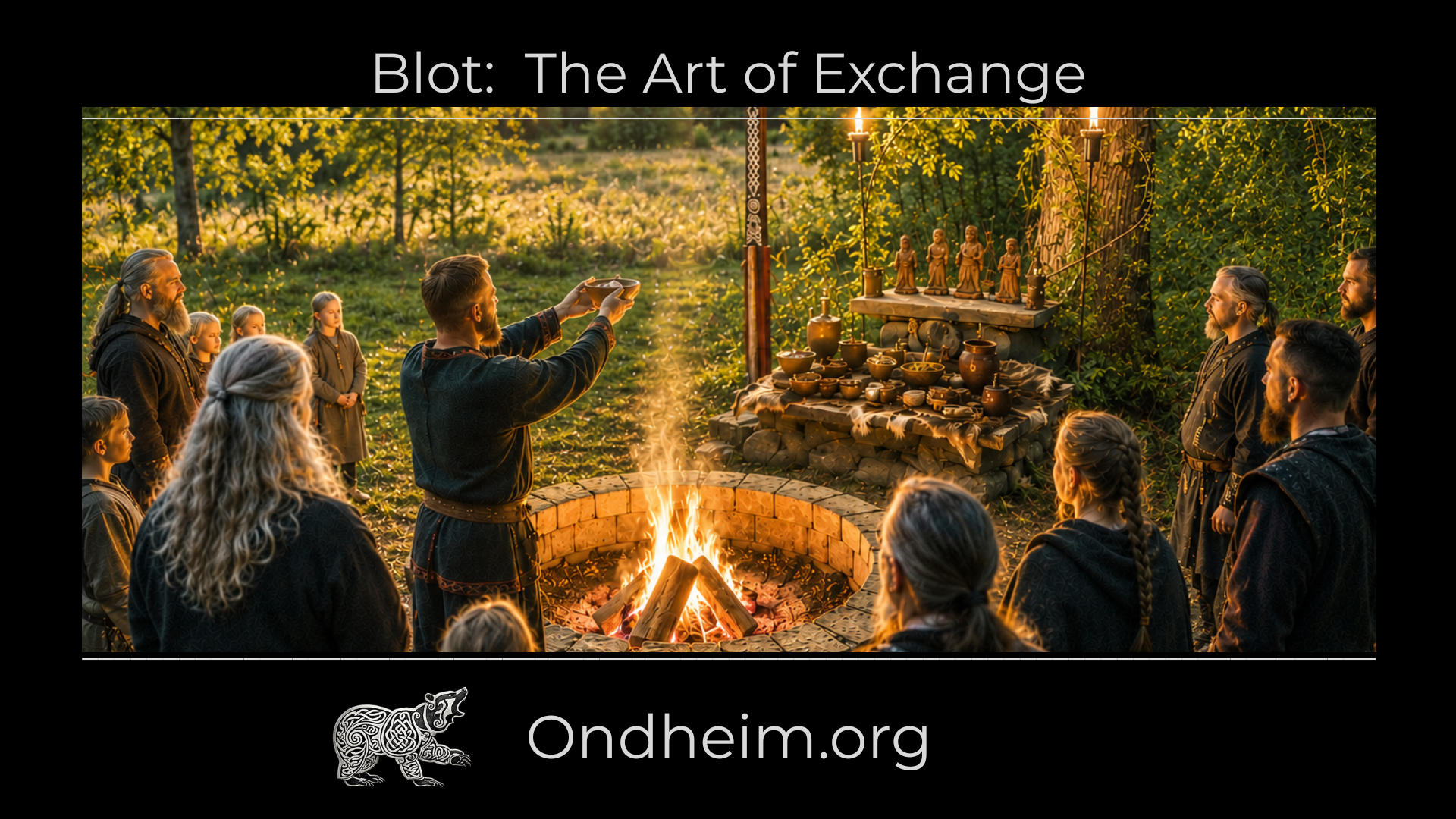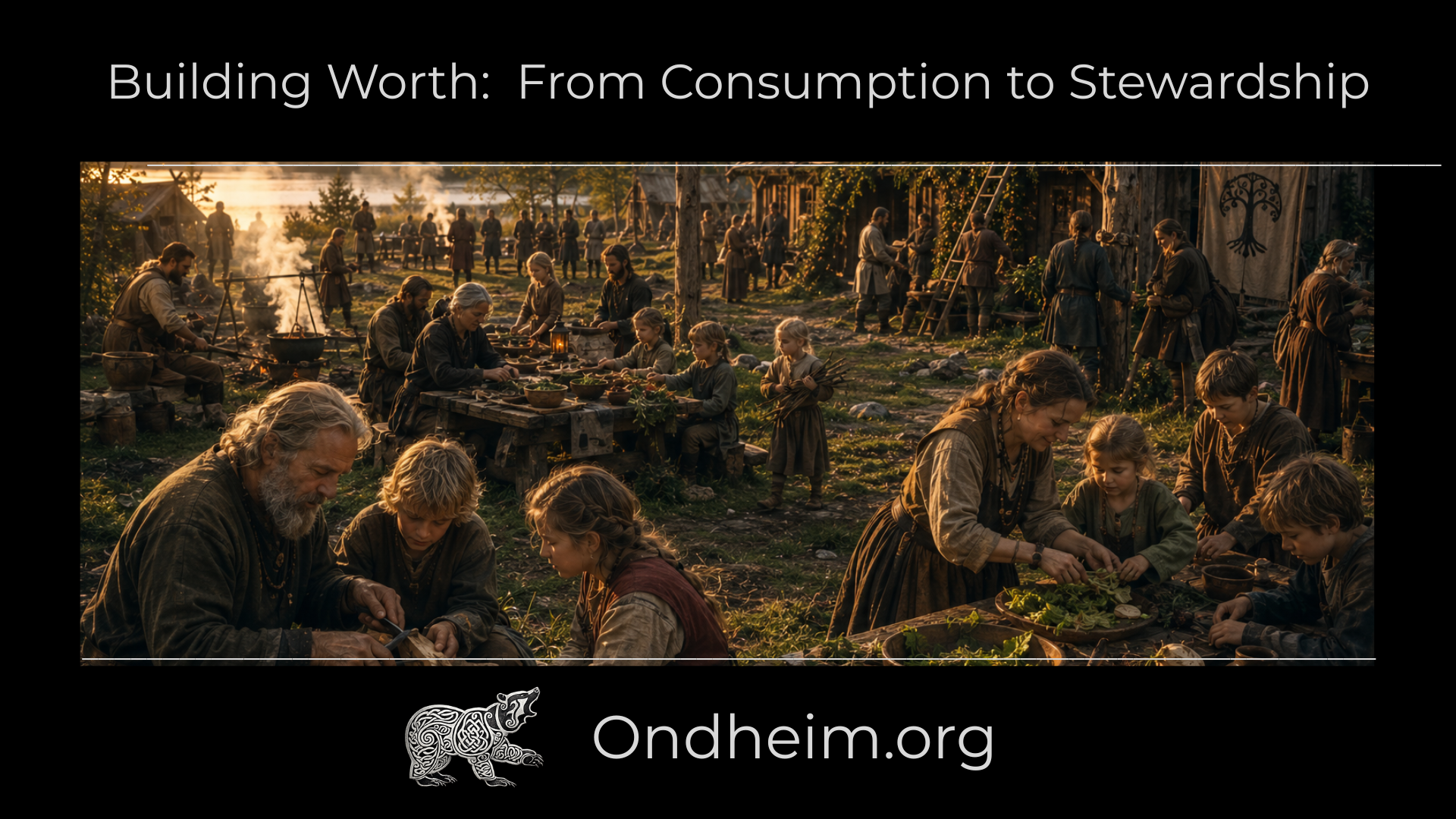
Blót: The Act of Exchange

Blót: The Act of Exchange

No lasting relationship survives without continued recognition.

Modern people often struggle to understand blót because they inherit a world increasingly detached from reciprocity. Relationships become temporary. Communities become transactional. Gratitude fades quickly. Obligation weakens the moment inconvenience appears. People consume constantly while giving very little in return.

The older worldview understood something fundamentally different: meaningful relationships survive through continued exchange maintained across time.

This principle applied not only between human beings, but also between the folk, the Gods, the ancestors, the wights, and the Holy Powers.

This principle applied not only between human beings, but also between the folk, the Gods, the ancestors, the wights, and the Holy Powers.

Within Ondheim, it is important to distinguish blót from broader ritual observance generally. Not every ritual is automatically called a blót. Historically, blót carried specific sacrificial associations tied to offering, blood, communal sacrifice, and reciprocal gifting. Ritual observances without sacrificial blood offering are more accurately described as fainings or rituals rather than blóts proper.

This distinction is not made merely for aesthetic preference.

It reflects the historical and linguistic weight attached to the term itself.

The Old Norse word blót is strongly associated with sacrifice and sacrificial offering, and many scholars have connected the older Germanic roots of the word to concepts involving blood, sacrificial staining, or consecration through offering. Historical descriptions of blót repeatedly involve sacrificial slaughter, hlaut bowls filled with blood, ritual sprinkling, and communal sacrificial feasts shared among the gathered folk.

The surviving sources preserve this understanding clearly. In Heimskringla, sacrificial rites involve blood collected within hlaut bowls and used to hallow altars, idols, and ritual spaces through sprinkling. Adam of Bremen likewise describes sacrificial rites involving both offering and communal feasting, though his accounts must be approached cautiously and critically rather than treated as perfect historical authority.

Even allowing for disagreement concerning details, the broader pattern remains consistent: historically, blót referred to sacrificial gifting tied directly to offering, blood, communal participation, and reciprocal relationship.

Understanding this helps clarify the deeper purpose behind the rite itself.

Blót is not symbolic worship performed merely to express belief, nor passive admiration directed upward toward distant divine figures. It is a deliberate act of reciprocal gifting through which relationship is maintained, strengthened, and recognized across time.

The older worldview consistently understood that all meaningful relationships require continued exchange.

A friend who never gives eventually ceases behaving like a friend. A man who only takes weakens the bonds surrounding him. A people who forget gratitude gradually lose connection not only to the gods and ancestors, but to one another.

This is one reason reciprocity appears so consistently throughout the surviving wisdom material. In Hávamál, the reader is reminded:

“A man should be a friend to his friend
And repay gift with gift…”

The wisdom extends far beyond hospitality alone. Reciprocity formed one of the foundational ways the older world understood relationship itself.

The gift cycle extended outward through every layer of communal life. Kin gave to kin. Lords rewarded loyalty. Hospitality created obligation. Generosity strengthened frith. Ancestors remained honored through continued remembrance. Offerings maintained relationship between the folk and the Holy Powers.

This was not blind devotion.

Nor was it commercial transaction.

Modern people often misunderstand offering immediately because they interpret words like exchange, sacrifice, or gift through the lens of economics and commerce. They imagine bargaining, purchasing favor, or attempting to manipulate divine powers through payment.

But blót is not transactional spirituality.

A transaction seeks immediate repayment. A relationship survives through repeated exchange maintained over long periods of time.

Healthy kinship does not survive by calculating exact repayment for every kindness given. A father does not feed his children while tallying debt constantly in the background. Yet relationships also weaken once giving disappears entirely. Gratitude eventually requires visible action or recognition rather than emotion alone.

The older worldview rejected both cold transaction and endless expectation without reciprocity.

Blót exists within this larger understanding of continued relational maintenance.

The folk give:
food,
drink,
labor,
effort,
sacrifice,
recognition,
time,
and honor.

Not because the gods require physical sustenance in simplistic material terms, but because giving itself reinforces continued relationship.

To give is to acknowledge.

And acknowledgment sustains connection.

This extends not only toward the gods, but also toward ancestors and wights. The older worldview did not imagine the world as spiritually empty or disconnected. Human beings existed within a layered network of visible and invisible relationships requiring recognition, respect, maintenance, and continued awareness.

Blót helps maintain those relationships through repeated reciprocal action.

This is one reason consistency matters far more than isolated dramatic intensity. A single offering performed theatrically carries far less weight than years of repeated recognition maintained steadily across time.

Communities remember patterns of conduct.

Over time, repeated giving reveals commitment just as repeated absence eventually reveals neglect.

The older worldview also understood that the value of sacrifice cannot be measured solely through economics or outward display. The worth of a gift rests partly in burden, consistency, sincerity, effort, and recognition.

A simple offering given sincerely may carry greater meaning than lavish display emptied of thought or genuine acknowledgment.

How a person gives often reveals something important about their character.

A man who gives thoughtlessly reveals thoughtlessness. A man who gives only when convenient reveals convenience. A man who gives steadily despite hardship reveals commitment.

Blót therefore affects not only the relationship between the folk and the Holy Powers, but also the relationships within the folk itself. Shared offering strengthens communal alignment because the tribe stands together in shared recognition, shared gratitude, and shared participation within the same cycle of reciprocity.

Children raised within such practices absorb these realities gradually over time. They learn that giving matters. They learn that gratitude requires action rather than feeling alone. They learn that relationships survive through continued maintenance rather than passive emotional attachment.

Like much within the older worldview, these lessons are transmitted less through abstract doctrine than through repeated lived participation within communal life itself.

Within Ondheim, blót remains important because the world still functions according to these realities whether modern people acknowledge them or not. No lasting relationship survives through endless taking. No people remain healthy once gratitude disappears completely. No community endures once recognition collapses into entitlement and consumption alone.

Blót reminds the folk that relationship itself requires maintenance repeatedly across time.

The gift strengthens the bond.

And bonds maintained across generations become part of what allows a people to endure.

— William Lord
Ondheim Theodish Fellowship
Ondheim.org

— William Lord
Ondheim Theodish Fellowship
Ondheim.org

Frith defines the boundary, oaths bind the word, kin carry obligation, and the hall holds witness and memory. The shape of obligation gives these structure, and through symbel they are spoken into wyrd and given force.

For additional primary sources and public-domain texts related to kinship, obligation, feud, and Germanic social structure, see our Links page.

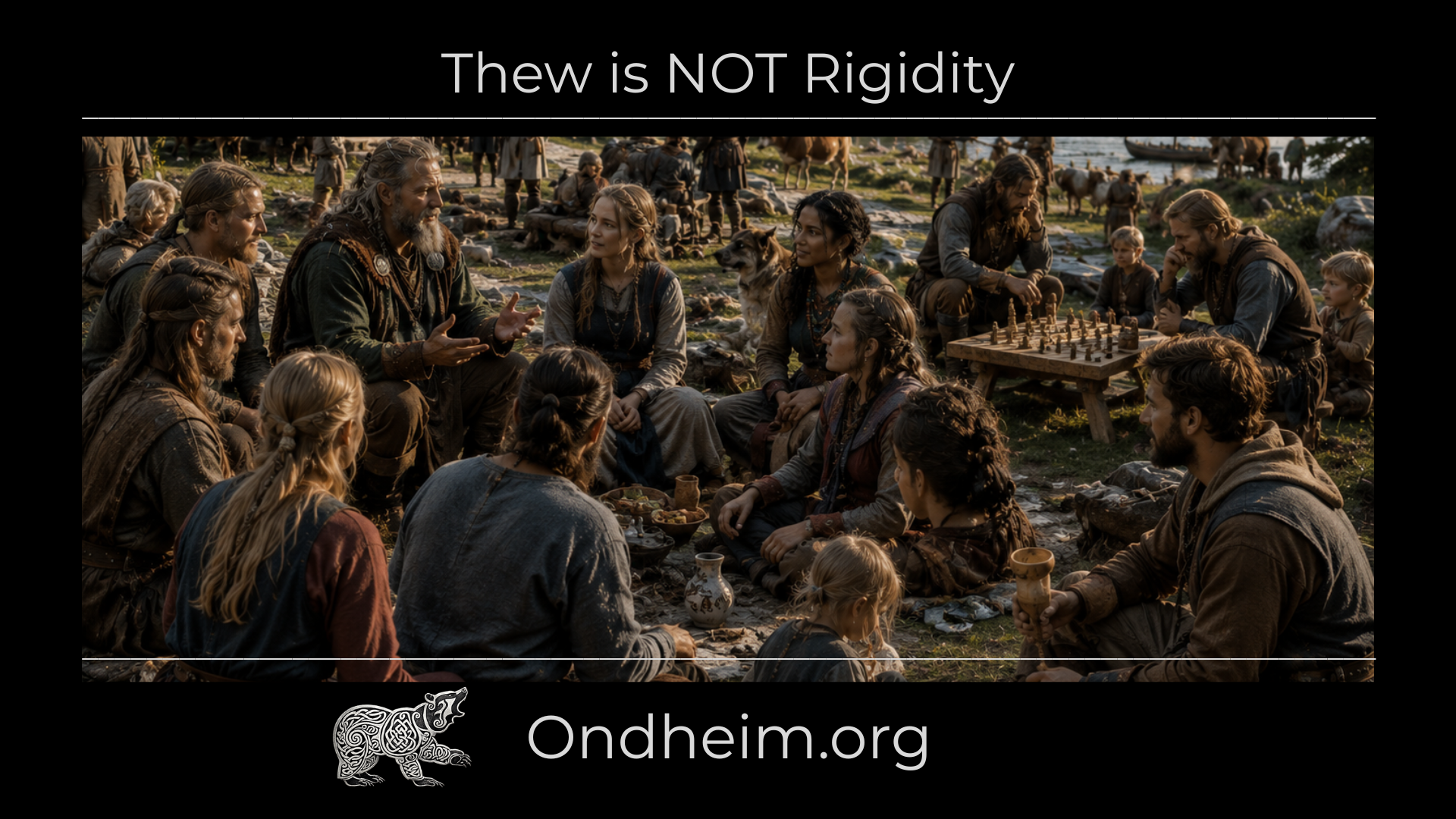
Thew is NOT Rigidity


Thew Is Not Rigidity

Modern people increasingly seek certainty through categorization. Everything must fit neatly into a box. Every disagreement becomes interpreted as loyalty or betrayal. Human beings are often evaluated through labels long before their actual conduct, contribution, responsibility, or character are seriously examined.

The result is a society that increasingly struggles with discernment.

People often stop evaluating individuals through lived relationship, demonstrated behavior, trustworthiness, reliability, and contribution to the communities around them. Instead, broad categories increasingly replace direct judgment. Political categories. Social categories. Ideological categories. Once a label is applied, many people stop looking deeper into the individual standing before them.

Within Theodish thought, the concept of thew offers a very different framework for understanding continuity, community, obligation, and human relationship. Thew is not merely law, doctrine, or rigid ideology. It is inherited custom, lived expectation, communal understanding, precedent, obligation, memory, relationship, and accumulated wisdom carried across generations within the life of a people.

Most importantly, thew functions as something living rather than mechanically fixed.

A codified legal system may attempt to apply identical standards to every situation regardless of changing context or consequence. Living thew does not function entirely that way. Thew requires discernment because human life itself contains changing circumstances, competing obligations, incomplete information, and relationships that cannot always be reduced to rigid formula.

This adaptive quality appears repeatedly throughout the surviving historical material. Different Germanic tribes maintained different customs. Different communities interpreted obligation differently. Even the Icelandic sagas preserve negotiation, reinterpretation, tension, compromise, arbitration, and disagreement concerning justice, obligation, and proper conduct.

This was not evidence of collapse or disorder.

It reflected the reality that living communities must continuously balance continuity with adaptation.

The Icelandic legal tradition especially reveals this clearly. Disputes were not always resolved through simplistic mechanical application of universal rules. Communities gathered at assemblies and þing in order to negotiate competing obligations, preserve social stability, arbitrate conflict, and maintain continuity within changing circumstances. The goal was not abstract ideological perfection. The goal was preserving the functioning life of the people.

This becomes especially visible in Njáls saga, where law, honor, kinship obligation, revenge, compromise, and social consequence repeatedly collide in ways that resist simplistic resolution. The saga consistently portrays human life as layered, relational, and often morally complex rather than mechanically reducible to rigid categories.

Modern thinking increasingly struggles with this kind of complexity.

People often become categories before they are recognized as human beings. Once labeled, nuance disappears. Individual conduct disappears. Relationship disappears. A person may be judged entirely through political affiliation, racial category, ideology, or abstract social identity before anyone seriously evaluates whether that person acts honorably, contributes meaningfully, strengthens the people around them, or fulfills obligation responsibly.

This creates a society that becomes less discerning the more heavily it depends upon categorization.

Within a living tribal worldview, belonging is not merely theoretical. It is relational, demonstrated, and reinforced gradually through participation, loyalty, contribution, trust, responsibility, sacrifice, and repeated involvement within the life of the community itself.

A tribe survives because its members actively maintain it through conduct rather than merely declaring attachment to it abstractly.

This is one reason simplistic racial reductionism ultimately fails as a meaningful measure of worth, loyalty, or belonging. Blood alone does not guarantee honorable conduct, contribution, wisdom, or reliability. Likewise, people born outside a community may eventually become trusted members of it through years of demonstrated loyalty, sacrifice, contribution, and right action.

The older worldview consistently evaluated human beings through lived relationship and observed conduct rather than simplistic abstraction alone.

This does not mean continuity, identity, inherited tradition, and shared worldview are meaningless. Quite the opposite. A people without continuity eventually dissolves. A people without shared expectation loses trust. A people without inherited memory loses direction.

But continuity does not require rigidity.

And rootedness does not require intellectual imprisonment.

Living traditions survive through balance. A worldview must remain rooted strongly enough to preserve identity, continuity, and direction while also remaining flexible enough to adapt to changing conditions without destroying itself in the process.

Even the surviving stories preserve complexity rather than simplistic ideological certainty. The Gods themselves embody contradiction and layered identity simultaneously. Odin is wisdom and frenzy, ruler and wanderer, seeker and manipulator all at once. The older worldview recognized that reality itself contains tension, ambiguity, competing obligations, and imperfect choices.

Rigid systems often seek universal categories, universal answers, and mechanically consistent applications detached from circumstance. Human beings do not actually live that way. Real communities must continuously navigate incomplete information, changing conditions, conflicting obligations, and evolving relationships.

A living people therefore requires discernment more than rigid abstraction.

Discernment requires observation, maturity, wisdom, memory, and the willingness to judge individuals through conduct rather than ideological convenience. This is more difficult than simplistic categorization because it requires personal responsibility rather than automatic judgment through predetermined labels.

Yet it also creates stronger communities and healthier continuity.

Worldviews are rarely transmitted through abstract instruction alone. They are absorbed gradually through lived participation: through observing conduct, hearing stories repeated, participating in communal life, watching obligations fulfilled, and existing within a community where values are embodied consistently rather than merely proclaimed.

Children especially absorb what they repeatedly experience around them.

This is one reason living traditions depend so heavily upon continuity of conduct rather than doctrinal perfection alone.

The goal of a living worldview is not to imprison people within rigid intellectual systems. The goal is to cultivate people capable of carrying the worldview forward with wisdom, adaptability, discernment, rootedness, and strength.

That is why thew must remain living.

Once a tradition becomes completely incapable of adaptation, it ceases functioning as living continuity and gradually becomes preservation for its own sake. Yet a people abandoning all continuity, expectation, memory, and rooted identity dissolves equally into fragmentation and directionless individualism.

The challenge is not choosing between rigidity and rootlessness.

The challenge is preserving continuity while remaining capable of wise adaptation to reality across generations.

This balance is not weakness.

Historically, it is one of the primary reasons human communities survive at all.

— William Lord
Ondheim Theodish Fellowship
Ondheim.org


Frith defines the boundary, oaths bind the word, kin carry obligation, and the hall holds witness and memory. The shape of obligation gives these structure, and through symbel they are spoken into wyrd and given force.

For additional primary sources and public-domain texts related to kinship, obligation, feud, and Germanic social structure, see our Links page.

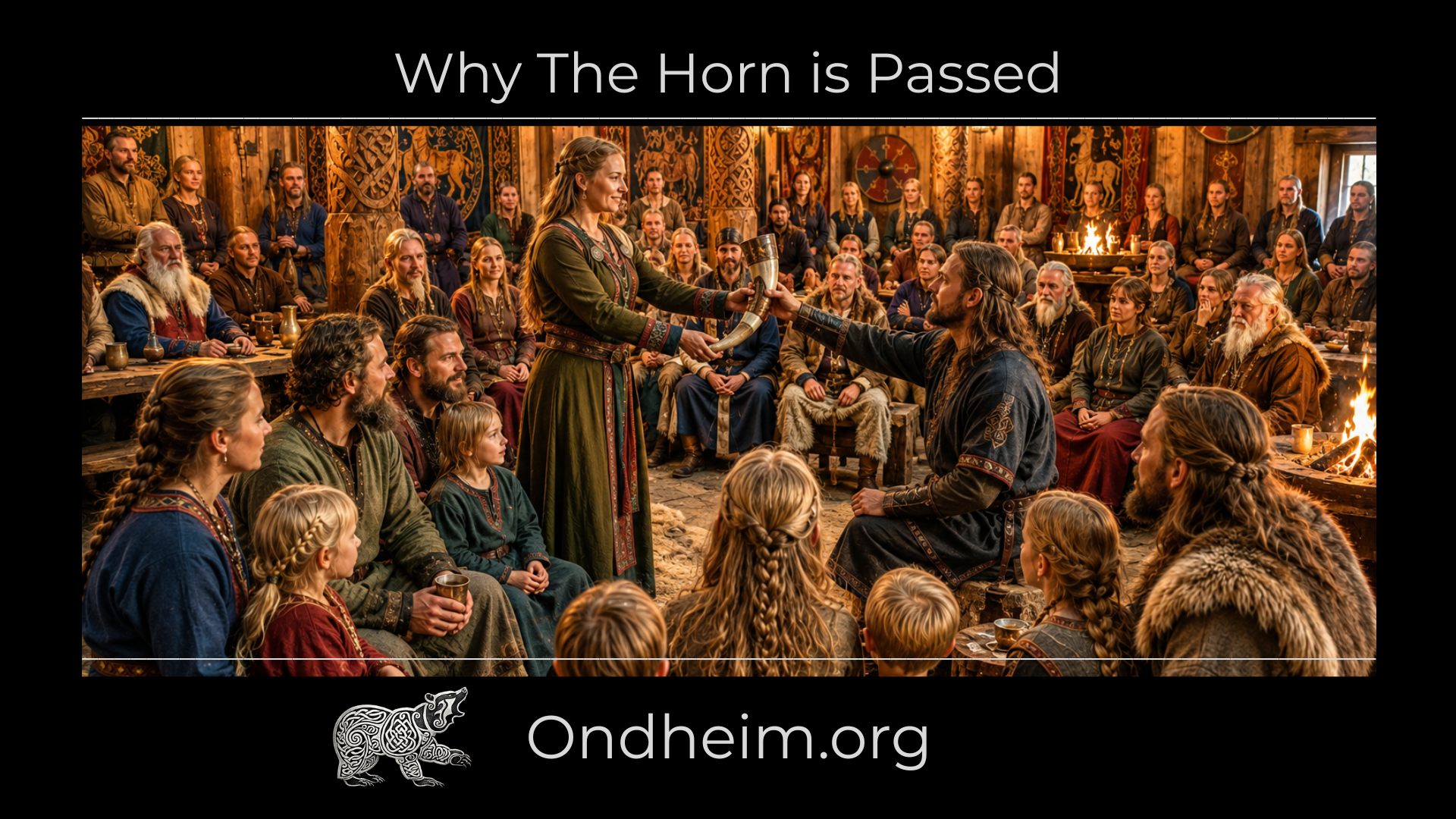
Why the Horn Is Passed

Why the Horn Is Passed

Speech, Witness, Frith, and the Continuity of the Folk

Modern speech is often careless.

Words are thrown outward constantly through reaction, argument, impulse, distraction, and performance. Most are forgotten almost immediately because modern life rarely expects speech to carry lasting consequence. Promises are made emotionally and abandoned easily. Opinions shift by the hour. People speak constantly without expecting their words to remain socially binding afterward.

The older traditions approached speech very differently.

Within Norse and broader Germanic societies, words carried real weight because communities depended heavily upon memory, reputation, obligation, and witnessed conduct. A boast invited future judgment. A promise established expectation. An oath bound the speaker to future action before those who would later remember whether those words had ultimately been carried through.

This is one reason formal speaking rituals mattered so deeply within the older world.

And this is why the horn was passed.

To modern eyes, the passing of the horn may appear simple: a ceremonial drinking custom, a social ritual, or little more than inherited tradition preserved through repetition. Yet beneath the outward act lies a sophisticated social structure designed to regulate speech, preserve memory, and maintain frith within the gathered folk.

Within symbel, only one person holds the horn at a time while the others listen. This immediately changes the nature of speech itself. Conversation slows down. Words become more deliberate. Silence gains importance because the structure requires attention rather than interruption. The gathered folk become participants in shared witness rather than isolated individuals speaking over one another.

The old traditions understood that speech spoken publicly before witnesses carries different consequence than words spoken carelessly into chaos.

As the horn moves through the hall, memory and obligation move with it.

This pattern appears repeatedly throughout the older Germanic world. In Beowulf, the cup-bearing queen Wealhþeow moves through the hall carrying the mead cup among gathered warriors and leaders. Speech, boasting, reputation, gift-giving, loyalty, and public obligation all unfold within this ritualized communal setting. Men do not merely speak privately for themselves. Their words are witnessed openly before the hall.

The hall itself becomes a place where reputation is formed socially through remembered conduct.

This matters because the older worldview understood speech as part of relationship rather than isolated self-expression. An oath sworn before the folk could not simply be withdrawn later because feelings had changed. A boast invited future testing. A declaration placed reputation at risk before witnesses who would later remember whether the speaker ultimately proved worthy of what had been spoken.

The structure of the ritual therefore binds speech to consequence.

This is one reason symbel carried such gravity within many Heathen traditions. The ritual created structured space where people could speak memory, oath, boast, gratitude, grief, praise, and obligation within a communal setting where those words would continue living afterward through witness and memory.

Without structure, strong emotion often becomes destructive.

The older traditions understood this clearly. Symbel was never meant to eliminate intensity or suppress difficult truths. Men might boast boldly. Oaths might be sworn. Ancestors might be remembered through grief, pride, or longing. Old conflicts and future ambitions could both rise openly before the gathered folk.

The structure existed so these powerful emotions could be expressed without destroying frith itself.

Frith is not merely silence. It is not passive peace, nor the absence of tension or disagreement. Frith exists where trust, obligation, responsibility, and right relationship are actively maintained within the boundary of the folk.

Ordered speech helps preserve that boundary because witness creates accountability and memory preserves consequence. The ritual structure allows truth, emotion, ambition, grief, and obligation to be expressed while still maintaining social cohesion.

The traditions also preserve examples of what happens when restraint breaks down. In Lokasenna, Loki enters the hall and unleashes accusation, insult, humiliation, and social destabilization against the gathered Gods themselves. The poem demonstrates both the immense power of speech within communal ritual space and the danger created when frith collapses beneath hostility and unchecked contempt.

The older traditions understood that speech could either strengthen the boundary or fracture it.

This is one reason ritual structure mattered.

Outside observers noticed similar patterns among Germanic peoples as well. In Germania, Tacitus describes communal drinking gatherings and councils where important matters were discussed publicly among the assembled folk. Though writing as a Roman outsider observing cultures not fully his own, his account still reflects the central role that witnessed speech, communal deliberation, and ritualized gathering played within early Germanic society.

Within many Theodish traditions, the passing of the horn itself is often carried out by a female horn bearer. To modern ears, this is sometimes misunderstood immediately through simplistic assumptions about dominance, submission, or rigid gender expectation. The older understanding is more subtle than this.

The horn bearer is not merely serving drink. She maintains the continuity and ordered flow of the ritual itself.

As the horn moves steadily through the folk from speaker to speaker and from oath to oath, the ritual maintains cohesion within the gathering. This reflects an older understanding that communities endure not merely through courage, force, or confrontation alone, but through the continued maintenance of relationship within the boundary.

A hall where conflict endlessly escalates eventually collapses. A tribe where resentment grows unchecked fractures over time. A gathering where speech becomes chaos cannot maintain continuity.

The preservation of frith therefore carried enormous importance.

Many people recognize this instinctively long before encountering formal ritual. A frightened child often calms differently in the presence of a mother. Her voice steadies panic. Her presence restores emotional balance. Even grown men who may answer aggression with greater aggression often respond differently when a respected woman steps between conflict and escalation.

This is not weakness. It is another form of social strength.

The older traditions understood that communities require more than courage and confrontation alone. They also require those capable of preserving cohesion when pride, anger, grief, or fear threaten to fracture the boundary holding the folk together.

The role of the horn bearer reflects this symbolically within the ritual structure itself.

And within symbel, something else often happens as well. As stories are spoken aloud and memory begins circulating through the hall, the distance between past and present can begin to feel less absolute for those gathered there.

Many people who have lost parents, grandparents, or respected elders recognize this experience immediately. During hardship or important decision, their voices sometimes return within memory with surprising clarity. A father’s warning resurfaces during ordeal. A mother’s comfort returns during grief, fear, or uncertainty. Advice that once seemed ordinary suddenly carries greater meaning once life creates the experience necessary to understand it fully.

The dead remain physically absent, yet they continue influencing the living through memory, inherited wisdom, example, tradition, and the relationships they helped shape within the folk itself.

Symbel creates a setting where this continuity becomes emotionally present in a direct and communal way. As the horn moves steadily through the gathered folk, stories are repeated, ancestors are recalled, oaths are witnessed, and younger generations hear the words and experiences carried forward by those who came before them.

For a time, the gathering no longer feels isolated within the present moment alone. The folk become conscious of themselves as part of something extending backward through earlier generations and forward toward those who will eventually inherit what is preserved, taught, and remembered.

This is one reason the ritual carries such emotional gravity for many Heathens.

The folk does not exist only within the present moment. It stretches backward through ancestors and forward through descendants yet unborn. Memory, speech, reputation, obligation, and story bind generations together across time.

That continuity survives only where the bonds of the folk are deliberately maintained.

It depends upon right good will.

The gathered folk must approach one another with respect, patience, responsibility, accountability, and willingness to interpret one another honestly within the boundary.

Without this, symbel collapses into ego, performance, hostility, or social competition.

The ritual only functions where the folk themselves willingly uphold the obligations necessary for frith to endure.

This is why right good will mattered so deeply within Theodish understanding. It does not remove accountability, require agreement in all things, or demand blindness toward wrongdoing. It means approaching one another first from the assumption that the bonds of the folk are worth preserving unless proven otherwise.

Without this, trust decays.

Without trust, witness loses meaning.

Without witness, speech becomes empty.

As the horn continues moving through the gathered folk, the ritual reinforces memory, accountability, and continuity simultaneously. Ancestors remain present through story and remembrance. Oaths become socially binding through witness. Reputation forms through words later measured against action. In this way, the ritual helps preserve frith not only within the moment itself, but across generations.

Long after those gathered in the hall are themselves gone, the words, lessons, examples, and obligations carried there may still continue shaping the folk that follows after them.

The continuity of the folk does not survive automatically. Each generation must deliberately choose to preserve it through remembrance, teaching, ritual participation, and the continued maintenance of relationship within the community itself.

The horn therefore becomes far more than a ritual object or drinking vessel. It serves as one of the mechanisms through which memory, obligation, witness, and continuity remain living realities within the folk rather than fading into abstraction or forgetting.

Through the passing of the horn, the living remain connected to one another, to those who came before, and to those who will one day inherit what the present generation chooses to preserve.

— William Lord
Ondheim Theodish Fellowship
Ondheim.org

Frith defines the boundary, oaths bind the word, kin carry obligation, and the hall holds witness and memory. The shape of obligation gives these structure, and through symbel they are spoken into wyrd and given force.

For additional primary sources and public-domain texts related to kinship, obligation, feud, and Germanic social structure, see our Links page.

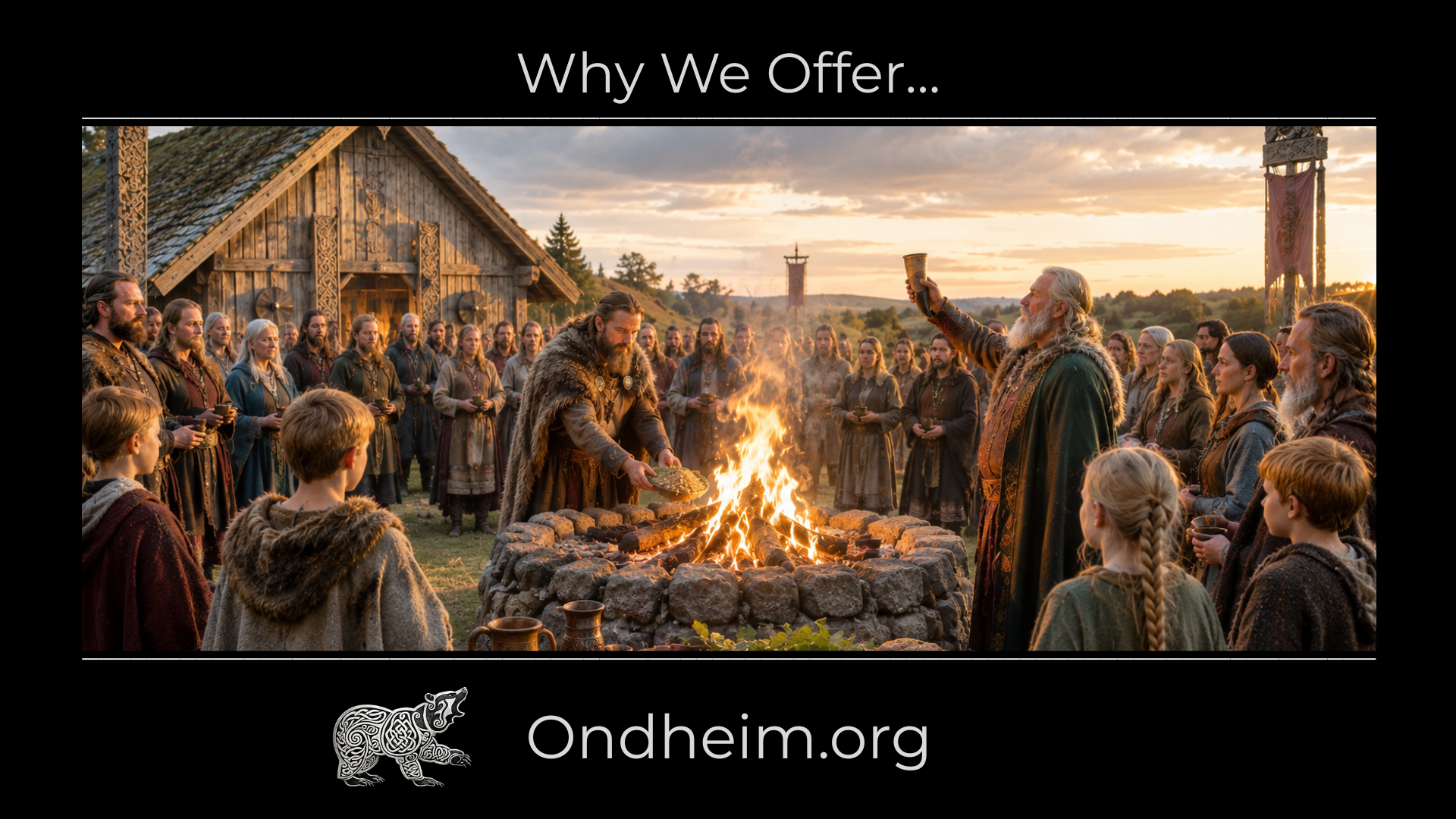
Why We Offer


Gift, Gratitude, and Right Relationship with the Holy Powers

The surviving Norse sources repeatedly preserve the idea that relationships are maintained through reciprocity. In Hávamál, friendship itself is described as something strengthened through exchange, remembrance, and continued participation rather than passive sentiment alone. One well-known passage advises:

“With gifts should friends gladden each other…”

The line is simple, but it reflects a much broader worldview. Relationships were not expected to maintain themselves automatically. Bonds between people required effort, consistency, mutual obligation, and visible acts of participation over time.

This same logic shaped the relationship between the folk and the Holy Powers.

Modern people often misunderstand offering because they approach it through assumptions inherited from very different religious and cultural frameworks. Some dismiss offering entirely as primitive superstition, imagining it as an attempt to bribe unseen forces through sacrifice or ritual payment. Others reduce it to little more than symbolism or personal psychology, treating ritual as a purely internal exercise with no relationship beyond the self.

The older worldview understood offering differently.

Offering was not primarily about purchasing favor, nor was it empty performance. It existed within a broader structure of maintained relationship between the folk and the powers surrounding them.

The Norse world did not view human beings as isolated or self-created. Survival depended upon layers of interdependence: family, tribe, land, weather, inherited knowledge, social obligation, and the labor of previous generations. A person inherited language, custom, protection, practical skill, memory, and social standing long before contributing anything of his own. Even the strongest individual still depended upon forces outside himself.

The Gods therefore were not understood merely as abstract symbols existing only within human imagination. They were viewed as real powers connected to the forces shaping existence itself: storm, fertility, wisdom, death, luck, craft, social order, victory, and the unseen patterns surrounding the lives of the folk.

To live well required maintaining right relationship not only within the human community, but within the larger structure of existence itself.

Offering existed inside that framework.

The surviving traditions preserve sacrifice and ritual exchange not as isolated acts of desperation, but as recurring acts that reinforced connection between the human and sacred worlds. Even outside observers such as Adam of Bremen recorded the centrality of sacrifice, feast, and communal ritual within Scandinavian religious life, though his perspective was that of a Christian outsider looking upon customs he did not fully share.

This is one reason the old phrase “a gift for a gift” carried such importance.

Modern readers sometimes misunderstand the phrase as though the Gods were imagined as machines dispensing blessings in direct exchange for ritual payment. That was never the older understanding. Sacrifice did not compel divine action, nor did ritual place the Holy Powers in debt to mankind.

What mattered was the relationship itself.

A simple offering given consistently and sincerely could carry greater meaning than extravagant public display performed without genuine reverence behind it. The act acknowledged dependence, gratitude, continuity, and participation within a greater order that did not begin with the individual alone.

This is also why offering was rarely separated entirely from communal life within the older traditions. Feasts, blóts, shared drink, seasonal rites, oath-taking, sacrifice, and remembrance existed within the same larger structure of maintained relationship. The folk gathered before the Gods together. They offered together, feasted together, and renewed the bonds connecting tribe, ancestors, land, and Holy Powers.

Offering therefore was never merely about obtaining things.

It was about maintaining alignment between the folk and the greater forces surrounding them.

This understanding also explains why neglect carried danger within the older worldview. Relationships ignored eventually weaken. This is true between friends, between family members, between lord and follower, between the living and the dead, and between the folk and the Gods themselves. What is no longer honored slowly fades from memory. What is no longer maintained loses strength within the life of the community.

The older traditions understood that continuity requires active participation.

Offering became one expression of that participation.

This is also why gratitude carried such importance. Modern culture often encourages people to imagine themselves entirely self-made, independent, and detached from obligation beyond personal desire. The older worldview regarded this as illusion. Every life rests upon inherited foundations: the labor of ancestors, the protection of community, the gifts of the land, and forces beyond human control.

Offering acknowledged this reality openly.

At the same time, offering was never meant to become hollow routine or performative spirituality. Ritual separated entirely from relationship eventually loses much of its meaning. The outward act matters, but the sincerity and consistency beneath the act matter more.

This is one reason continuity carried such importance within many older ritual structures. Relationship is not built through isolated moments alone. It is maintained over time through remembrance, gathering, sacrifice, feast, gratitude, and continued participation in the bonds connecting the folk to the Holy Powers.

The offering itself therefore becomes more than the object placed upon the altar or cast into the fire.

It becomes recognition of place within a larger order of existence.

The folk give because they recognize they have already received.

And through continued offering, relationship remains living rather than forgotten.

— William Lord
Ondheim Theodish Fellowship
Ondheim.org

Frith defines the boundary, oaths bind the word, kin carry obligation, and the hall holds witness and memory. The shape of obligation gives these structure, and through symbel they are spoken into wyrd and given force.

For additional primary sources and public-domain texts related to kinship, obligation, feud, and Germanic social structure, see our Links page.