
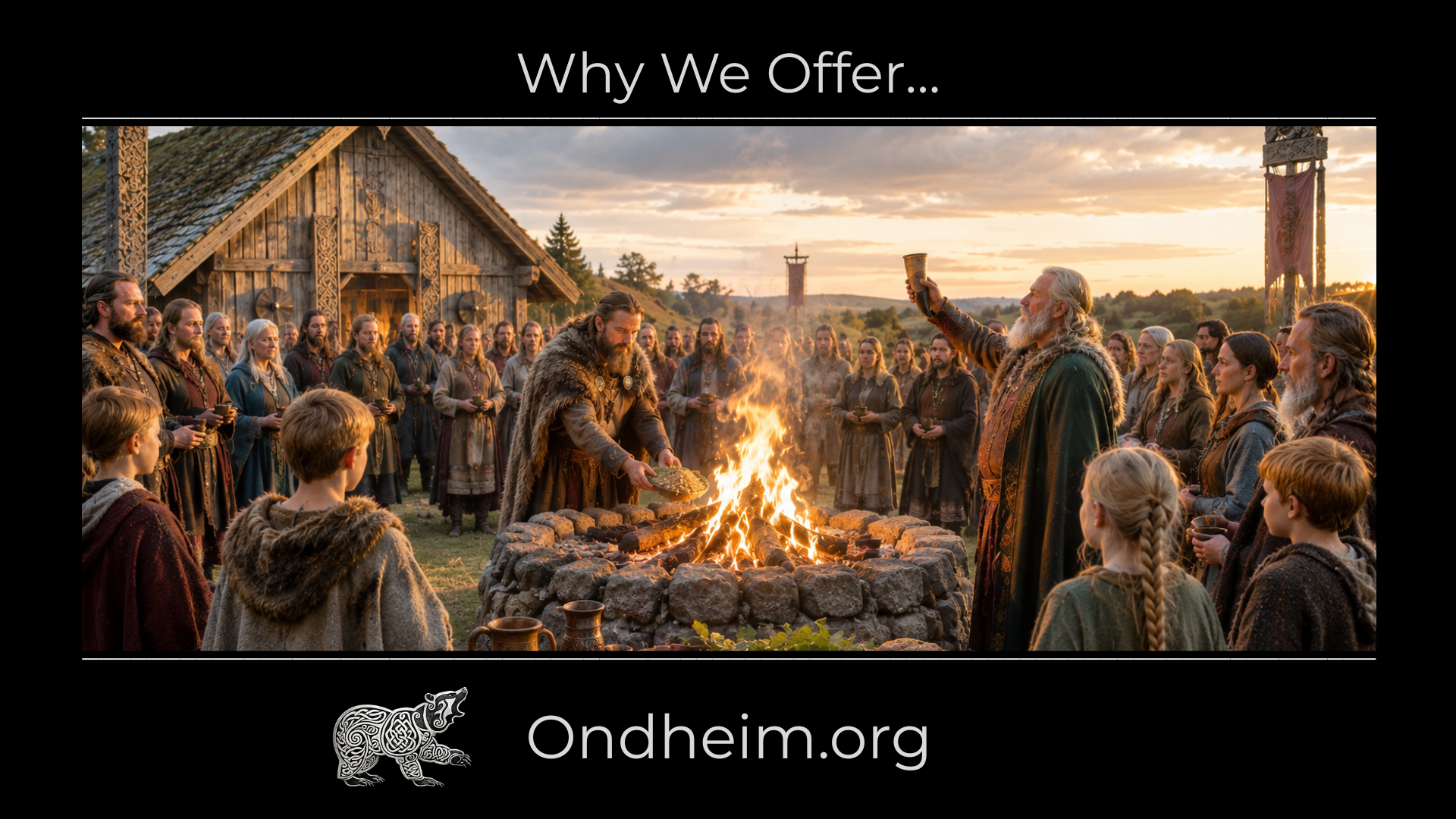
Modern religion runs on belief and feeling. People chase emotional resonance, personal experience, subjective meaning.
The old way ran on something more concrete: offering.
To offer was to give. To give was to affirm relationship. And through repeated giving — generation after generation — the bonds between humans and gods, between the living and the dead, were maintained and deepened.
The sources are full of it. Hákonar saga góða describes the sacrificial feasts: animals offered, and then the folk sharing the feast together. The offering wasn’t thrown away. It was given to the gods and shared communally — binding the folk to the powers and to each other in the same act.
And the logic underneath is stated directly in the Hávamál (Hávamál 41):
Friends shall gladden each other | with arms and garments,
As each for himself can see;
Gift-givers’ friendships | are longest found,
If fair their fates may be.
The friendships that last are the ones where giving goes both ways. That governed men among men — and it governed men and the holy powers too.
Because offering rests on reciprocity, and reciprocity isn’t bargaining. It’s deeper than that. It’s the understanding that a relationship only exists where both sides contribute.
A friendship where one man always gives and the other only takes doesn’t survive. A marriage where one carries everything and the other carries nothing breaks. The holy powers are no different: the relationship is maintained through ongoing exchange, or it isn’t maintained at all.
Humans give to the gods. The gods give protection, prosperity, wisdom, favor. Neither side gives unconditionally and neither side receives without owing. That’s not crude. That’s honest.
Offering is also gratitude — but gratitude made concrete. You can feel thankful in private and it costs you nothing. To offer is to take that thankfulness and put weight behind it: to surrender something you value, on purpose, to someone greater.
That’s why the offering had to be genuine. A worthless gift tossed off carelessly said exactly what the giver thought of the relationship. A valuable gift, given with full intention, said the bond mattered. The quality of the offering showed the quality of the relationship. There’s no faking that.
The old way of naming what this maintained is right relationship. The cosmos is ordered, everything has its place, and right relationship means honoring that order in how you act. Offering did that four ways at once: it acknowledged the gods’ power and place — they’re greater, and the folk said so openly. It admitted dependence honestly — the folk need the gods’ favor, and pretending otherwise would be a lie. It paid what was owed — what’s been received calls for giving in return. And it kept the continuity — repeated offering across time, the unbroken relationship.
Neglect the offering and you neglect the relationship. Neglected relationships weaken. There’s no version of this where they don’t.
And it was never just individual. When the folk gathered for blót and offered together, they affirmed two bonds at once — with the gods, and with each other. Shared giving made shared bonds. The man who offered alongside the folk showed he belonged. The man who refused set himself apart. Participation was membership, made visible.
What was offered varied — animals at the great blóts, food and drink at smaller observances, valued objects at shrines and holy places. The forms change. The requirements don’t. An offering has to be given freely — not extracted, not compelled. Given with intention — knowing to whom it’s made and why. Given genuinely — something of real value, not a token tossed to check a box. And given regularly — because a relationship isn’t maintained by one grand gesture, it’s maintained by showing up.
So what does it take to offer rightly? Understand why it matters — it maintains relationship, not just tradition. Give what’s genuinely valuable, not what’s convenient. Know to whom you’re giving and why. Give regularly, not once. Stand with the folk in their shared offerings. And receive gratefully — take the gods’ gifts with the same seriousness you bring to giving your own.
We offer because relationship requires giving. We offer because gratitude has to be made concrete or it isn’t real. We offer because the holy powers deserve honor and the folk deserve continuity.
You can’t maintain a relationship on feeling alone. You maintain it by giving.
We give, that the bonds may hold.
William J. McNamara Jr.