
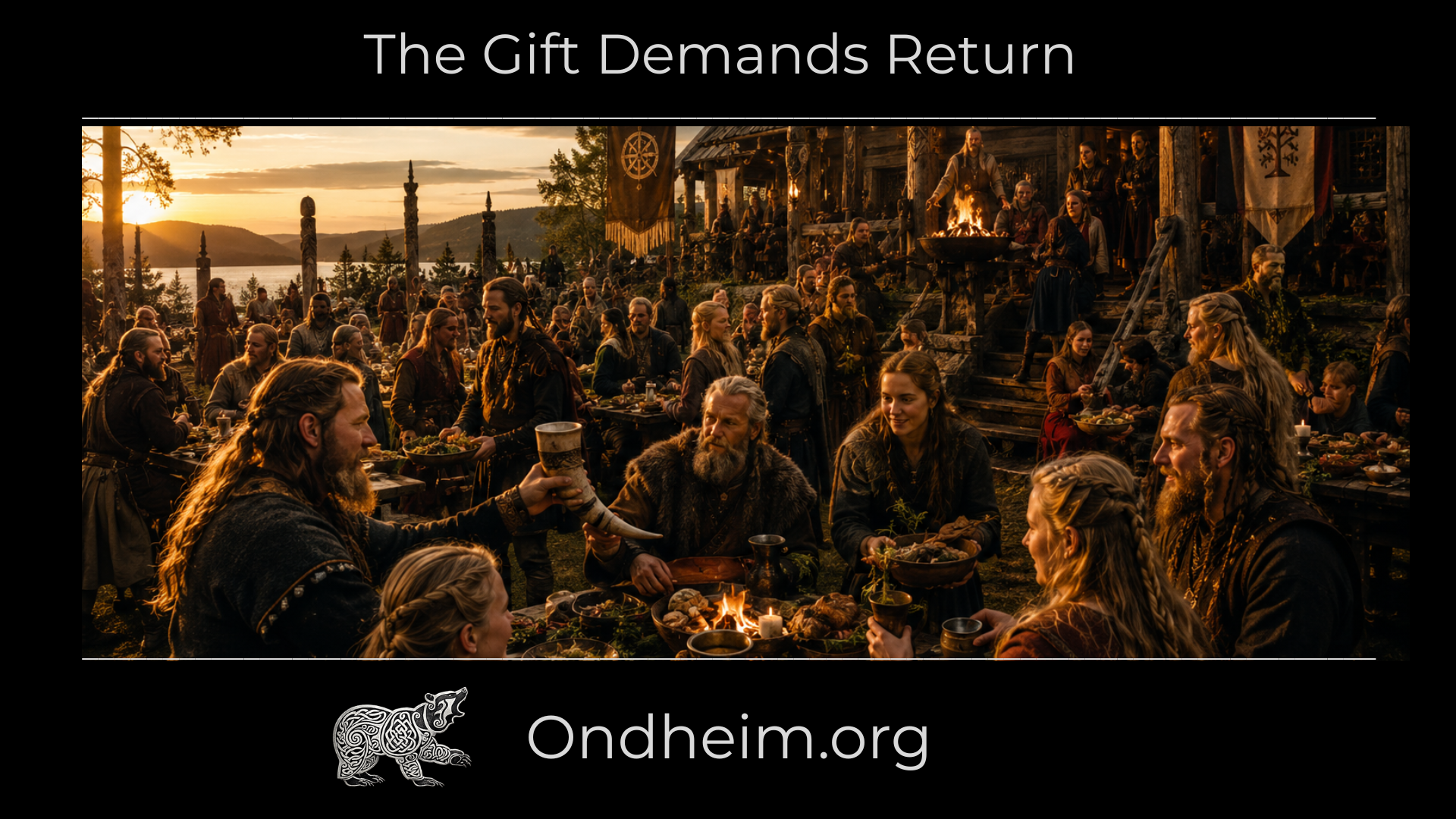
People hear the word "gift" and they picture something free. No strings. You give it, you feel good, it's done.
That was never how it worked.
In the old way, a gift was never free. It was the beginning of something — a bond, an obligation, a relationship with weight on both sides. You gave, and the giving tied you together. That wasn't the downside of the gift. That was the point.
The Hávamál says it straight.
"Friends shall gladden each other with arms and garments, as each for himself can see; gift-givers' friendships are longest found, if fair their fates may be." (Hávamál 41)
"To his friend a man a friend shall prove, and gifts with gifts requite; but men shall mocking with mockery answer, and fraud with falsehood meet." (Hávamál 42)
Gift answers gift. That's not cynicism — it's how a healthy folk actually functions.
You can watch the mechanism running in Beowulf. The lord gives rings, weapons, land — and what he's really giving is the bond itself. The retainers take the gifts and owe back service, loyalty, their lives if it comes to that. When Beowulf goes to face the dragon and his men run — all but Wiglaf — the poem doesn't treat it as bad luck. It treats it as moral collapse. They took the gifts. They didn't return the loyalty. The bond broke, and it broke from their side.
The sagas show the same logic everywhere. Gifts sealed friendships and agreements. They demonstrated honor. They established who stood where. Refusing a gift could be an insult. Accepting one created obligation. Failing to return one damaged your standing. Everybody understood the rules because everybody lived inside them.
This is also how leadership worked. The man who gave most generously was usually the man who led — and that wasn't coincidence or display. A lord who gave to his followers was fulfilling the obligations of his position. The gifts were the material form of the bond between him and them. That's why a stingy leader was despised, not just disliked. A lord who hoarded wealth while his people went without was breaking the reciprocal bond that justified his seat in the first place.
The same principle ran upward, toward the holy powers. Offerings were gifts. Humans gave; the gods gave protection, prosperity, favor in return. The exchange never stopped because the relationship never stopped. Stop giving and the bond weakens. Give generously and you affirm that it matters. That's why blót sat at the center of religious life — it was the formal, communal enactment of the gift-bond between the folk and the gods.
But the old way also understood the danger in this. A gift accepted is an obligation taken on — so you'd better think about whose gift you're accepting. The Hávamál counsels loyalty to friends and return for return, but the wise man also knows: not every gift should be received. Some gifts are traps dressed up as generosity. Refusing those isn't ingratitude. It's discernment. To accept a gift is to enter a relationship, and you should enter it with your eyes open.
Inside the tribe, this was daily life, not philosophy. Hospitality to guests. Generosity to kin. Support when somebody fell on hard times — not from abstract benevolence, but because the bonds of the folk required it. And when fortunes turned, the giving flowed back the other way. Across years and generations, that countless back-and-forth wove something no single person could build alone: a folk that could weather hardship because its members were tied together by mutual obligation.
So what does it ask of you? Give generously — don't withhold from those you're bound to. Receive gratefully — a gift is a relationship affirming itself. Return faithfully — the obligation is real. And discern carefully — know whose gifts you're accepting, because every one of them ties you to the giver.
To give is to bind. To receive is to be bound. To return is to affirm the bond.
A community isn't built on contracts. It's built on gifts.
William J. McNamara Jr.