
People hear "Hel" and they think "Hell." Same root, same idea — a place of punishment for the wicked.
That's Christian overlay talking, not the sources.
The Norse Hel, as Gylfaginning describes it, is the realm of the dead ruled by Hel, Loki's daughter. Those who die of sickness, age, or ordinary causes go there — and so does Baldr, among the most beloved of the gods. That fact alone should end the confusion. You don't send the best-loved god to a torture chamber.
Hel isn't a Satan figure opposing the gods. The realm isn't punishment for moral failure. The atmosphere in the sources is solemn, grave, distant — tied to mortality itself, not to damnation. It looks more like the older Indo-European underworld traditions than anything in later Christian theology.
But the bigger difference isn't geography. It's how the living understand the dead.
Modern culture treats death as a clean break. The person departs, exists elsewhere, done. The old way never thought of a person that way. Identity lived inside kinship — ancestry, memory, oath, inherited worth, obligation, the continuing life of the folk. You weren't an isolated soul standing alone before the cosmos. You were a link.
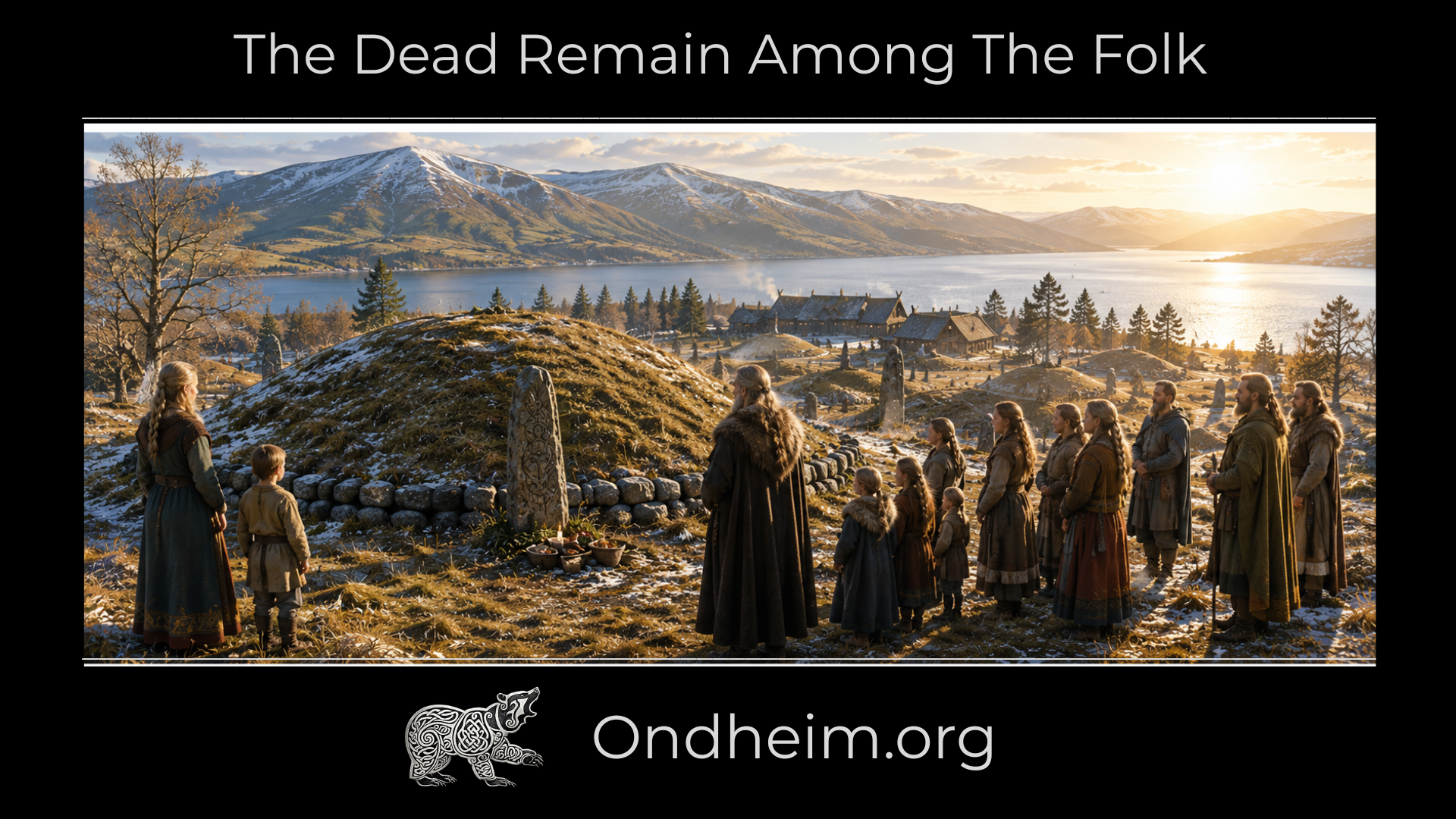
So the dead didn't vanish from the community. They stayed woven into it: through ancestor veneration, burial mound custom, naming traditions, inherited luck and hamingja, reputation wisdom, the sheer weight of remembered deeds. The Hávamál puts it the way it always does — plainly (Hávamál 77):
Cattle die, | and kinsmen die,
And so one dies | one's self;
But a noble name | will never die,
If good renown | one gets.
That wasn't poetry for comfort. It described how things worked. A name spoken again in the family line. A child with her great-grandmother's temperament. Stories told around the hearth for generations. Skills, habits, strengths, obligations moving down through descendants. The honored dead remembered in feast and seasonal observance. The boundary between living and dead was never sealed shut.
Which is why trying to force the lore into one rigid afterlife system never quite works. The sources preserve overlapping possibilities — Hel, Valhalla, Fólkvangr, the mound traditions, ancestor presence, the continuing tie between living and dead — without handing us a single universal doctrine for every soul. The old way had room for mystery. It didn't need a perfectly organized sorting system to take death seriously.
Modern people hunger for certainty on this — one heaven, one hell, everything filed correctly. The sources don't oblige. What they emphasize instead, over and over, is continuity: kinship, relationship, memory, inherited worth, the unbroken life of the people across generations.
That's also why reputation carried the weight it did. Your deeds didn't end at death. They kept shaping your descendants — family standing, inherited reputation, the strengths and burdens carried by everyone connected to you. The dead kept influencing the living through consequence and remembrance.
The old sources don't give us a neat unified doctrine of the soul, and we shouldn't pretend they do. What the patterns show, consistently, is identity as something interwoven — through kinship, ancestry, obligation, memory — across generations. You stand in a living chain. The dead shaped you; you'll shape the unborn.
Hel isn't paradise and it isn't torment. It's one part of a larger relationship between the living and the dead — solemn, unavoidable, and real.
What endures isn't a map of the afterlife. It's the continuity itself. The dead remain in descendants, in memory, in inherited worth, in story, in reputation, in the ongoing life of the folk. The living carry them forward.
And through that carrying, the folk remain unbroken.
William J. McNamara Jr.